
Start direction and curve answer two different questions about a golf shot. Start direction tells you where the ball launched relative to the target line. Curve tells you how the flight bent after launch. Read them in that order, then check strike and repeat the task before deciding what changed in the swing. A ball that starts left and curves right is not the same pattern as a ball that starts right and keeps moving right, even if both finish in the same rough.
That separation gives you a practical way to use ball flight without pretending one shot is a complete diagnosis. Establish a real target line, observe the first part of the flight, observe the bend, note obvious contact location and then look for repetition across a small set. The result is a useful question for practice or coaching: is the main pattern in where the ball starts, how it curves, where it is struck, or how the intended target changes from shot to shot?
This guide explains that process for right-handed and left-handed golfers without relying on labels such as slice, hook, push or pull. Those words can be useful, but they often hide the two observations you need. “Starts right, curves left” is clearer than a label because it describes the flight directly. It also avoids assuming that every golfer is trying to hit the same shape or that a ball must finish on the target line to be well planned.
The direct answer: read the flight in a fixed order
Use the same five-step order after every valid shot. First, name the target line you chose before the swing. Second, identify where the ball began relative to that line. Third, identify the direction and amount of curvature. Fourth, note whether contact was sufficiently centred for a simple face-and-path explanation to be useful. Fifth, compare the shot with the rest of the set. Do not reverse the process by starting with a swing fault and searching the flight for confirmation.
TrackMan defines launch direction as the horizontal direction of the ball immediately after it leaves the club face, measured relative to the target line. A positive or negative number is only meaningful when the target line is correctly established. Launch direction describes the start, not the subsequent curvature. That distinction matters outdoors, indoors and when you are judging the shot with your eyes rather than a launch monitor.
Read TrackMan's definition of launch direction ↗
Curve is the visible change in direction during the flight. TrackMan represents this through spin axis: the tilt of the ball’s rotational axis after impact. You do not need to estimate the number from the range. You only need an honest description such as curves a little left, holds its line or curves strongly right. The number can support the observation when measured, but it does not replace a clear target and a representative set of shots.
Read TrackMan's explanation of spin axis ↗
Why the target line comes before the ball flight
A start direction cannot be left or right in isolation. It is left or right of something. On the course that reference might be the centre of the fairway, the left edge of a green, a tree beyond the target or an intermediate mark a few feet ahead of the ball. On the range it may be a flag, a bay line or a deliberately chosen stripe. If the intended line is vague, the same shot can be praised or criticised after the result simply by moving the imaginary target.
Choose the target before stepping into the shot. State the intended shape as well: for example, start near the right edge of the green and curve towards the centre, or start at the left side of the fairway and hold that line. That makes the flight accountable to a plan. A draw that starts at the flag and finishes in trouble may be a familiar shape, but it was not necessarily a successful decision for that target.
Check whether the physical setup supports the line you named. Range mats, bay dividers and tee markers can point somewhere different from the chosen target. A camera positioned behind you can also mislead if it is not aligned with the target line. Use an intermediate spot close to the ball when it helps, but remember that the close spot is part of the same line rather than a second target.
When practising with a launch monitor, aim the device and target line according to the facility’s procedure. A precise launch-direction number relative to the wrong line is still the wrong comparison. When practising without technology, stand behind the ball, trace the intended line and pick a distant and near reference. The process takes only a few seconds and makes the next observation far more useful.
Start direction: what the first part of the flight tells you
Watch the ball immediately after impact rather than waiting for the finish. Did it begin left of the chosen line, within the intended launch window or right of it? A launch window is often more useful than a single perfect line because golf shots have width. Define the window before the set. It might be the space between two distant trees, the width of a fairway segment or a corridor around a range flag.
TrackMan describes face angle as the horizontal direction the club face points at impact and states that it is the primary contributor to the ball’s starting direction. That is a practical relationship, not permission to diagnose the whole swing from the start alone. Club delivery, club type and strike still matter, and the face angle that produces a planned fade or draw will not always point at the final target.
Read TrackMan's definition of face angle ↗
If several shots begin on the same side of the intended window, you have found a start-direction pattern. Before changing technique, check the obvious variables: was the target consistent, did the ball position change, did alignment drift, did the club face appear different at address and did strike move around the face? The purpose is not to fix the shot by inspection. It is to remove uncertainty from the question.
If starts alternate left and right, resist averaging them into “straight”. A two-sided pattern asks a different question from a tight pattern that sits consistently left. Record the spread. The next task may be to stabilise strike, alignment or face delivery rather than to force the average towards zero. A centred average can conceal a pattern that is difficult to aim on the course.
Curve: what happens after the ball starts
Once you have named the start, watch the relationship between the initial line and the later flight. Does the ball bend left, remain close to its launch line or bend right? Describe the amount in terms that match the task: slight, playable, strong or crossing the whole target window. Avoid judging curve only from the finishing point. Wind, slope and the length of the shot can make the finish look dramatic even when the early curve was modest.
TrackMan defines face-to-path as face angle minus club path and identifies it as a key factor in expected curvature when contact is centred. In plain language, the relationship between where the face points and where the club is travelling helps shape the spin axis. For either handedness, the ball generally curves towards the face angle and away from the club path under the centred-contact assumption.
Read TrackMan's explanation of face-to-path ↗
That relationship explains why start and curve must be kept separate. Two shots can begin in a similar direction yet curve differently because the face-to-path relationship differs. Two shots can curve in the same direction yet begin on opposite sides of the target because the entire delivery points differently. Observing both parts prevents the vague conclusion that every right-finishing shot came from one identical motion.
Club path is the horizontal direction the club head is moving at impact relative to the target line. TrackMan notes that it contributes to both curvature and starting direction. It is not a score that must always be zero. A useful path depends on the intended shot, the club and the face relationship. Treating zero as universally correct can make a planned fade or draw look faulty simply because the number is not neutral.
Read TrackMan's definition of club path ↗
The centred-contact caveat
The simple face-and-path model becomes less reliable when strike moves substantially away from the centre of the face, especially with a driver. Off-centre contact can change launch and curvature through the geometry and rotation of the club head during impact. That is why a shot can display a curve that does not seem to match the measured face-to-path relationship. Strike is not an optional footnote; it is part of interpreting the flight.
TrackMan’s club-data definitions distinguish club delivery measured around the club head’s centre from face orientation at the actual impact location. The same source explains that impact location, club-head properties and collision behaviour can affect the relationship between delivery and resulting flight. The practical lesson is modest: check where the ball met the face before turning a surprising curve into a confident swing diagnosis.
Read TrackMan's detailed club-data definitions ↗
Use impact tape, face spray or another facility-approved method when appropriate. Follow the product instructions and clean the club afterwards. Without a marking aid, listen and feel cautiously, then inspect the flight pattern. Sound and feel can suggest a strike difference, but they are not perfect measurements. A launch monitor that reports impact location can add evidence when correctly set up.
With irons, turf contact adds another layer. A heavy strike, thin strike or impact affected by grass and ground may not fit the same clean explanation as a centred strike from a tee. Record the contact category rather than hiding it. If the set contains several different strike types, separate them before deciding that the curvature pattern came from one stable delivery.
Nine observable start-and-curve patterns
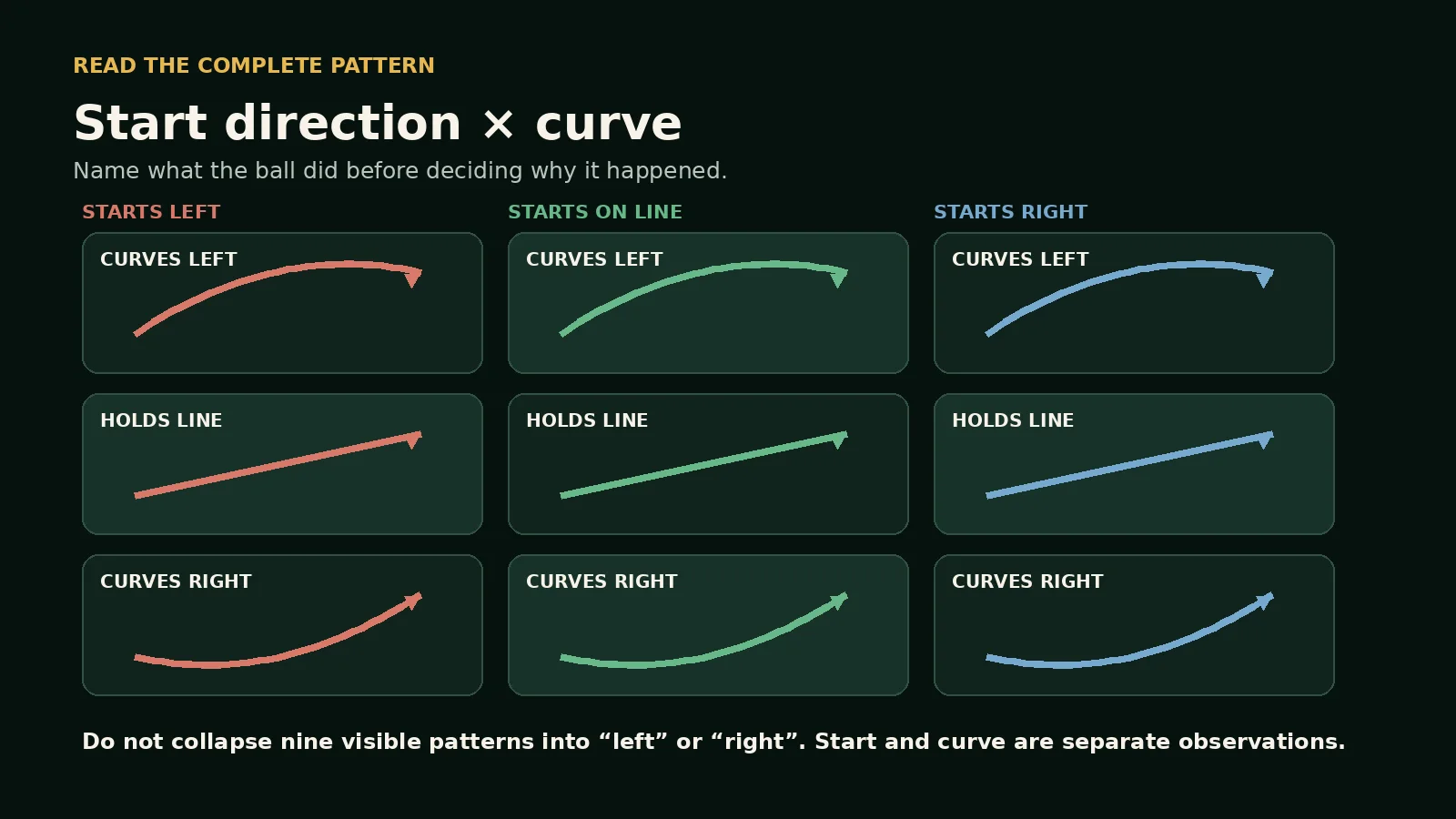
Three start categories and three curve categories produce nine simple descriptions: starts left and curves left; starts left and holds; starts left and curves right; starts on line and curves left; starts on line and holds; starts on line and curves right; starts right and curves left; starts right and holds; starts right and curves right. These are observations, not swing faults. Each becomes meaningful only beside the intended shape, strike and finish window.
Starts left, then curves left
This flight moves away from the target line in the same general direction after starting left. If it repeats with centred contact, compare measured or coached face angle and path rather than guessing from the finish alone. If it was a planned shape aimed far enough right, it may still be playable. If the plan was a straight shot, the start and curve both need to be represented in the practice question.
Starts left, then holds its line
A left start with little visible curve suggests that the launch direction is the dominant observable feature. The ball may finish left without a dramatic bend. Check whether the target line and alignment were honest before making a technical change. A consistent straight-left pattern is easier to describe and potentially easier to plan around than a two-sided set that happens to average near the target.
Starts left, then curves right
This is a common shape for a planned fade when the start window is left of the final target. The key question is whether the amount of curve matches the available space. If the ball starts too far left, it may never return. If it curves too much, it may cross the target and continue right. Separate the start-window task from the curvature task when reviewing the set.
Starts on line, then curves left or right
A ball that launches near the final target and then bends away may look like a curvature problem, but the decision may also be wrong for the golfer’s natural shape. If you intend to curve the ball, the start window normally allows room for that movement. Practice can therefore involve choosing a safer starting line as well as changing delivery. Strategy and technique should not be confused.
Starts on line and holds
A shot that starts in the intended window and remains close to it fits a straight-flight plan. Do not make it the only acceptable outcome if your reliable pattern is a controlled curve. Chasing perfectly straight shots can produce constant adjustments when a repeatable one-way shape would offer a clearer target. Judge the flight against the plan, not against an abstract ideal.
Starts right, then curves left
This can be a planned draw when the starting line leaves room for the ball to return. As with the fade, a good description includes both parts: did it start far enough right, and did it curve by a manageable amount? A draw that begins at the final target may finish too far left even when the curve itself is familiar. The intended window must anticipate the bend.
Starts right, then holds its line
A right start with little curve makes the launch direction the obvious feature. Confirm target, alignment and strike across the set. If it repeats tightly, it differs from a pattern that begins in several directions and merely produces a similar average finish. Record width and bias rather than labelling every right finish as the same miss.
Starts right, then curves right
This flight starts and continues to the same side of the target line. A simple label may tempt you to prescribe one universal fix, but strike can materially affect the curve, especially with the driver. Check contact and repetition. If the pattern is stable, bring the start, curve and strike evidence to coaching rather than cycling through unrelated swing tips.
A diagnostic sequence that avoids guesswork
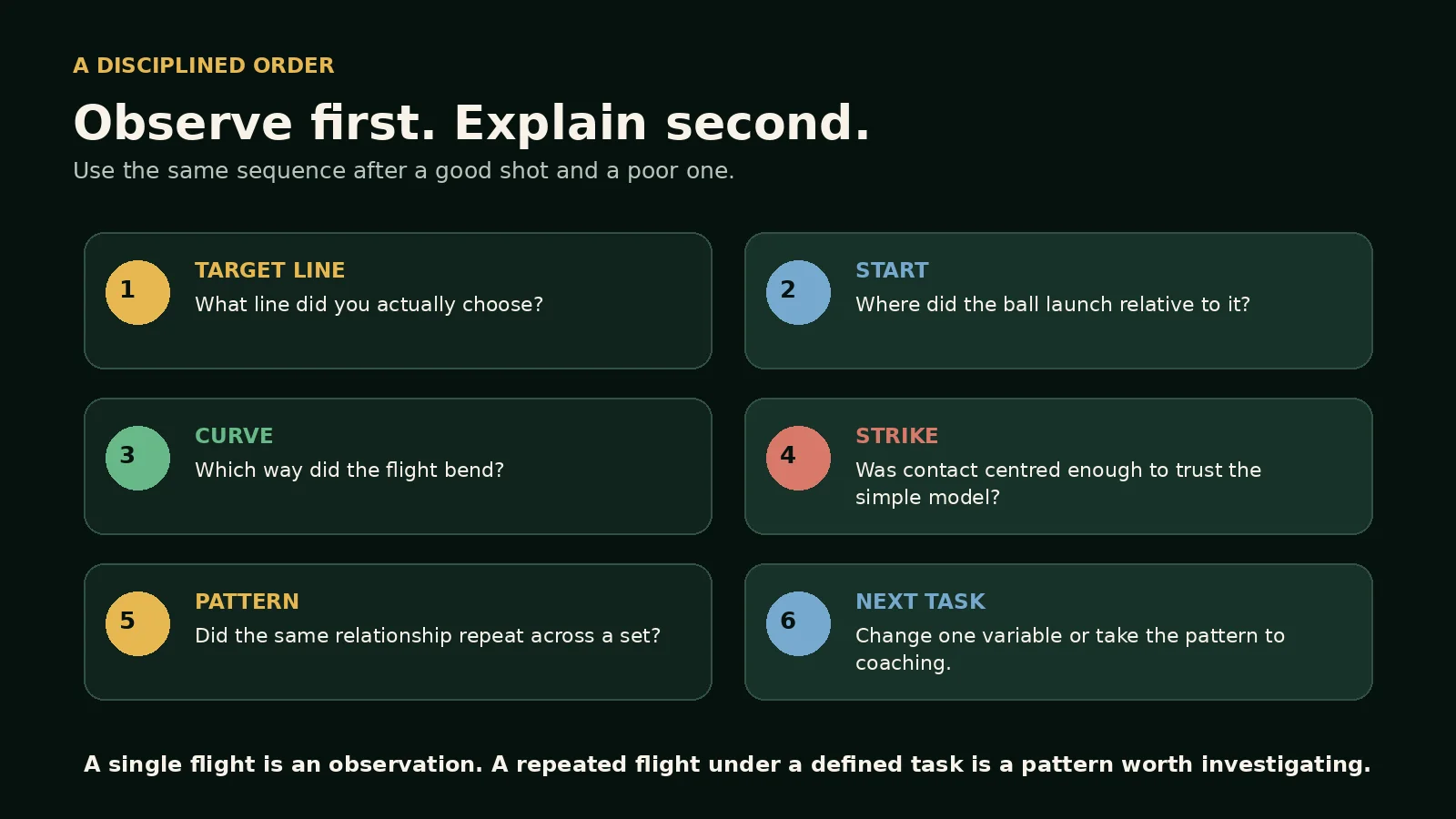
The sequence in the diagram deliberately delays the swing explanation. The target line and visible flight are available immediately. Strike can often be checked. A repeated pattern can be measured. The exact movement that produced the delivery may require video, launch-monitor data and coaching context. Keeping those layers separate stops a reasonable observation from becoming an unsupported claim about wrists, shoulders, grip or swing plane.
After a poor shot, many golfers skip directly to a body part: “I came over it,” “I left the face open,” or “I stopped turning.” Even when one of those statements is eventually useful, saying it before reading the ball creates confirmation bias. The next swing becomes a reaction to an assumed cause. A better response is: “It started right, curved right, contact was towards the heel, and that is the third similar ball.”
After a good shot, use the same discipline. A pleasing finish does not prove that the planned start and strike occurred. The ball may receive a favourable bounce, wind shift or slope. Record the full pattern so that successful shots also teach you something. The goal is not to remove feel or athletic response; it is to anchor them to observable outcomes.
Build a representative set rather than judging one ball
One shot can identify what happened once. It cannot establish your normal pattern. Use a small set with a defined club, target and intended shape. Twelve valid shots is a practical example, not a universal statistical threshold. It is long enough to reveal obvious repetition without turning the session into an endurance test. Shorten the set when concentration, safety or physical comfort declines.
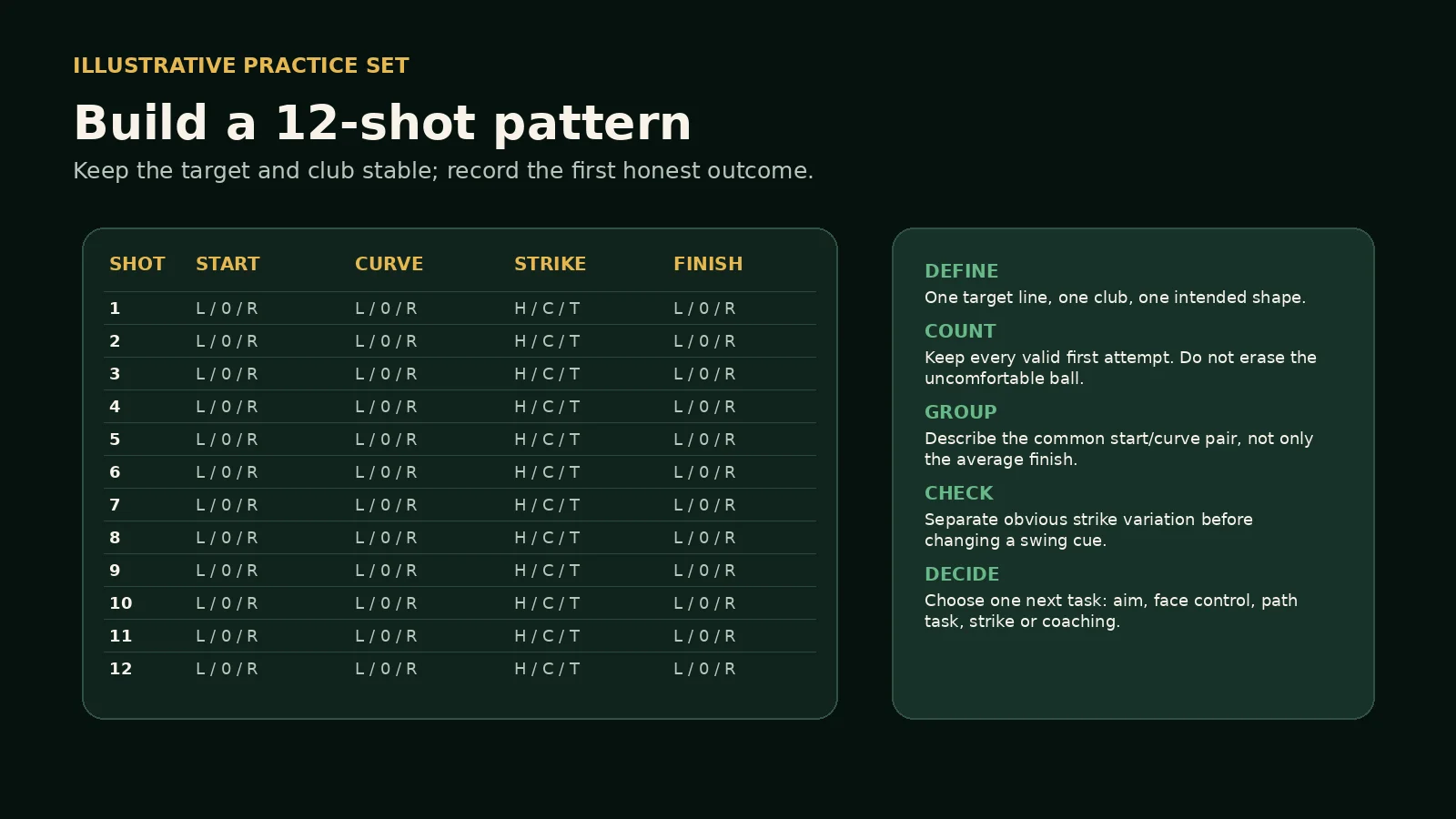
Keep the first valid attempt. Do not classify every uncomfortable result as a warm-up until the flight agrees with your expectation. You may exclude a shot when an external interruption makes it unsafe or invalid, but write down the reason. Honest first attempts make the pattern useful for course decisions, where you do not receive several rehearsals with the same ball and target.
Record start as left, window or right; curve as left, little or right; strike as heel, centre, toe, low, high or unknown; and finish relative to the intended corridor. The categories can be broad. Consistency matters more than false precision. If you have measured numbers, retain them, but also write the plain-language pattern that a future session can recreate.
Review the set in layers. First, count the most common start category. Second, count the most common curve category. Third, look at which strike category accompanies each flight. Fourth, note the width and whether misses appear on one side or both. Fifth, decide the next task. Do not choose five corrections. Pick one question that the next set can answer.
A 30-minute ball-flight practice session
Minutes 0–5: define the task
Choose one club and a target that fits the practice space. State the intended start window and shape. Check safety, wind, mat or turf condition and any facility rules. If you are using technology, confirm alignment and club selection. Hit only enough unscored shots to become physically ready; do not use the warm-up to edit the later baseline.
Minutes 5–13: capture a baseline
Hit six valid shots using your normal routine. After each shot, say the start and curve before looking at a screen. Then compare your observation with measured data if available. Mark strike. The verbal prediction helps connect sight and feel to the result rather than letting the number become something you read passively after the event.
Minutes 13–21: investigate one variable
Choose one variable based on the baseline. If starts were consistently outside the window, clarify alignment or use the face-control task already agreed with your coach. If curvature varied with strike, work on a centred-contact task. If the shape was stable but the finish missed the target, change the starting line and keep the delivery intention. Alter only one element so that the result remains interpretable.
Minutes 21–27: change targets
Keep the intended shape but move to three different targets, two shots at each. Rebuild the target line and start window every time. This tests whether the pattern belongs to the shot or only to one rehearsed station. Count the first ball at each target. If the pattern disappears, the next practice question may concern alignment, routine or adaptability rather than the original delivery number.
Minutes 27–30: review
Write one sentence for the pattern, one caveat and one next action. For example: “Most seven-irons started near the right edge and curved left; toe strike accompanied the two strongest curves; repeat with strike spray and the same start window.” This does not claim a permanent cause. It records enough evidence to design the next task or support a coaching conversation.
Practising without a launch monitor
You can use this framework with a clear view of the early flight and a defined target. Place yourself where the target line is unambiguous and use a safe intermediate reference. Watch the launch window and curve, then mark the result in a note. A companion standing safely behind the line can help observe, but agree on the categories before the set so that feedback does not change after every shot.
Video can help with start direction when the camera is aligned correctly, but a wide-angle phone view can distort lines. Use it as supporting evidence rather than a precise launch monitor. Keep other golfers out of frame unless they have consented, and follow venue rules. A short clip of representative shots is more useful than a montage containing only the best contacts.
If you cannot see the early flight because of light, background or netting, do not pretend the observation is reliable. Use a different target, move within the permitted practice area or rely on suitable measured feedback. Indoors, screen graphics can display launch and curve, but the device must be aligned and the shot must be captured correctly. A missing or questionable read should not be converted into a confident category.
Using launch-monitor numbers without chasing them
Begin with the flight question, not a preferred number. Launch direction, face angle, club path, face-to-path, spin axis and impact location can explain different layers. They are not independent grades. A golfer can produce a useful planned shot with non-zero path, face and spin-axis values. The useful combination is the one that creates a repeatable flight suited to the target and the golfer’s intention.
Look for relationships across the set. If launch direction moves with face angle while strike remains stable, that supports a clearer question. If spin axis changes when strike moves across the face, centredness may need attention before changing path. If the measured values look stable but the visible finish changes outdoors, wind and landing conditions may explain part of the result. No single column owns the whole shot.
Do not copy another golfer’s preferred numbers without context. Club speed, club type, delivered loft, shot intention and strike all affect what a given difference means. Even examples published for tour players are illustrations, not prescriptions for every golfer. Use your measured pattern with a coach who can connect the numbers to the actual ball flight and movement rather than chasing a screenshot target.
Driver and iron flights need different caution
A driver’s curved face and off-centre strike can make impact location especially important. A toe or heel strike may alter the flight in a way that a centred-contact face-to-path explanation does not predict cleanly. Record strike on every driver set. If the curve and face-to-path relationship appear contradictory, investigate impact location before making a larger movement change.
With an iron, the ball may be struck from turf, a mat or a tee, and the ground can influence contact. A divot direction is not a complete club-path measurement, because the club continues moving and interacting with the turf after the ball. Use the ball flight and measured delivery when available, and treat the divot as one contextual observation rather than the verdict.
Shorter clubs often produce less visible sideways movement over their shorter flight, while a driver gives curvature more distance to develop. That does not mean the shorter-club pattern is automatically better. Use an appropriate target window for each club and compare like with like. A small curve with a wedge and a larger curve with a driver should not be judged by the same yardage threshold.
Wind, range balls and other conditions
Wind can move the ball after launch and change the apparent finish. TrackMan notes that spin axis is established at impact even though wind can push the flight. Practically, identify the wind before the set and avoid treating every downrange movement as a delivery change. Compare shots hit in similar conditions, or move indoors when the practice question requires cleaner control of environmental variables.
Range balls can differ in construction, wear and consistency. They can still reveal broad start, curve and strike patterns, but exact carry and curvature comparisons deserve caution. Use the same ball category where possible and avoid mixing a premium ball result with a worn range-ball result as though only the swing changed. The narrower the claim, the more carefully the conditions should match.
Sloping ground, uneven lies and tee height also alter the task. Begin from a repeatable lie when learning the framework, then introduce representative variation. Label the context rather than merging every ball into one set. A draw pattern from a level tee and a different flight from a ball above the feet may both be understandable without declaring one to be the golfer’s single permanent shape.
Common mistakes when reading ball flight
- Calling the finishing side the start direction without watching the first part of the flight.
- Using left and right without establishing a target line first.
- Treating every curved shot as a path problem while ignoring face angle and strike.
- Assuming centred contact when driver strike has moved towards the heel or toe.
- Changing target, club, tee height and swing cue together, then claiming one cause.
- Discarding poor first attempts and keeping only the shots that fit the expected pattern.
- Chasing zero values even when the intended shot is a controlled fade or draw.
- Copying another player’s launch-monitor numbers without matching speed, club or intention.
- Making a permanent diagnosis from one small set in changing wind or with mixed range balls.
- Ending the session without one written pattern, caveat and next action.
Another mistake is using ball-flight language as a judgement of the golfer. A strong curve is information, not evidence of poor character or effort. Neutral descriptions make practice more accurate. “Starts right and curves farther right” contains a task. “Terrible slice again” contains frustration but very little guidance. The language you choose can either preserve the observation or replace it with an emotional label.
Turn the pattern into a course strategy
A repeated pattern has strategic value even before it is technically ideal. If the normal shot starts near one edge and curves in one direction, choose targets that leave room for that flight and its ordinary spread. Avoid aiming the centre line as though every shot were straight when the intended or reliable shape needs a different start window. The safest target respects both the common pattern and the damaging miss.
Use the pattern, not the single best ball. If ten shots occupy a broad corridor and one finishes perfectly, the perfect shot is not the whole planning model. The existing Swing Suite guide to choosing targets from your shot pattern explains how to use the distribution rather than aiming from a highlight. Start-and-curve notes add useful detail to that distribution by showing how the ball entered it.
Read how to choose golf targets from your shot pattern ↗
On the course, do not run a full technical investigation after every miss. Use the observation to make the next decision: confirm the next target, allow for the pattern and commit. Save deeper diagnosis for the range or a lesson unless one simple, trusted cue is already part of your plan. Playing golf and rebuilding a movement are different jobs.
When the pattern needs coaching
Bring a coach a defined task rather than a vague complaint. State the club, target, intended shape, common start, common curve, strike pattern and conditions. If you have launch-monitor data, include a representative set rather than one extreme screenshot. If you have video, include ordinary shots as well as the best and worst. That evidence helps the coach connect ball flight, delivery and movement without relying on memory.
Seek help when the pattern is two-sided, strike varies enough to confuse the flight, a familiar miss has changed suddenly, or repeated self-directed fixes are creating more variables. Stop and seek appropriate medical advice when pain or injury is involved; a ball-flight drill is not a treatment. Coaching can clarify whether the next priority is target choice, setup, face control, path, strike or a simpler practice structure.
The current Swing Suite TrackMan lesson page describes focused coaching with measured feedback. Use the live lesson and booking pages for current venues, formats and availability rather than relying on copied details in an article. The useful starting point is one clear question and an honest sample of your normal pattern.
Learn about the Swing Suite TrackMan golf lesson ↗
Questions golfers often ask
Does the club face control the start direction?
Face angle is the primary contributor to start direction, but the complete result also depends on club delivery, club type and impact. Use that relationship as a guide, not a slogan that eliminates every other variable. When the observed start differs from expectation, verify target alignment and strike before drawing a confident conclusion about the face or the movement that produced it.
Does club path create the curve?
Club path contributes to the flight, but expected curvature is more usefully considered through the face-to-path relationship under centred contact. Strike can modify the result. Saying “path creates curve” by itself is too incomplete for diagnosis. Observe start, curve and contact together, then compare measured face and path when available.
Should every golfer try to hit the ball straight?
No single visible shape is automatically correct for every golfer and target. A repeatable fade or draw can be planned effectively when the start window and spread fit the available space. Straight can be a valid intention, but forcing every measured value towards zero may remove a useful pattern. The practical standard is predictable enough to choose a safe target and execute the intended shot.
Can I diagnose my swing from the ball alone?
Ball flight gives strong information about what the ball did and useful clues about impact. It does not identify every body movement that produced the delivery. Different movements can create similar deliveries, and strike can complicate the simple model. Use ball flight to form a better question, then use coaching, measured club data and representative video when the movement itself needs diagnosis.
How many shots do I need?
There is no universal minimum that proves a permanent pattern. A set of six to twelve valid shots can reveal an obvious practice pattern, but it remains a sample from that club, task and day. Repeat it under comparable conditions before making broad claims. Fewer high-attention shots are better than a large set in which target, strike and concentration have drifted.
What if the ball starts and curves in both directions?
Record the two-sided pattern rather than averaging it away. Check whether strike, target alignment or setup also changed. Simplify the task, use a shorter set and avoid adding several swing cues. A two-sided flight is a useful reason to seek coaching because the next priority may be centred contact or delivery consistency rather than moving the whole pattern in one direction.
Your next ball-flight session
Choose one club and one safe target. Define the start window and intended shape before the first scored ball. Hit a small baseline set, naming start and curve before checking any screen. Mark strike. Group the results into the nine observable patterns, then choose one next task. Keep the conclusion narrow: what happened in this set, under these conditions, and what question should the next set answer?
The most useful habit is the order: target, start, curve, strike, pattern, next action. It works with a launch monitor and it works with careful observation. It protects you from turning one shot into a complete swing theory, while still extracting information you can use for practice, target choice and a focused lesson.
Book focused feedback on your ball flight
If your starts, curves and strikes are difficult to separate, bring the pattern to a lesson. A defined target and representative set give the coaching conversation a clear starting point. Use the live booking page to view current Swing Suite availability.