
A useful short-game practice session should give you more than a warm feeling after a few good chips. It should tell you which shot you were trying to play, where the ball landed, where it finished, what changed the difficulty and whether the skill survived when the next task became less predictable. The simplest structure is to calibrate one stock shot, build one controllable variable, challenge it with different lies and targets, then finish with a scored test in which every shot is different.
This guide gives you an example 60-minute session for chipping, pitching and putting. The times, distances and scoring examples are illustrative rather than universal prescriptions. Adapt them to the practice area, your current ability and any coaching plan you already have. The purpose is not to prove that your technique is perfect. It is to leave with a clearer pattern and a decision about what to practise next.
Short-game feedback is most useful when it stays close to the task. Record the intended landing area, the actual landing, the finish and the type of miss. A strike can feel poor yet finish close; a crisp strike can fly past a sensible target. Both pieces of information matter. Do not let one attractive contact erase the outcome, and do not let one disappointing finish turn the whole session into a technical rebuild.
The direct answer: build the session around a question
Begin with one question that can be answered by the end of the hour. Good questions include: how reliably can I land a basic chip in a chosen zone, which of two clubs gives me the more manageable finishing pattern, how does a light rough lie change my contact, or can I control the pace of a long putt after changing direction and distance? A question creates a boundary. Without it, every miss suggests another fix and every good shot tempts you to change the target.
The question should describe an observable golf task rather than a body position. “Can I land eight out of twelve chips beyond the front line of this zone?” is observable. “Can I keep my wrists quiet?” may be a useful coaching cue, but it is not enough by itself to judge the ball. If you have a technical priority from a lesson, connect it to an external result so that you can recognise when the movement is serving the shot.
Choose only one primary question. You can still hit several shot types, but the session needs a centre. If the primary question concerns landing-point control, the chip, pitch and transfer test can all return to that measure. If it concerns pace, use the same idea through long chips and putts: the first bounce or roll may vary, but the finishing window remains the feedback.
What useful feedback actually means
Feedback is information that changes the next decision. “That was good” is too vague. “The ball landed inside the zone but finished long because the first bounce released more than expected” is useful: it separates execution from prediction. The next attempt might keep the motion and move the landing point. That is a better adjustment than replacing the whole technique because the ball did not stop beside the hole.
For most short-game tasks, collect four layers. First, name the task. Second, record the ball outcome. Third, note the context: lie, slope, club, target, surface and any pressure you added. Fourth, choose the next action. The action may be to repeat the same task, simplify it, change one variable or progress into a more representative challenge.
Useful feedback does not require a launch monitor or a detailed spreadsheet. Two clubs laid on the ground can define a landing zone. A towel can mark a carry area when the facility permits it. Tees can create a finishing gate. A phone note can hold a score and one sentence. Technology can add measurement, but the structure still comes from a clear task and honest recording.
TrackMan describes practice design that avoids dependency on perfect data and aims to create practice that transfers. Its Performance Studio guide also describes target and on-course practice options that include short game and putting. Those tools can be valuable, but the principle is available anywhere: decide what the feedback is for, then let it support a golf decision rather than becoming a separate scoreboard.
Read TrackMan's discussion of practice that transfers ↗
Before the first ball: define the practice area
Spend the first few minutes looking at the surface rather than immediately hitting. Identify safe hitting directions, other golfers, greenkeepers, boundaries and any local rules about practice balls, mats, bunkers or markers. Choose a target that lets you work without crossing another person’s line. A well-designed task is not useful if it creates a safety problem or damages the practice area.
Notice the lie under the ball, the ground between ball and green, the slope around the landing area and the amount of green available. These are not background details. They decide which shot is sensible. A low chip from a clean fringe, a pitch over rough and a putt from the edge may all reach the same hole, but they ask different questions and produce different feedback.
Choose one primary landing zone and one finishing zone. Make them generous enough that success is possible but precise enough to reveal a pattern. The right size depends on the shot and golfer. If almost every attempt succeeds, narrow the task or add a decision. If almost every attempt fails, enlarge the zone, shorten the shot or improve the lie. Difficulty should reveal information, not create noise.
Use your own ball when the venue allows it, because cover and condition can affect feel and rollout. Keep the ball type consistent during the comparison. If you must use mixed practice balls, treat exact distance conclusions cautiously. The session can still examine start direction, landing pattern and routine, but small differences in flight and release may belong to the ball as well as the stroke.
The 60-minute short-game feedback session
The session has four phases: calibrate, build, challenge, then transfer and review. This is not a promise that sixty minutes is the ideal dose for everyone. It is a complete example that can be shortened by reducing repetitions while preserving the order. The key is to keep a scored transfer phase and a written review rather than spending the entire visit in a comfortable block.
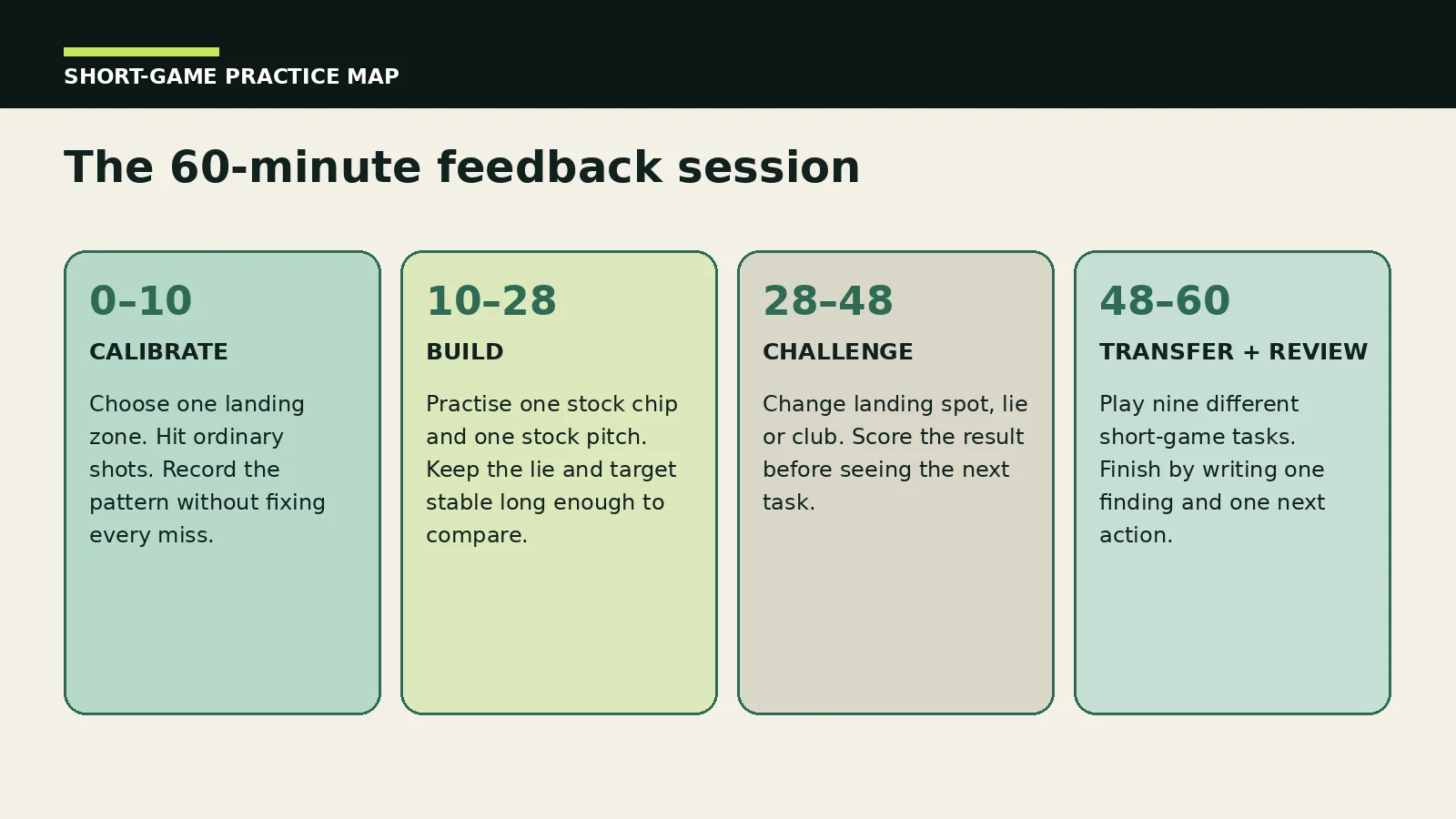
Minutes 0–10: calibrate without chasing fixes
Choose a straightforward chip from a clean lie with enough green to work with. Use the club and method you would normally select. Mark a landing zone and a finishing circle or corridor. Hit a small baseline set without changing technique after every ball. Your job is to see the ordinary pattern: start direction, landing, first bounce, finish and the common miss.
Count the first attempt, even when you dislike it. A baseline that excludes heavy strikes, thin contacts and poor reads is not a baseline. You may remove a ball only when an external interruption makes the attempt invalid—for example, someone walks into the safe area or another ball deflects it. Do not quietly reclassify an uncomfortable result as a warm-up.
After the set, describe the pattern in one sentence. Examples might be: “Most balls landed near the zone but finished long,” “The finish was mixed because landing varied,” or “The first three were short and the final three improved after I settled into the routine.” These are observations, not diagnoses. They tell you what needs measuring in the build phase.
Minutes 10–28: build one stock chip and one stock pitch
Keep the target and lie stable for long enough to compare attempts. Start with a stock chip: a shot you could reasonably choose on the course from a clean lie with no forced carry. Pick one club, one landing zone and one pre-shot routine. Work in short sets rather than one long stream. Record landing success and finish pattern after each set, not a judgement after each individual swing.
Next, create a stock pitch that carries farther and lands softer. The exact distance is not important to this plan. Choose a safe shot that fits the facility and your current ability. Keep the landing area visible. The comparison is not “which shot is better?” It is “what does each shot require, and how predictable is its pattern from this lie?”
If a technical cue is part of your current coaching, use only that cue. Do not add a second fix because one ball is poor. Complete the set, read the pattern, then decide whether the task should remain, become easier or pause. When discomfort or pain appears, stop; practice scoring is never a reason to swing through a physical warning.
Between sets, step away from the ball. Restate the task before returning. Retrieval matters: on the course you will not hit fifteen identical chips without interruption. A short break lets you see whether you can rebuild the setup, picture and routine rather than merely continuing a rhythm that existed for the previous ball.
Minutes 28–48: challenge the skill by changing one variable
Now make the practice less predictable, but do not randomise everything at once. Change one variable: landing point, club, lie, trajectory or amount of green. Keep the primary question intact. If you are studying landing-point control, every new task still has a visible landing zone. If you are studying pace, every task still has a finishing window.
One useful sequence is to alternate a near landing point and a far landing point with the same club. Another is to keep the target but alternate two clubs. A third is to move from a clean lie to light rough while retaining the same safe target. The purpose is not to discover a magic club. It is to see whether your planning and contact adjust in a recognisable way.
Score only the first ball at each changed task. Additional attempts can help you explore, but label them as practice rather than allowing them to replace the first decision. On the course you normally receive one attempt from the lie. A first-ball score keeps the challenge honest and prevents a corrected second ball from hiding a poor initial read.
After each small group, write what changed. Did the landing pattern move? Did the same landing point produce a different finish? Did your routine survive the club change? Did the lie reduce predictability enough that a safer target would have been the better golf decision? The answer can be strategic even when the technique did not change.
Minutes 48–60: transfer, then review
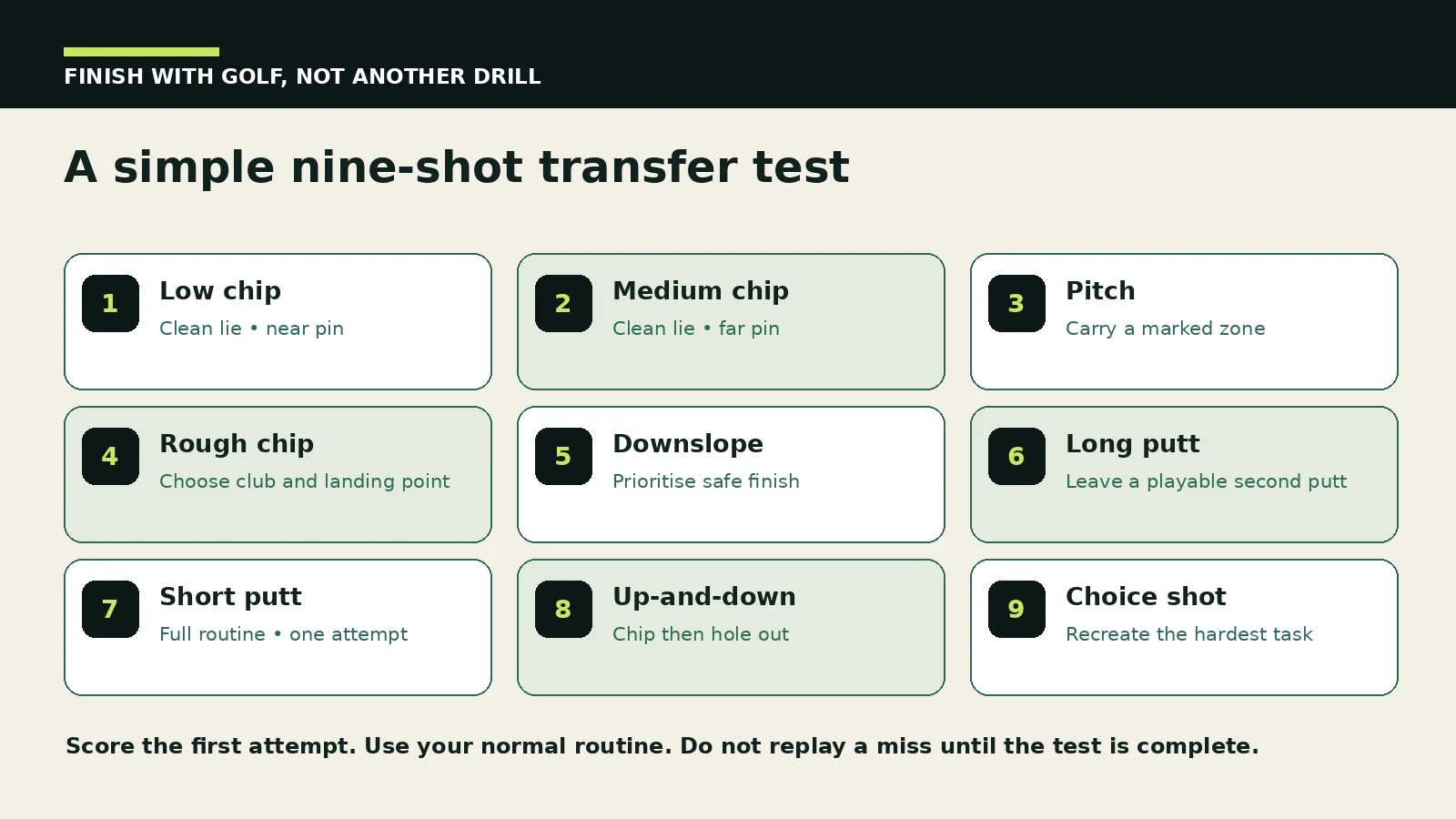
Finish with a nine-shot test in which every task is different. Use one ball and your normal routine. Include chips, a pitch, long and short putts, and at least one task that requires you to choose the shot rather than follow a preset instruction. Score the first attempt and move on. Do not replay the miss until all nine tasks are complete.
The test should resemble decision-making, not an obstacle course built to embarrass you. Include ordinary shots you may face as well as one or two uncomfortable tasks. If the practice area does not permit a particular shot, replace it rather than forcing the issue. A safe, representative test is more valuable than a dramatic one.
Use a simple score: landing-zone success, finishing-zone success and whether the routine was completed. You can also hole out for an up-and-down score, but do not let one made putt conceal a poor chip or one missed short putt erase a well-controlled pitch. Keep the components visible so that the review can identify the next practice priority.
How to choose a landing zone
A landing zone is a planning aid, not a guarantee that the ball will finish near the hole. Choose it by working backwards from the intended finish. Consider the first bounce, slope, firmness, moisture and how much the ball is likely to roll. Then select a club and trajectory that can reach the zone with a strike you can reasonably produce.
Make the zone a shape rather than a single painted point. A towel-sized area, a stripe between two clubs or a section of green can work. A point encourages false precision and makes every small miss look identical. A zone shows whether the error is consistently short, long, left or right, which is more useful for the next decision.
Do not place objects where a ball could damage them or rebound dangerously. Follow venue rules and remove every marker when finished. When physical markers are not allowed, use an existing colour change, mowing line, shadow or visual reference. The measurement can be approximate as long as you use the same reference during the comparison.
For a very short chip, the landing zone may be close enough that strike and start direction dominate. For a pitch, carry control may become more visible. For a long putt, the equivalent measure may be a ball crossing a pace gate or finishing beyond a minimum line but short of a back line. Keep the feedback appropriate to the shot.
Measure the pattern, not only the average
An average finish can hide the shape of the misses. Three balls short and three balls long may average near the hole while showing poor control. Record the spread and direction as well as a central tendency. You do not need statistical software. A quick sketch or four counts—short, long, left and right—can reveal whether the pattern is balanced or biased.
Separate landing variation from rollout variation. If landing points are tightly grouped but finishes spread, read, bounce or surface interaction may need more attention. If landing points spread widely in the same conditions, contact, setup, aim or speed control may be the more immediate practice issue. This does not diagnose the swing; it narrows the question you can take to a coach.
Keep sample claims modest. A set of six or nine shots tells you what happened in that set, not your permanent skill level. Wind, moisture, fatigue and changing turf can alter the picture. Repeat the same benchmark on another day before claiming that one club, method or cue is reliably superior.
When comparing two clubs, give each a fair task and record the order. The second club may benefit from having read the green with the first. Alternate the order on another day, or switch in small blocks. The aim is to learn what each option gives you, not to manufacture a winner from one convenient sequence.
A feedback note you can use next time
A good note is short enough to read before the next session. Record the task, outcome, context and next action. Avoid a diary of every feeling. Feel can be useful, but it changes quickly and can become detached from the ball. Tie any feel to the attempt it accompanied and to the external result it was meant to influence.
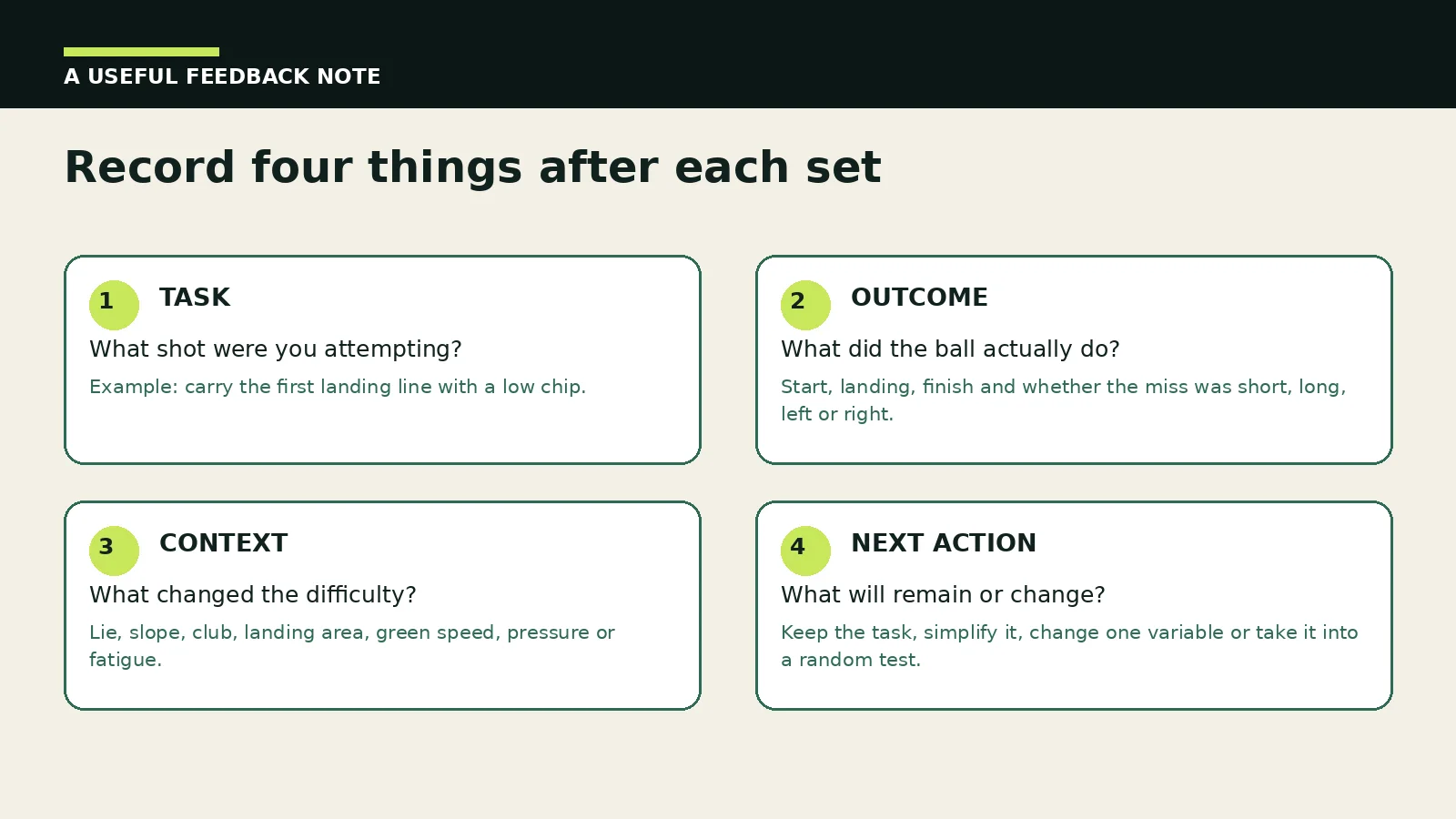
For example: “Task: low chip from clean fringe, land beyond the front line. Outcome: seven of twelve carried the line; most misses were short, finishes were otherwise playable. Context: damp surface, same ball and club. Next action: repeat with a slightly larger landing zone, then alternate near and far targets.” The numbers are illustrative, but the structure is reusable.
Another note might be strategic: “Task: choose between putter and wedge from the fringe. Outcome: putter produced the tighter finishing pattern today. Context: flat, closely cut approach with no obstruction. Next action: keep both options, but favour the simpler ground shot from this type of lie.” That does not prove putter is always better; it records a conditional decision.
If the session becomes confused, the next action may be to seek coaching rather than add more volume. Bring the note, the task and—if useful—a small number of representative videos. A coach can examine the relationship between lie, strike, launch, landing and finish without relying on your memory of only the best or worst ball.
Chipping feedback: contact, landing and rollout
For a basic chip, watch three moments: contact, landing and finish. Contact tells you whether the attempt was functional. Landing shows whether the planned carry was delivered. Finish shows whether the plan matched the surface. Keeping those moments separate prevents the common reaction of blaming technique for a poor read or praising technique solely because a fortunate bounce finished close.
Use a safe, ordinary lie first. A difficult lie adds useful realism later, but it can hide the basic pattern. Once the stock task is stable enough to compare, change the lie and ask what the new context demands. The right outcome may be a larger finishing window or a safer target rather than the same precision from worse grass.
Vary the amount of green. A chip to a near hole and a chip to a far hole can use the same landing-zone concept while demanding a different plan. Decide whether to keep the club and alter carry, or change the club and keep a similar motion. Record what happened; do not assume one model must suit every golfer or every surface.
If repeated heavy or thin contact appears, reduce the difficulty before adding speed or complexity. Improve the lie, shorten the shot, widen the landing zone and use the cue already agreed with your coach. If you do not have a clear cue, treat the pattern as information to discuss rather than cycling through unrelated internet fixes.
Pitching feedback: carry first, finish second
A pitch spends more time in the air, so begin by judging whether the ball carried to the intended area. The finish still matters, but separating carry and release helps you decide whether the issue was delivery or prediction. A ball can carry correctly and release too far; the next decision may be a different landing point, club or trajectory rather than a completely different motion.
Use targets that are comfortably within the safe practice space. Do not chase a distance that requires maximum effort simply because the session has a clock. A controlled pitch should let you maintain balance, observe flight and retrieve the task after a pause. When effort changes substantially, treat it as a different task rather than combining the results.
Practise from more than one lie only after establishing the first pattern. A tight lie, light rough and downslope can produce different strike and launch demands. Give each context its own label. Mixing all outcomes into one score makes the feedback hard to interpret and may encourage an unsuitable technique comparison.
For bunker practice, follow facility rules and rake the area. The same task-outcome-context structure still works: name the carry and finishing objective, record whether the ball escaped and where it landed, note sand depth and lie, then decide whether the next task should remain, simplify or change. Do not infer a general bunker skill from one patch of sand.
Putting feedback: start line, pace and decision
Putting practice can use the same structure. For a short putt, the primary question may be start line and routine. For a long putt, pace and leave distance may matter more than holing. Choose a gate or corridor that reflects the task, then record the first attempt before repeating from the same place.
Avoid turning a long-putt session into a contest to hole unlikely putts. Define a finishing zone that leaves a manageable second putt and observe the pattern around the hole. If misses are mostly short, the next task differs from a pattern that repeatedly runs beyond the back line. The hole alone does not tell you enough.
Change direction as well as distance during the transfer phase. Uphill, downhill and side-slope putts demand different reads and pace. Keep the score honest by using one ball and completing the routine. Repeatedly rolling three balls from the same place can teach the line for that station without testing whether you can read the next one.
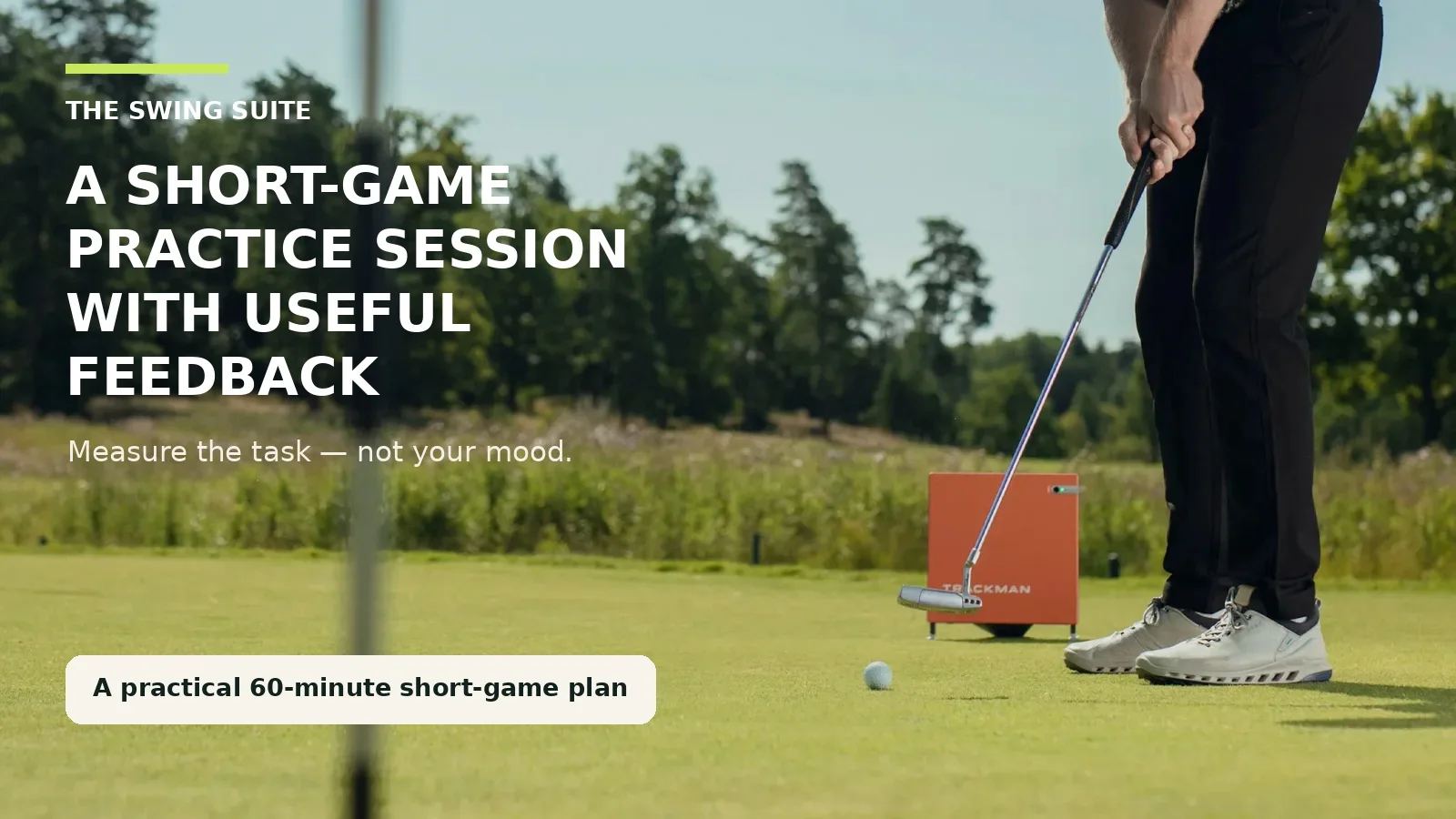
The cover image for this guide shows TrackMan putting technology supplied by the site owner. It is illustrative golf imagery and is not presented as a Swing Suite venue, client session or proof of an outcome. The practice structure in this article does not require that equipment.
Block practice and random practice both have a job
Repeating the same shot can help you understand a task and stabilise attention. Changing the shot can test whether you can plan again. The mistake is treating either structure as complete. If every ball is different before you understand the measure, the session can become noisy. If every ball is identical until the final minute, the skill may depend on rhythm and correction from the previous attempt.
Use blocked sets early: same lie, club, landing zone and routine for a small group. Then introduce variation deliberately. Change one variable, score the first ball and move on. The transfer test brings several variables together only after you have a baseline. That sequence gives practice enough stability to learn from and enough uncertainty to resemble golf.
Do not make random practice theatrical. Throwing balls into impossible lies or inventing trick shots may be entertaining, but it does not automatically create useful transfer. Choose situations you are likely to face and decisions you can explain. Representative practice is about the information and choices in the task, not merely about making it difficult.
When performance drops during the random phase, compare it with the block. The difference is useful. It may show that the skill relies on repeating the previous shot, that the planning routine is incomplete, or that the challenge became too broad. Keep the result; do not erase it by returning immediately to the favourite station and ending on a perfect ball.
How to score without turning practice into punishment
A score should focus attention, not decide whether you are a good golfer. Use measures you can act on: landing-zone hits, finishing-zone hits, routine completed, safe decision chosen, or number of shots to hole out. Avoid a single total that hides the components. Two golfers can record the same up-and-down result after very different chips and putts.
Set the success threshold after a small baseline rather than copying someone else’s number. A target that is demanding for one golfer may be trivial or unrealistic for another. You can preserve comparability by keeping the same task and measure across several sessions, then adjusting only when the current level no longer reveals useful variation.
Write down the rules before the scored set. Decide whether a ball touching the line counts, what makes an attempt invalid and whether the routine score is separate. Clear rules prevent you from moving the boundary after a near miss. They also make the next session comparable without relying on memory.
Stop a score when safety, pain, deteriorating turf or severe fatigue changes the task. Mark it incomplete rather than forcing a result. An incomplete test with an honest reason is better evidence than a completed number gathered after the conditions ceased to represent the intended practice.
Common mistakes in short-game practice
- Hitting several balls to one hole and remembering only the closest finish.
- Changing club, lie, target and technique at the same time, then guessing what caused the result.
- Calling every early ball a warm-up until one succeeds.
- Judging contact but ignoring landing point and rollout.
- Using a tiny target that creates frustration rather than information.
- Repeating the miss immediately instead of scoring the first attempt and moving on.
- Finishing with a favourite shot rather than a transfer test.
- Leaving without one written finding and one next action.
Another mistake is treating a short-game session as a race through balls. The pause before the shot is part of the skill. Read the lie, select the landing area, choose the club, picture the trajectory and commit to the task. A fast stream may feel productive while removing the decisions that make short-game golf difficult.
Do not let a good total hide a poor process. A ball can strike a slope, collide with another ball or receive a favourable bounce. Record the outcome, but note the context. Equally, do not discard a well-planned shot solely because it took an unlucky bounce. The next action depends on both execution and environment.
How to adapt the session indoors
An indoor simulator can support short-game work when the software, hitting surface and available space are suitable. Confirm what the facility permits. Use target or on-course practice modes to create changing carries and decisions, and distinguish measured carry from any simulated rollout. The mat and virtual green are not identical to turf, so be cautious when transferring exact bounce conclusions.
TrackMan’s Performance Studio guide describes target practice, on-course practice, short game, bunker shots and putting within its practice tools. Use those options to make the task specific: choose a lie or location, set a carry objective, complete the routine and record the first result. Do not simply hit until the displayed number becomes attractive.
See TrackMan's overview of Performance Studio practice options ↗
For a lesson, measured feedback can help connect contact, launch, landing and result. The current Swing Suite TrackMan lesson page describes focused coaching and feedback golfers can act on. Use the live booking page for current venues, times and availability rather than relying on a copied timetable in this article.
Learn about the current Swing Suite TrackMan lesson ↗
How this session fits with a wider practice plan
Short-game work should not become an isolated collection of drills. Link it to the rest of your practice by carrying the same structure: one question, a baseline, a build phase, a challenge and a transfer test. The clubs and targets change, but the feedback loop remains stable. That makes notes easier to compare and reduces the temptation to invent a new system every visit.
If you already use a general sixty-minute practice plan, replace one of its skill blocks with the short-game calibration and challenge phases from this guide. Do not simply add another hour. The volume should fit your time, concentration and physical capacity. Quality falls when the session becomes a checklist that must be completed regardless of fatigue.
Use the broader 60-minute golf practice plan ↗
A personal wedge carry matrix can support pitching decisions, but carry numbers and short-game scoring answer different questions. The matrix helps describe expected distances from defined swings. The practice session tests whether you can choose and produce a suitable shot from a changing context. Keep the two records connected without pretending one replaces the other.
When to change the plan
Change the task when the feedback has stopped being informative. If nearly every attempt succeeds, narrow the zone, change the context or introduce a first-ball decision. If almost none succeed, simplify the lie, shorten the shot or widen the target. If results vary but the cause is unclear, preserve the notes and seek coaching rather than adding more variables.
Change the club when the current option does not fit the shot, not merely because the previous attempt missed. A different club may create a safer trajectory or more predictable rollout, but the comparison needs a fair sample. Give the new option a defined task and record its pattern rather than making a one-ball judgement.
Change the session when the environment changes. A wet green, strong wind, temporary mat or crowded area may make the planned benchmark inappropriate. Keep the primary question if possible, but rewrite the task. A flexible plan protects the purpose; stubbornly forcing the original station can produce misleading data or unsafe practice.
Stop when pain, loss of control or poor concentration makes the next attempt unrepresentative. A planned hour is not an obligation. Record where the quality changed. That information can help you choose a better dose next time and prevents the final fatigued set from being interpreted as a permanent loss of skill.
The five-minute review
Reserve the final five minutes before you begin. If review is treated as leftover time, it disappears. Collect the markers, leave the area tidy, then write one finding, one uncertainty and one next action. Keep the wording specific enough that your future self can rebuild the task.
A finding might be: “From the clean fringe, landing was more consistent with the lower club, but the far target required a different landing point.” An uncertainty might be: “The rough sample was too small and the lies were not comparable.” The next action might be: “Repeat the clean-lie comparison from the opposite order, then ask about the rough contact pattern in the next lesson.”
Take a photograph of the station only when the venue and other golfers’ privacy allow it. The purpose is to remember marker positions and task geometry, not to present the session as proof of improvement. Do not photograph or publish other people without permission.
Finish by naming the course decision that changed. Perhaps you now prefer putter from a flat fringe, know that a favourite chip releases farther on damp ground, or recognise that your first attempt worsens when you skip the landing picture. A practice finding becomes valuable when it changes preparation, club choice or target selection.
Your next short-game session
Use the same primary question for at least one more comparable session before drawing a broad conclusion. Recreate the task, keep the scoring rules and note meaningful condition changes. Then compare patterns rather than chasing a personal best. Improvement may appear as a smaller spread, a better first attempt, a more reliable routine or a safer decision—not only as more holed shots.
The practical sequence is simple: inspect the area, define the question, mark a landing and finishing zone, record a small baseline, build one stock chip and pitch, change one variable at a time, complete a nine-shot transfer test, then write the finding and next action. That is enough structure to turn an hour of short-game activity into feedback you can use.
If the pattern remains unclear, bring the task to a lesson. Show the coach what you attempted, what the ball did and which contexts changed it. That is more useful than saying only that your short game felt poor. A coach can help decide whether the priority is technique, prediction, club choice, routine or practice design.
Book focused coaching for your short game
You do not need a perfect session before asking for help. Arrive with one question and a truthful sample. The aim of coaching is not to award a score for your practice; it is to make the next decision and the next repetition clearer.