

Better practice starts before the first ball
A useful golf practice session has a purpose, a way to check what happened and a task that resembles playing golf. You do not need to hit hundreds of balls or rebuild your swing every visit. Start with one problem, give it your attention, then find out whether you can manage it when the club or target changes.
This guide sets out a practical sixty-minute session you can use at a driving range or indoor simulator. It also explains how to adapt the plan when you have less time, how to use launch-monitor feedback without becoming buried in numbers, and how to carry useful habits onto the course. The timings are a starting point, not a test you must complete perfectly.
The central idea is simple: practise a skill, then test it. Hitting repeated shots with the same club can help you explore a change. Playing different shots, with a fresh decision before each one, helps you discover whether that change is available when you need it. Both have a place in a balanced session.
If you already have a practice plan from your coach, use that as your priority. The structure here can organise the work, but it should not replace advice based on your own swing, contact and ball flight. A beginner learning to make dependable contact needs a different challenge from an experienced player refining a reliable fade.
Before you begin, write one sentence: “Today I want to improve…” Finish it with something you can observe. “My golf swing” is too broad. “Starting more short-iron shots towards my chosen target” gives the session a clear direction. You should be able to explain the task without demonstrating several different movements.
Choose a problem you can actually measure
Think about the shots that cost you opportunities in your last few rounds. Perhaps approach shots regularly finish short. Perhaps your driver produces an occasional wide miss that makes club selection uncomfortable. Perhaps you strike the ball well on the range but rush when a shot matters. Choose the pattern that matters to your game, rather than the most impressive-looking drill online.
Separate an outcome from a possible cause. “My ball finished right” describes an outcome. “My backswing was too long” is a proposed explanation. The explanation might be correct, but it needs checking. When you begin by changing an assumed cause, you can spend a session solving a problem you have not actually identified.
A useful starting note contains three parts: the shot you want, the result you currently see and the measure you will record. For example: “With my usual short iron, I want a predictable carry towards a broad target. I currently alternate between solid contact and short mishits. I will record contact quality and how many shots finish in my chosen area.”
Keep the measure modest. A target corridor, a landing zone or a count out of ten is enough to begin. Choose a zone that reflects your present ability and the conditions. If almost every shot succeeds, the task may be too easy to teach you much. If none succeeds, make it simpler before drawing conclusions about your technique.
Record a short baseline before you make changes. Hit a small set using your normal routine and keep the ordinary misses in the record. Ten shots will not establish your permanent ability, but they give you something specific to compare with later. Use a larger sample across several visits before making firm claims about progress.
You can also measure a behaviour. Did you choose a target before every shot? Did you step away after a distraction? Did you use the same decision process when changing clubs? A process score is particularly useful when the strike is variable, because it gives you something repeatable to work on without pretending that every result is controllable.
Build your sixty-minute practice session
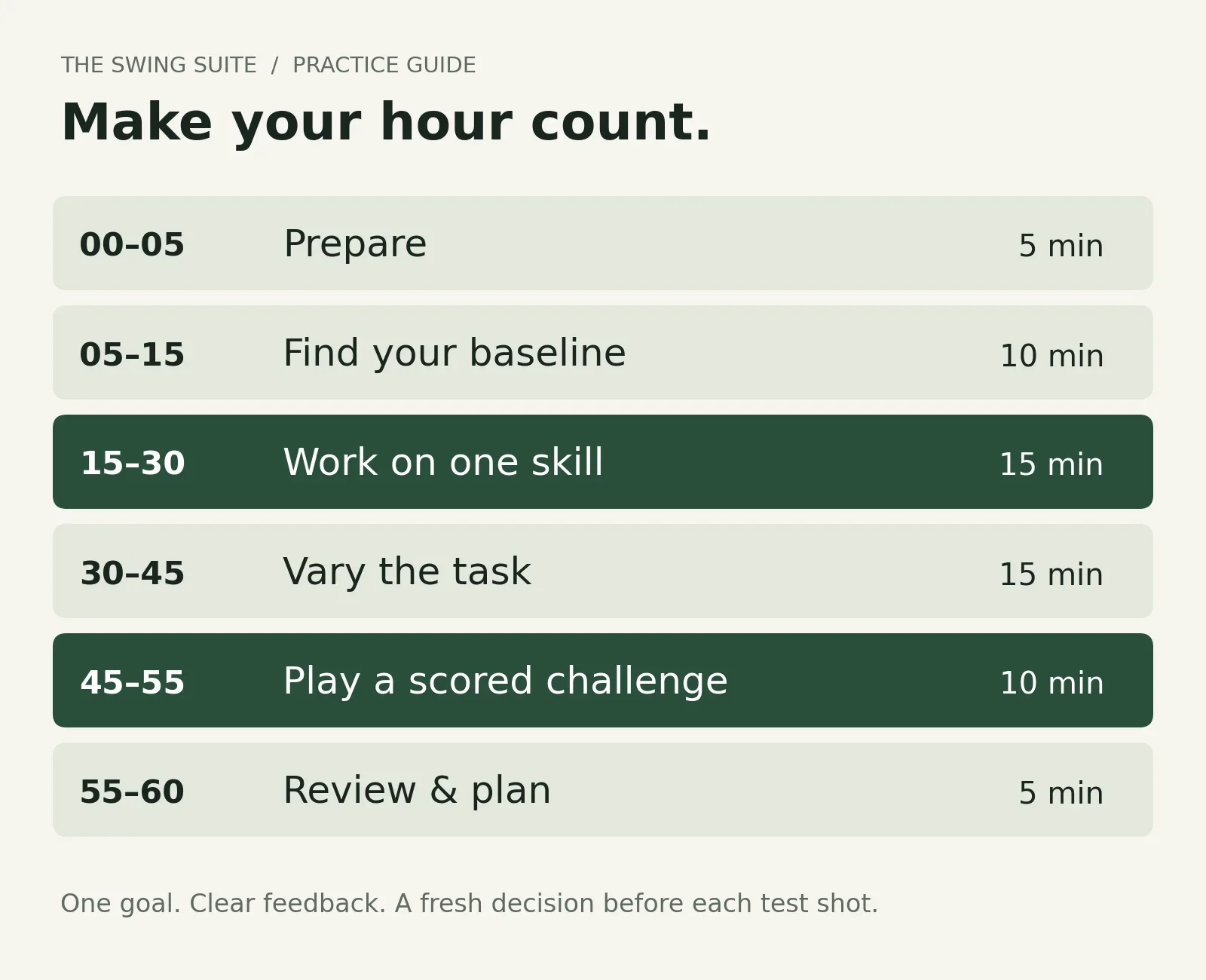
Use six stages: prepare for five minutes, establish a baseline for ten, work on one skill for fifteen, vary the task for fifteen, play a scored challenge for ten and review for five. Together they fill an hour while leaving room for thinking between shots. The point is to protect time for learning and testing, not to keep a stopwatch running through every pause.
During the opening five minutes, organise the space and ease into comfortable swings. Check the target line, select the right club and make sure the hitting area is clear. Build up gradually with short, unhurried shots. Start at an effort level you can manage comfortably; there is no need to make the first full swing your fastest of the day.
Use minutes five to fifteen for your baseline. Pick one club and one task that match your session goal. Hit a small set, recording the results as they happen. Avoid using the baseline as an opportunity to try a different fix after each miss. You are finding out what you brought to the session before you begin changing it.
Minutes fifteen to thirty are your focused practice period. Use the drill or cue agreed with your coach, or a simple task from this guide that matches your goal. Alternate a rehearsal with a ball where that helps you understand the movement. Pause between small groups to decide whether the result is moving in the intended direction.
From thirty to forty-five minutes, vary the situation. Change the target, the distance or the club while keeping the same overall purpose. You might move between three landing areas, or switch between a short iron and a mid iron. Change one demand at a time initially, so you can tell which variation makes the task harder.
Use the next ten minutes for a challenge in which each ball counts. Announce the target before the shot, complete your routine and record the result without an immediate retry. This provides a different kind of feedback from a run of repeated practice shots: it asks what you can produce after making a fresh decision.
Reserve the last five minutes for a short review. Write down what you practised, what the evidence showed and what you will repeat next time. Finish with a clear next step rather than another bucket. If the session has raised a question you cannot explain, save that question and the relevant results for your next lesson.
Set up so the feedback makes sense
An uncertain target line makes practice confusing. Choose a clear distant target and a nearby reference that helps you orient yourself. At an indoor venue, check which line the simulator regards as the target line. The direction you believe you are aiming and the direction used by the system need to agree before you interpret left and right.
If the venue allows an alignment aid, place it safely outside the club’s path and use it as a visual reference. Do not place hard objects where the club or ball could strike them. You can practise the same alignment task without an aid by standing behind the ball, choosing the line and then stepping into position deliberately.
Check the basic conditions of the session. Are you using range balls or your usual playing ball? Is the simulator showing yards or metres? Are wind, altitude or normalised settings changing the displayed results? You do not need to become a technician, but you should avoid comparing two sessions as though they were identical when their settings differ.
Make the task visible before you hit. If you are working on a landing zone, identify its front, back and side boundaries. If you are working on start direction, choose a clear visual window. “Somewhere near the flag” is difficult to score consistently, especially when a good strike encourages you to be generous with yourself.
Keep the record simple enough that you will use it. A note with the date, club, target and ten small result marks is more useful than an elaborate spreadsheet you abandon after three shots. Add a brief comment when something changes, such as a different target, a stronger breeze or a pause to speak with your coach.
Three drills for a more useful practice session
Drill one: the contact notebook
Choose a club you can swing comfortably and make a short set of controlled shots. After each one, describe the contact in plain language: solid, thin, heavy or uncertain. If approved impact tape or another venue-permitted strike aid is available, use it to check where the ball met the face. Follow the product and facility instructions rather than improvising with unfamiliar substances.
Write the result before hitting again. This small pause encourages you to notice the strike rather than judge the whole shot only by distance. A ball can finish near the target after an unconvincing strike, and a well-struck ball can miss because the direction or club choice was unsuitable. Keeping those observations separate makes the next decision clearer.
After a small set, look for a pattern. Do the poorer strikes occur when you increase effort? Does contact become less predictable with a longer club? Does the last shot after several quick swings differ from the first? These are questions to investigate, not proof of a particular swing fault. Change one part of the task and compare another small set.
A beginner can do this with short swings and a broad target. A more experienced player can retain a normal swing while changing the required carry. In both cases, stop the drill when attention disappears. The useful outcome is a clearer description of your contact and the conditions in which it changes, not a record number of balls struck.
Drill two: the start-window challenge
Pick a distant reference and define a sensible visual window around it. Use existing range markers or the simulator display; avoid creating an obstacle in front of the hitting area. Hit ten shots and record where each ball starts: left of the window, inside it or right of it. Observe the early direction before becoming distracted by where the ball eventually finishes.
Now review the pattern. A mixture of starts on both sides asks a different question from a group that starts consistently on one side. Before attempting a swing change, check your aim and setup reference. If those are reliable, take the pattern to your coach or compare it with the relevant launch-monitor feedback.
The window should be achievable without requiring perfection. Keep the same window for a repeat test, and note when you deliberately change its width. Otherwise a better score might reflect an easier target rather than improved control. The score is useful only when you understand the conditions that produced it.
For a second round, change the final target after every shot while keeping the same start-direction task. Step away and choose the new line before setting up again. This exposes whether your alignment and routine remain dependable when the previous shot no longer gives you a ready-made reference.
Drill three: the three-distance ladder
Choose three comfortable carry targets with one club. They might be short, medium and longer pitch shots within your current ability. The exact distances are personal; there is no universal wedge distance you must match. Establish a landing zone around each target and decide what counts as success before starting.
Begin with a few attempts at the same distance so you can explore the required swing length and rhythm. Then move through the three distances in a fixed order. Finally, choose them in an unpredictable order, using shuffled notes or a simple list prepared beforehand. The task gradually changes from finding a solution to recalling it when requested.
Record both distance and direction. A shot that carries the intended distance but misses the useful area sideways has not solved the whole problem. Equally, a ball that rolls close to the target after landing short may disguise weak carry control. Decide whether you are measuring the landing point or the final resting position and keep that decision consistent.
If you use a simulator, make sure the displayed value matches the task. If you use a range without measured landing distances, choose obvious zones rather than pretending to know exact yardages. You can still learn a great deal from controlling relative lengths and recognising which swings produce a dependable pattern.
Use TrackMan numbers to answer one question
A launch monitor is most useful when you know what you are asking it. Start with the shot outcome: where did the ball start, how far did it carry and how widely were the shots spread? Add club-delivery information when it helps explain a pattern. Displaying more numbers does not automatically give you a clearer practice plan.
TrackMan’s carry measurement describes flight to a point at the same height as the strike, sometimes called carry flat. It differs from total distance, which includes the subsequent ground travel. For approach practice, make sure you know which figure you are comparing with your intended landing area. On the course, elevation and playing conditions still need consideration.
TrackMan: the definition of carry ↗
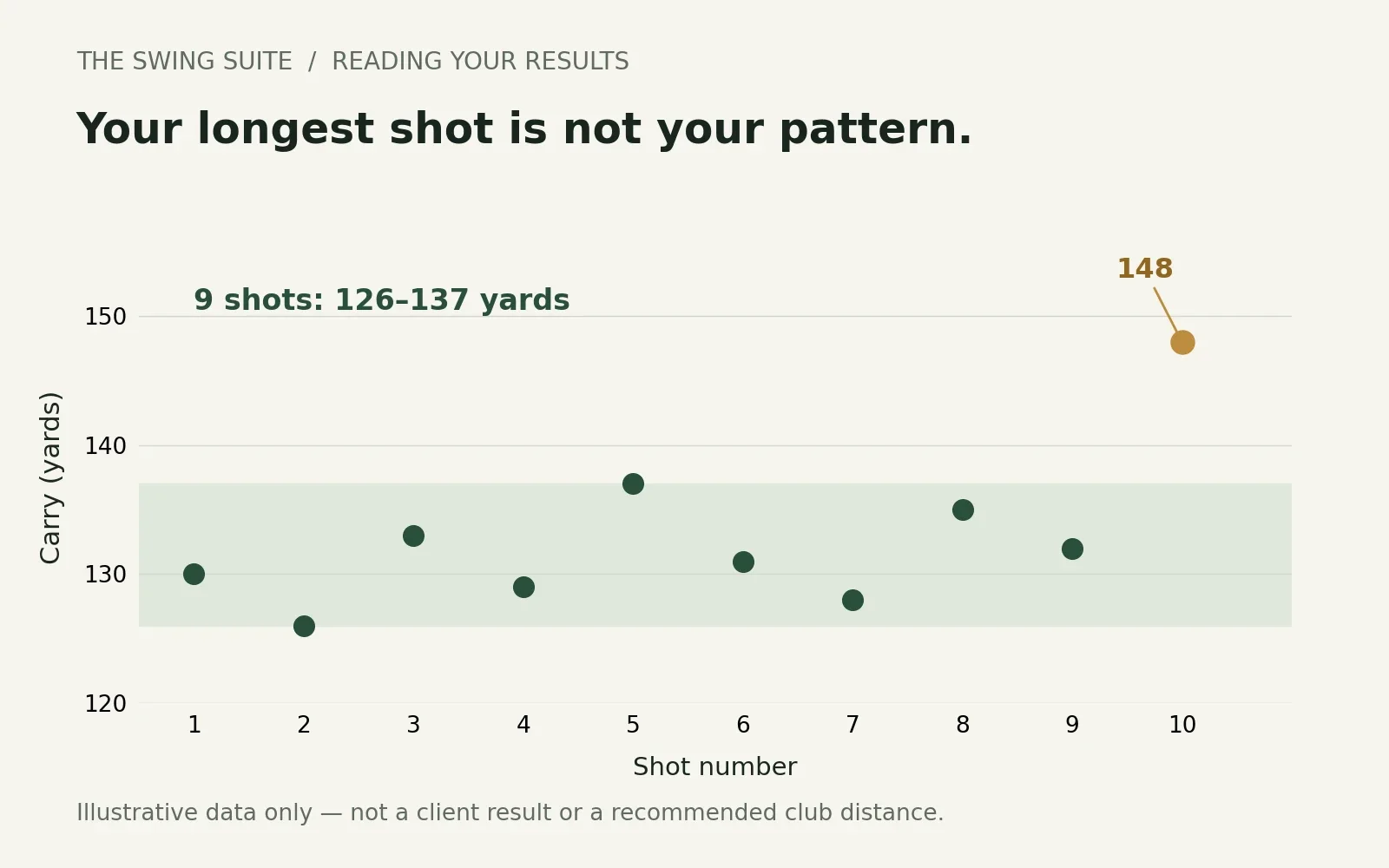
Look at a group of shots rather than selecting the longest one as your normal distance. Keep ordinary mishits visible when you want to understand the pattern you take onto the course. If you exclude an obvious misread, record why. If you separately study well-struck shots, label that group clearly instead of presenting it as your complete performance.
Suppose a fictional ten-shot set contains nine carries between 126 and 137 yards and one at 148. The long shot is interesting, but it does not make 148 yards a dependable planning distance. Review the typical group, the shorter shots and the conditions. The purpose of this example is to illustrate a decision, not to prescribe a distance for any particular club.
Start direction and curvature are also different observations. TrackMan identifies face angle as a major influence on the ball’s starting direction. Its face-to-path measure compares face direction with club path and helps explain expected curvature when contact is centred. Strike location, particularly with a driver, can complicate that relationship. A single number should not become a universal instruction to change your swing.
If you have access to those measurements, use them alongside the shot you actually saw. A zero face-to-path value means the face and path match each other; it does not necessarily mean both point at your target. Ask your coach which measurements matter for your intended shot, and which ranges make sense for your own task.
Keep comparisons fair. Use the same club, units and relevant settings for a repeat test, and record whether the balls or conditions changed. A useful notebook might contain the target, typical carry, left-right pattern and one short observation. You do not need to copy every field from the screen after every swing.
There is also value in occasionally hiding the immediate result until you have made your own prediction. Say whether contact felt solid, where you think the ball started and whether the carry was short or long. Then compare that impression with the feedback. This helps you notice where your feel is informative and where it needs checking.
TrackMan: face-to-path explained ↗
TrackMan: face angle and other ball-flight measurements ↗
Move from repeated shots to playing a shot
Repeated practice and varied practice ask different questions. Repeating a club and target can help you explore a new task with fewer distractions. Changing the situation asks whether you can select and execute a response again. The PGA’s practice guidance encourages mixing shots and bringing the demands of play into practice. The session structure here uses both approaches rather than treating one as suitable for every moment.
A simple transition is to move from five attempts at one target to five attempts at five different targets. Keep the club the same at first. After that, alternate two clubs. Eventually, combine club selection, distance and target choice. You are adding decisions gradually instead of making every part of the task unfamiliar at once.
Expect the varied stage to feel less tidy. You may strike a lovely run of shots with one club, then feel less certain when you return to it after a wedge or driver. That does not automatically mean the earlier work was wasted. It identifies a task worth practising: preparing for the shot without relying on the rhythm of several identical attempts.
Build a short routine around decisions you can repeat. Stand behind the ball, choose the shot and target, make a rehearsal if it has a clear purpose, then address the ball and commit. After the shot, observe the result and step away. The exact timing can be personal; the important point is that the routine helps you make and finish a decision.
If you become distracted halfway through, reset instead of carrying several competing intentions into the swing. That reset is itself worth practising. On the course, a noise, a changing breeze or a doubtful club choice may interrupt you. A useful routine gives you a way to begin again without turning the interruption into a prolonged technical discussion.
PGA: practising golf with a purpose ↗
Give the last ten minutes a score
Choose a challenge linked to your session goal. For approach practice, select ten targets in advance and award one point when the ball finishes inside the agreed zone. For a carry task, score the landing distance instead. Keep the rules simple, and use a zone suitable for your ability rather than borrowing the dimensions of a professional challenge.
Each shot gets one attempt. Record the miss and move on. An immediate repeat can be useful during a learning drill, but it changes the meaning of a scored test. If you want to explore the miss, save the question for another practice block after the challenge rather than quietly replacing the result.
Add a separate routine score if that helps. You might earn one process point for choosing the target and completing your normal preparation, regardless of the shot result. Keep process and outcome totals separate. That makes it possible to notice a useful improvement in decision-making without claiming that the ball flight has already become more consistent.
The challenge should create attention, not punishment. Avoid consequences that make you rush, overswing or continue after you have lost concentration. A clear score, a personal best and a repeat attempt on another day are enough. The purpose is to practise making a decision when the result matters a little.
Compare like with like across sessions. A score of six out of ten has meaning only alongside the target size, clubs and conditions. Keep a short description of the test so you can repeat it. If you make the challenge harder, start a new comparison rather than treating the lower score as evidence that your golf has gone backwards.
Turn the session into a four-week plan
For the first week, establish the task and collect an honest baseline. Use one main goal and a challenge you can repeat. Write down the target area, club and normal preparation. Your first job is to understand the current pattern well enough that the next session has a purpose. Avoid promising yourself a particular handicap change by the end of the month.
In the second week, keep the same main goal and refine the focused practice block. Review whether the chosen drill is addressing the pattern you recorded. If contact is becoming more dependable but direction remains variable, keep those observations separate. Discuss an unexplained pattern with your coach instead of adding a second and third swing fix automatically.
During the third week, increase the decision-making in the varied stage. Change targets more frequently, alternate clubs or choose shots from imagined holes. Retain enough repeated practice to revisit the task, but protect time to test it under different demands. You are checking access to the skill, not simply trying to produce a prettier sequence on the screen.
In the fourth week, repeat the original challenge under reasonably comparable conditions. Look beyond the total score. Has the widest miss changed? Are you making clearer club choices? Can you describe the strike more accurately? Is your routine still present after a poor shot? Several useful changes can occur before a single headline number moves noticeably.
Use the review to choose the next month’s priority. You might continue with the same problem, make the target slightly more demanding or move to a different part of the game. A plan is allowed to stay simple when it is still useful. Changing the subject every week can make it difficult to know which work is helping.
If you practise once a week, use the full session and keep a short note after your next round. If you practise twice, one visit can emphasise learning and the other can emphasise varied shots and a challenge. Adjust the load to your available time and attention. Consistency in returning to a useful task matters more than creating an ambitious timetable you cannot maintain.
A worked example: unreliable approach shots
Imagine a golfer whose approach shots often finish short of the intended area. This is a fictional planning example, not a client result. The golfer initially wants to swing harder, but decides to investigate contact and carry first. That produces a useful question: is the club choice unrealistic, is the strike variable, or are both contributing?
In the first session, the golfer chooses a comfortable iron and a broad target. Ten recorded shots show a mixture of solid contact and shorter mishits. Instead of combining everything into one number, the notebook records the complete set and adds a contact note beside each shot. The golfer now has evidence to discuss rather than a general feeling of lacking distance.
The focused block uses the contact notebook drill at a manageable effort. The varied block alternates two nearby targets with the same club. The final challenge includes several fresh target decisions and records every attempt. If contact improves during repetition but becomes less dependable after a target change, the next session should revisit both the strike task and the preparation between shots.
During the following round, the golfer also notes when a longer club would have left a more useful result. This does not prove that taking more club is always correct. It identifies a decision worth testing alongside the contact work. Lie, wind, elevation and trouble beyond the target still matter.
At the next lesson, the useful conversation is specific: “Here is the difference between my repeated shots and my one-attempt challenge. Here are the shots I judged as poor contact. Here is what happened when I chose a different club on the course.” A coach can then help interpret the pattern and choose an appropriate task.
Notice what the example avoids: an instant diagnosis, a promised distance gain and a collection of unrelated swing changes. The practice plan creates information that improves the next decision. Even when the answer is that more assessment is needed, the hour has produced something useful. Keep that standard for sessions, and let the evidence guide what you practise next.
Take the useful parts onto the course
Before your next round, choose one practice habit to carry with you. It might be selecting a precise target, using a familiar routine or making club choices from your normal carry pattern. Keep the intention small enough to remember when you are walking, talking and responding to different lies. A list of six swing instructions is difficult to use well.
Choose targets with your usual shot pattern in mind. If a typical group spreads across an area, plan for that area rather than assuming your next shot will reproduce your best range ball. Notice where a modest miss would leave a manageable next shot. The right decision depends on the hole, lie, conditions and your own pattern, not a universal rule about aiming at every flag.
Treat the round as a source of questions. Did you repeatedly misjudge carry? Did contact change from uneven lies? Did the routine disappear when the group behind approached? Record a few observations afterwards. You do not need a detailed technical diary between shots, and keeping up with the pace of play remains part of the task.
Be careful when comparing a flat simulator mat with the course. Turf interaction, slopes, weather and the consequences of a miss change the problem. A good indoor session can give you useful information and a clearer plan, while outdoor experience shows how you apply it. Neither setting needs to imitate every feature of the other to be valuable.
If you arrange an on-course practice session, follow the club’s rules and avoid holding up other players. Use permitted practice areas and appropriate quiet opportunities. You can learn from making a single clear decision on each hole; improvement does not require scattering extra balls across a busy course.
Common practice problems and sensible adjustments
You hit the ball well until you change clubs
Make the transition itself part of the practice. Alternate two familiar clubs and take time to establish the new target, setup and intended shot. Avoid treating the first attempt with the second club as a disposable warm-up. If the problem persists, record what changed and ask your coach to help distinguish a preparation issue from a technical one.
Every poor shot starts a new swing experiment
Finish a small, agreed set before reviewing it. Keep the same task long enough to collect a pattern, unless something feels clearly unsuitable. A poor result is information, but it is rarely a complete explanation. Write down the question raised by the miss instead of immediately adding another instruction to the swing.
You judge the session by the last few balls
Review the whole record. A strong finish can make an inconsistent session feel solved; a weak finish can hide useful progress. Compare the baseline, focused practice and challenge separately. They were different tasks, so they should not be collapsed into a single emotional verdict about whether you are “good” or “bad” at golf.
You keep running out of time for the test
Reduce the number of balls in the technical block and protect the final challenge. You need enough time to check whether the task survives a different target or a fresh decision. A smaller session that includes a review can give you a clearer next step than a longer session that ends abruptly halfway through another experiment.
You feel overloaded by advice and numbers
Return to one question and one main measure. Close unnecessary data panels if the software allows it, and use the cue your coach has prioritised. Keep interesting secondary observations in a note for later. You can investigate them without making them all immediate instructions for the next swing.
Questions golfers ask about practice
How many balls should I hit in an hour?
There is no useful universal quota. The answer depends on the task, club, breaks and time spent reviewing each shot. Leave enough space to choose a target, notice the result and make a decision. If you are hitting faster simply to empty the basket, reduce the number of balls and give the session a clearer structure.
Can I use this plan without a launch monitor?
Yes. Use visible targets, sensible landing zones and a written record. You can observe contact, early direction, curvature and the quality of your routine without exact numbers. Be honest about what the setting cannot measure. A range marker can support a useful distance task without becoming a precise measurement of every ball’s carry.
Should a beginner practise with every club?
Begin with a manageable selection and tasks that make sense at your current stage. A comfortable iron and a wedge may offer enough variety for a session. Introduce other clubs gradually, ideally with guidance on setup and purpose. The aim is to learn useful decisions and contact, not to rush through the whole bag to claim completeness.
What if I only have thirty minutes?
Use five minutes to prepare, five for a baseline, ten for one focused task, seven for varied shots and a brief challenge, then three to review. Keep the same basic sequence while reducing its size. Choose fewer targets and a shorter test, rather than removing every part that asks you to think between shots.
Should I practise immediately after a lesson?
Follow the plan agreed with your coach. A short, attentive rehearsal can help you recall the task, but there is little value in turning it into a long session when you are tired or confused. Before leaving the lesson, make sure you understand the purpose, the feedback to watch and what a useful practice attempt looks like.
How will I know when I need another lesson?
Seek help when you cannot explain a recurring pattern, when the task no longer produces useful feedback or when you are unsure which problem deserves priority. Bring your notes and a few representative examples. They give the conversation a clear starting point and help the lesson connect directly with what happens during your own practice.
Make your next practice session specific
Before you book your next practice hour, choose one question about your game. Write down the task, the target and how you will record the result. Prepare a small challenge that asks you to use the skill after a fresh decision. That gives you a complete session before you have hit a ball.
The Swing Suite offers one-to-one coaching with Scott Winyard in Balham, Battersea and Putney. A lesson can help identify a useful priority and turn feedback into a practice plan suited to your game. Bring the shots that trouble you, the questions you want answered and any practice notes you already have.
You do not need to arrive with a perfect explanation of your swing. Start with an honest description of the result you want to change. Clear practice begins there: one useful question, a manageable task and enough attention to learn from the answer.