
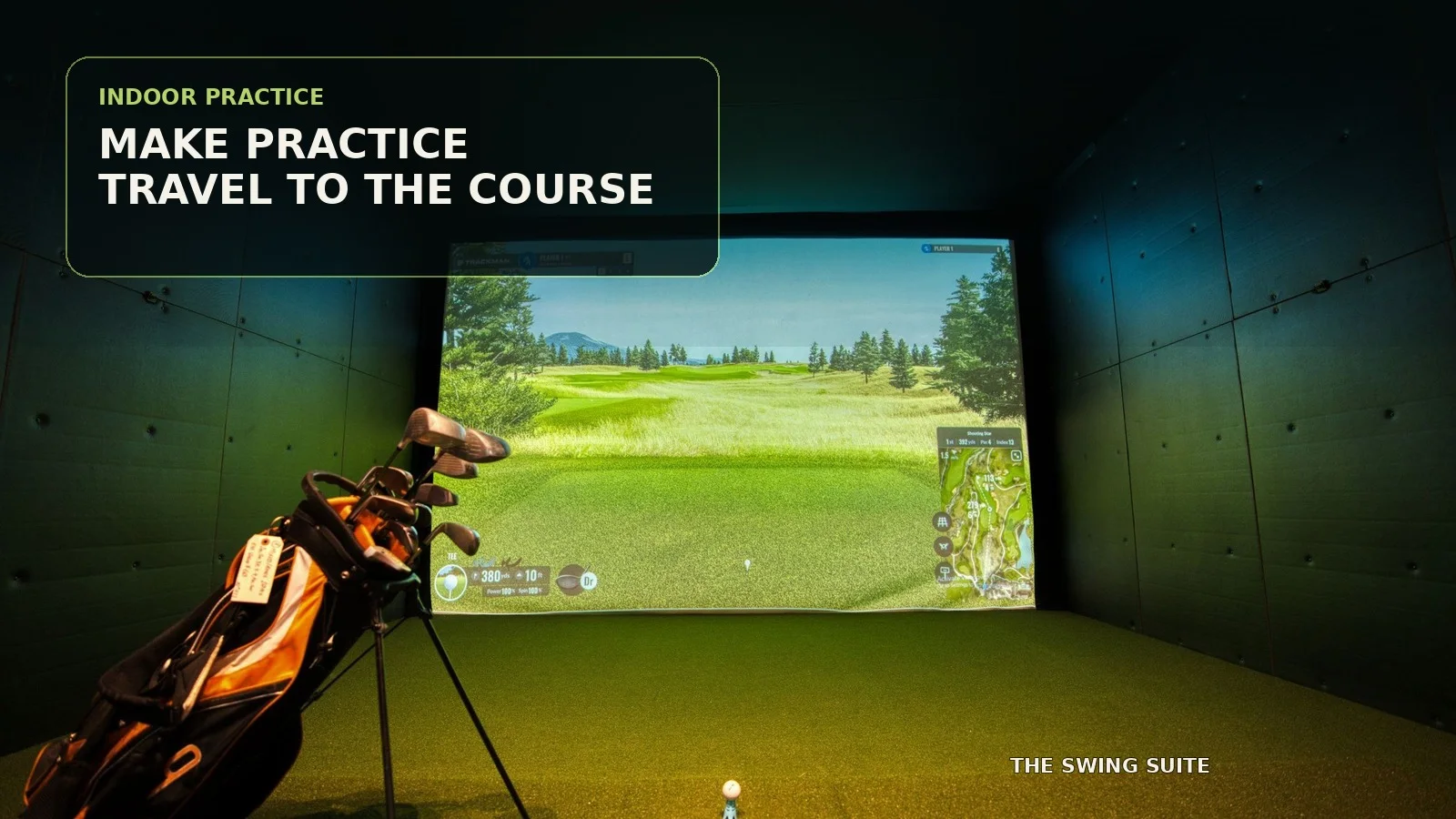
Indoor practice transfers to the course when it asks you to solve golf problems rather than merely repeat golf swings. Use the simulator to change clubs, targets, lies, trajectories and consequences; hit one meaningful ball at a time; commit to a plan before each shot; and review the decision as well as the strike. Keep some blocked repetition for learning or calibrating a movement, but finish with a variable, one-ball test that resembles the decisions you will face outdoors.
A launch monitor can make feedback immediate and precise, but the numbers are only useful when they help you choose and execute a shot. The aim is not to make your best indoor pattern look tidy. It is to build a skill that remains available when the target changes, the previous ball cannot be replayed, and the result affects the next decision.
This guide gives you a practical structure for doing that. You will learn how to separate technical work from transfer work, design representative tasks, add uncertainty without making practice random, use virtual golf deliberately, and leave each session with evidence you can test on the course. Any sample scores, yardages or shot sets below are hypothetical. Replace them with your own measured information.
The direct answer: make the last part of practice look like golf
Begin with a clear purpose. If you are changing a movement, use a short block in which the club, target and feedback remain stable enough for you to understand the change. Once you can produce the intended movement or ball flight occasionally, reduce the help. Change the target. Change the club. Wait between shots. Use your normal routine. Give yourself one attempt and make the outcome matter.
A useful transfer block has five features. It asks for a specific ball flight, changes the problem from shot to shot, requires a decision before the swing, gives honest feedback after the shot, and prevents the immediate correction ball from becoming the main learning method. The simulator is then doing more than measuring. It is creating a controlled version of the uncertainty that makes golf difficult.
Do not try to make every minute representative. Technical learning and course transfer are related but different jobs. A player who is making a grip, set-up or movement change may need repetition and frequent feedback. The mistake is ending there. If every ball is hit with the same club to the same broad target, the player may become better at that indoor task without becoming better at retrieving the skill on demand.
Why a good indoor session can disappear outdoors
Indoor practice removes many sources of variation. The lie is level, the stance area is familiar, the ball position can be rebuilt perfectly, and the visual scene may stay unchanged for dozens of swings. There is no walk between shots, no uneven ground, no wind on the face and no need to wait while another player prepares. Those advantages make the environment excellent for measurement and controlled learning, but they can also make performance depend on conditions that will not exist on the course.
Repetition creates a warm-up effect. After several shots with one club, you know the task, you remember the previous strike and you can make an immediate adjustment. The fifteenth seven-iron is not the same problem as the first seven-iron after a drive, a walk and a new lie. A tight group late in a block can show that you solved the repeated task. It does not automatically show that you can recall the solution once, later, under different conditions.
Indoor feedback can also become too available. Ball speed, club speed, launch, spin, face, path, carry and dispersion may all be visible. That information can be valuable, but watching every value after every ball can turn practice into number chasing. The player starts trying to manufacture a preferred screen rather than choose a flight for a target. Transfer improves when data answers a question, not when the number becomes the task by default.
Separate acquisition, calibration and transfer
Give each block one job. An acquisition block is for learning or changing something. The question is: can I understand and produce the intended movement or contact? A calibration block is for mapping what a club or shot actually does. The question is: what carry, launch, curve or dispersion can I support? A transfer block is for selecting and delivering the shot in changing conditions. The question is: can I use what I have when I get one attempt?
The three blocks can appear in one session, but their success measures should differ. In acquisition, you may value movement quality, contact location or one relevant club-delivery parameter. In calibration, you need representative shots and honest inclusion rules. In transfer, the result must be judged against the chosen target and decision. Combining all three into one vague bucket makes it easy to declare success because one attractive number improved.
Write the job at the top of your practice note. For example: “Learn a more centred strike with the seven-iron”, “Check carry windows for three wedge swings”, or “Choose and execute nine different approach shots”. If you cannot name the job, the simulator will usually choose it for you by displaying the most noticeable number.
Use blocked practice without becoming trapped in it
Blocked practice means repeating a similar task: the same club, target, intention or movement. It is useful when you need enough stability to notice cause and effect. If you are testing ball position, trying a set-up cue or learning where a new strike feels, changing everything after every shot may hide the information you need.
Keep the block narrow. Choose one target, one club and one primary feedback measure. Hit a small set, pause, and decide whether the cue produced the intended change. Avoid turning one successful ball into proof or one poor ball into a new swing theory. You are looking for a pattern strong enough to justify moving to the next stage.
Then add a bridge. Keep the same club but move the target. Keep the target but change the trajectory. Alternate between the new shot and a familiar stock shot. Step away between balls. The bridge protects the learning objective while removing some of the repetition that supported it. It is often more useful than jumping directly from a technical drill to a full virtual round.
Build a constraint ladder instead of adding chaos
Variability should be designed, not sprinkled into the session. A constraint ladder changes one source of difficulty at a time so that you can identify where the skill becomes unreliable. Start with the simplest version that still represents the intended shot, then climb only when the current level is reasonably stable.
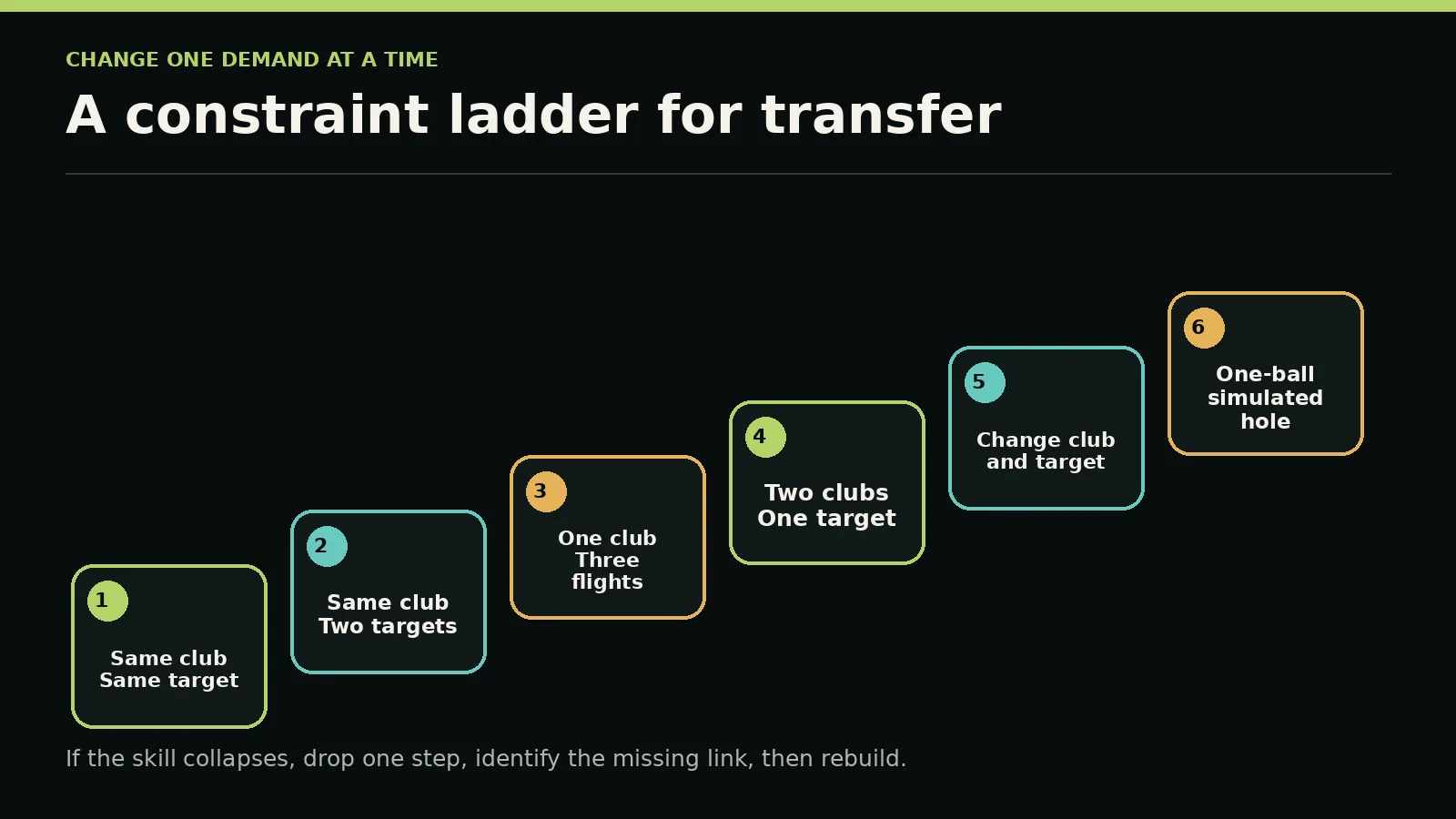
A six-step ladder might be: same club and same target; same club with two targets; same club with three trajectories; two clubs to one target; changing club and target; then a one-ball simulated hole. You can also vary carry window, start line, curve, height, lie setting or consequence. The exact order depends on the skill, but each step should have a reason.
If performance collapses at one level, do not punish yourself with more complexity. Drop one step, identify the missing skill, and rebuild. Perhaps the movement survives a target change but not a club change. Perhaps carry is stable but start direction is not. The ladder turns a general statement such as “it does not transfer” into a specific practice question.
Give every shot a target that changes the decision
A different picture is not necessarily a different problem. Moving from one virtual green to another while still hitting the same stock seven-iron to the centre may add novelty without changing the decision. The target should ask for a different club, start line, trajectory, carry window, shape or acceptable miss.
Define the useful area before swinging. For an approach, that may be a front-to-back carry window and a side of the green that leaves the easiest miss. For a tee shot, it may be a landing corridor that avoids the severe boundary. For a wedge, it may be a minimum carry over trouble with a maximum finish beyond the flag. A target becomes representative when it changes what you intend to do.
Use the simulator’s course and target tools deliberately. TrackMan’s current Performance Studio describes options for situational practice, free placement on a course, repeated on-course shots and custom tests. Those tools can support transfer, but the player still has to define the task. Loading a course does not by itself make the practice representative.
Explore TrackMan Performance Studio practice tools ↗
Use one ball, one plan and one routine
The most important change is often procedural rather than technical. Before each transfer shot, stand back, read the task, choose club and flight, name the target, rehearse once if that is part of your normal routine, and hit. Do not make the decision while already standing over the ball. The process should resemble the sequence you want to use outside.
Read TrackMan’s discussion of practice that transfers ↗
After the shot, record what happened without immediately hitting a correction ball. Separate intention, start, curve, strike and finish. Ask whether the decision was suitable and whether the execution matched it. A poor result can come from a good decision and unusual execution. A good result can come from a vague decision and a fortunate bounce. Transfer practice should teach you to recognise both.
If you want a second attempt, it must be earned by the task design rather than emotion. For example, a two-ball challenge can ask for two different trajectories, but “I did not like that one” is not a sufficient rule. Immediate do-overs train a pattern that the course does not permit.
Introduce consequence without pretending practice is a tournament
Consequence makes attention more realistic. It does not require punishment, embarrassment or inflated pressure. A consequence can simply change the score, end a streak, move the ball to a harder next position, or remove the chance to replay the shot. The purpose is to make the target and miss matter before the swing.
Use scoring that reflects the task. A wedge challenge might award two points for the intended carry-and-finish window, one for a safe miss and zero for short-sided trouble. A tee-shot game might score playable corridor, recovery required and severe outcome. A nine-shot test might require a minimum number of committed routines as well as a target score. Process and outcome can be tracked separately.
Keep the consequence proportionate. If every miss means complete failure, players often become defensive or start manipulating the scoring. A course contains gradients: perfect, useful, playable, difficult and severe. Your practice score should recognise them. This gives you a better picture of decision quality than a binary hit-or-miss label.
Change clubs before repetition becomes a hidden warm-up
On the course, consecutive full shots with the same club are uncommon. Indoor practice should therefore include club changes once the technical block is complete. Start with a simple alternation: driver, seven-iron, wedge; then a different driver target, a different approach and a different wedge distance.
Physically change the club, reset the ball and rebuild the routine. Do not rush the transition to preserve rhythm. The transition is part of the skill. You are practising how quickly you can organise a new task, not how quickly you can hit a bucket.
Club changes expose whether a cue is robust or narrowly tied to one set-up. A feel that helps a seven-iron may make little sense with a driver or partial wedge. Keep the underlying intention where it remains relevant, but allow the set-up and shot demand to change. Transfer is not making every club look identical; it is preserving the useful principle across different tasks.
Vary the shot while protecting the primary skill
Variability should not force a golfer to attempt shots they do not own. If the session is about reliable stock approaches, you do not need low hooks, high fades and extreme flop shots. Change enough to require selection and adaptation while keeping the shots connected to the golfer’s real game.
Useful variations include carry distance, target side, trajectory window, club, start line, intended curve, and acceptable miss. For a beginner, the variation may simply be short, medium and long targets with familiar clubs. For a more experienced player, it may include wind settings, uneven-lie simulation where available, or a choice between two shapes.
Return occasionally to the stock shot. This tests whether the skill can be retrieved after interference rather than only when it is continually rehearsed. A pattern such as stock, lower, stock, higher, stock can reveal whether the stock flight is genuinely available or dependent on momentum from the previous ball.
Design a representative wedge session
Begin with calibration only if needed. Hit a small honest sample with one wedge and one swing length. Record a carry window rather than selecting the best number. If the task is movement learning, use one relevant feedback measure and keep the rest of the display quiet where possible.
Move to a three-distance bridge. Choose three targets that require meaningfully different carries. Hit one ball to each, then change the order. State the carry intention before the swing. Score the result by carry and finish rather than proximity alone, because a ball that lands short and rolls close indoors may not represent the outdoor shot you intended.
Finish with a nine-shot transfer test. Use three targets, but do not repeat the same target consecutively. Add one safe-side rule for each. Use the normal routine and one attempt. Record intention, actual carry category, finish category and whether the next shot would be straightforward. The score is less important than whether the process remains clear when the distance changes.
Design a representative iron session
An iron transfer session should connect distance, target shape and miss. Choose several approach situations rather than a row of flags. One might reward a centre target because trouble surrounds the green. Another might permit a broad safe miss on one side. A third might require carrying a front hazard without chasing a back flag.
Alternate clubs and targets. A hypothetical sequence could be nine-iron to a front pin, six-iron to a broad centre, eight-iron to a back-left zone, hybrid to a front carry, then seven-iron to a safe right half. The distances are not recommendations. The point is that each shot requires a fresh club-target decision.
Track start direction, curve, strike and finish category. Do not reduce the whole test to average carry. If the carry is suitable but the pattern repeatedly finishes on the short-sided half, the practice has found a strategic or directional problem. If start and curve are stable but carry changes with strike, the next technical block can be more specific.
Design a representative driving session
Driving practice transfers when the target includes consequence and the club choice remains open. Create three virtual tee corridors: one wide with a distant reward, one narrow with a severe side, and one where a shorter club changes the landing problem. Decide the useful corridor before choosing the club.
Hit one ball on each hole and rotate. Record club, intended start line, intended shape, strike and finish category. A drive can miss the painted fairway yet leave a good next shot; another can find the fairway but finish blocked or too close to a hazard. Score the strategic job rather than only fairways hit.
Include at least one hole where driver is the sensible choice and one where it is not. If every challenge rewards restraint, you are rehearsing a generic rule. If every challenge rewards speed, you are doing a driving session rather than decision practice. The purpose is to identify when distance creates value and when dispersion changes the answer.
Use virtual golf as a decision test, not background entertainment
A virtual round can be excellent transfer practice because club, target and consequence change naturally. It can also become poor practice if the player rushes, accepts automatic targets, ignores lies and simply advances the ball. Treat each shot as a small decision test.
Before the round, choose one process goal. Examples include naming the start line before every full shot, selecting the safest useful target, or completing the same routine after a poor result. Do not carry five technical goals into a simulated round. The round should test availability, not become another crowded lesson.
During play, use the information the platform provides but retain uncertainty. Indoor surfaces cannot reproduce every lie, wind or turf interaction. Avoid turning a virtual score into a literal forecast for outdoor golf. Use the round to assess decisions, routines and shot selection under change. The course remains the final test.
Build a nine-hole transfer circuit without playing a full round
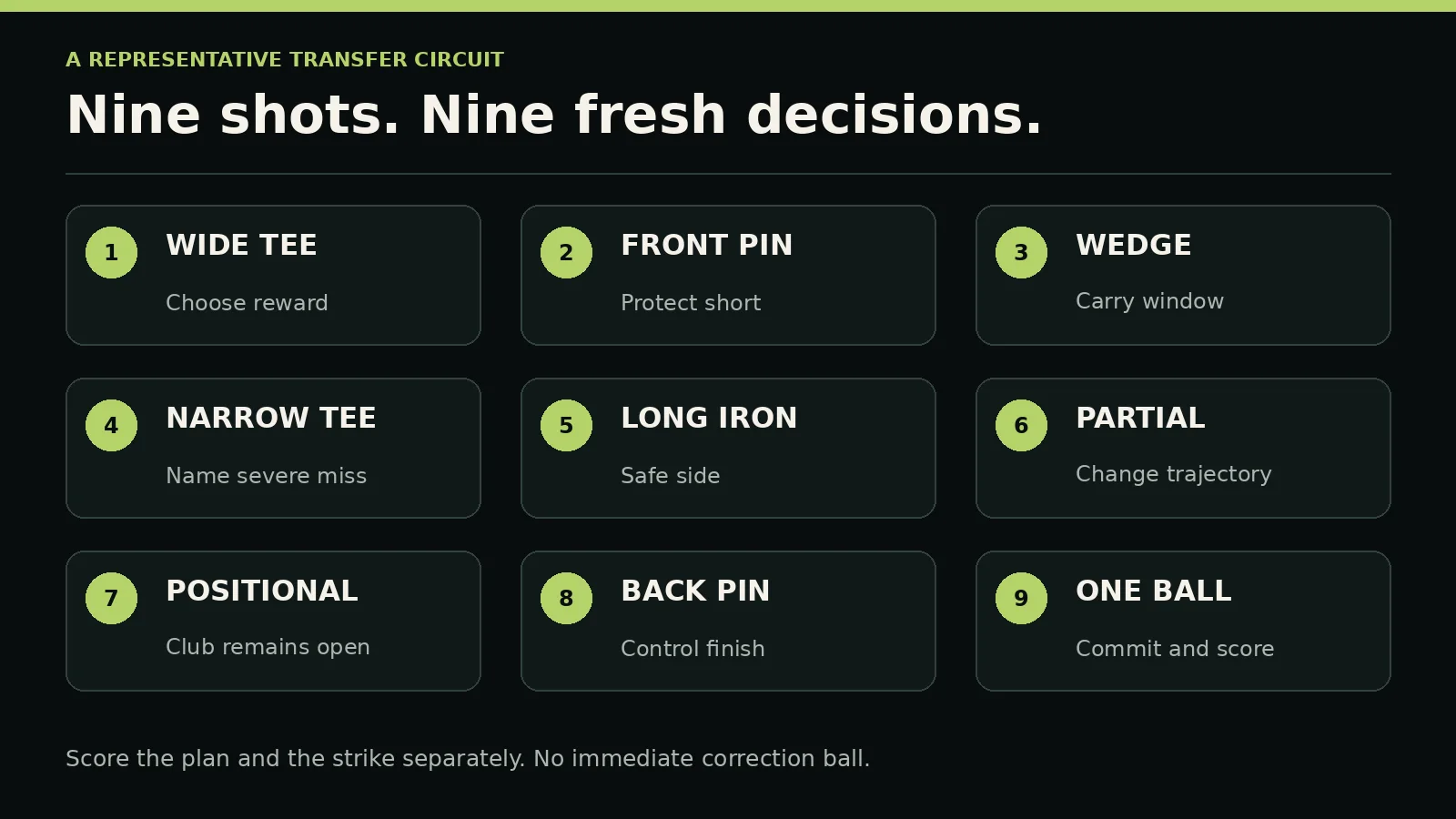
A transfer circuit is useful when time is limited or when you want to isolate a specific part of the game. Choose nine different situations from virtual courses or target tools. The circuit should contain changes in club, target, trajectory and consequence, but every shot should relate to the skill you are training.
For approach play, include three comfortable shots, three boundary decisions and three recovery or awkward-distance tasks. For tee shots, include wide, narrow, forced-carry and positional holes. For wedges, vary carry, landing window and safe miss. Write the nine tasks before beginning so that you cannot redesign the test after seeing the results.
Hit one ball per task. Record the plan and outcome, then move on. At the end, review which failures came from selection, commitment, start direction, curve, strike or distance. The circuit should produce a diagnosis for the next practice session, not just a score.
Make feedback less frequent as the session progresses
Early in learning, immediate feedback can clarify whether a movement or strike changed. Later, too much feedback can make the player dependent on the display. Gradually reduce how often you inspect detailed numbers. You might check the key measure after every shot in the technical block, after every three shots in the bridge, and only after completing each transfer task.
This does not mean ignoring evidence. It means predicting before looking. State what you felt, where you think the ball started and how you think it curved, then compare with the data. The gap between prediction and measurement is itself useful feedback. Better self-observation helps on the course, where the complete data screen is absent.
Choose the minimum useful set of parameters. If the task is start direction, face angle or launch direction may help; if it is carry control, carry and strike quality may be enough. Opening every metric can create false explanations. Use the data that answers the question you wrote at the beginning.
Practise the pause between shots
Golf includes time. You walk, wait, change clubs, read the next problem and manage the response to the previous shot. Indoor repetition can remove those pauses and create a rhythm that never appears outside. Add a deliberate reset between transfer shots.
The reset does not need to be long. Step away, record the result, change the target, take a breath and begin the routine again. If practising with another person, alternate shots rather than hitting complete blocks. If alone, use a short written prompt or change the virtual situation before touching another ball.
Notice whether the skill survives the pause. A movement that works only when the next ball follows immediately may not yet be retrievable. That is not failure; it is a useful stage of learning. Return briefly to the bridge, then test again after a reset.
Add pressure through clarity, not theatre
Pressure practice should make the task meaningful, not recreate tournament emotion perfectly. Clear scoring, limited attempts and a visible finish line are enough. A final three-ball challenge can require one playable drive, one approach into the safe zone and one wedge inside a carry-and-finish window. If the sequence fails, record where and why rather than restarting indefinitely.
Use personal baselines rather than arbitrary standards. A challenge that is impossible produces guessing; one that is automatic produces little attention. Set the boundary from recent representative practice and adjust only after enough evidence. The goal is to test decision and execution at the edge of current reliability.
Keep identity out of the score. Missing a challenge does not prove you are bad under pressure. It shows what happened in one designed set. Repeat the same test on another day, then compare process and outcome. Transfer evidence becomes stronger when it is reproducible.
Use a pre-course rehearsal carefully
Indoor practice can prepare you for a course by rehearsing likely shots, but avoid pretending the simulator is a perfect copy. Choose a small number of important decisions: a tee shot with a severe boundary, a forced-carry approach, a positional lay-up or a wedge distance that may recur.
Rehearse the decision and routine, not an exact predicted result. Outdoor wind, lie, temperature, ground firmness and visual scale will differ. Build two or three acceptable options for each situation rather than one scripted shot. The plan should survive new information when you arrive.
Finish the rehearsal with changing tasks so that you do not leave the session locked into one club or shape. The last few balls should require fresh reading and commitment. You want to arrive at the course ready to solve problems, not trying to reproduce a perfect indoor sequence.
Transfer one technical cue into a playing intention
A technical cue can help in a controlled block, but carrying it unchanged into every course shot may overload attention. Before the transfer block, translate the cue into a task or ball-flight intention. “Move pressure earlier” might become “start the ball through the chosen window with centred contact”. The exact translation depends on what the cue is meant to change.
Test whether the intention preserves the useful effect. Alternate one rehearsal with the technical cue and one shot with only the external target. If the movement disappears immediately, the change may need more learning time. If the ball flight remains, the simpler playing intention may be ready for the course.
Do not force the cue out too early. Some golfers benefit from one familiar movement reminder. The aim is not to ban internal attention; it is to prevent a long diagnostic list from replacing the shot. Keep the course cue short, practised and connected to the intended flight.
Review decisions and execution separately
After the session, draw two columns. In the first, review the plan: club, target, intended flight, safe miss and commitment. In the second, review execution: start, curve, strike, carry and finish. This stops one poor strike from making every strategic choice look wrong.
Look for repeated mismatches. Did your chosen target leave enough room for the normal curve? Did you repeatedly select a carry that required your best strike? Did a technical cue work in blocks but disappear after club changes? Did the routine become shorter after a miss? Those patterns tell you what to practise next.
Retain successful decisions that produced imperfect shots. If the target made the ordinary miss playable, the strategy may be sound. Also flag poor decisions that received a lucky outcome. Transfer practice should improve your ability to judge the process without being fooled by one result.
A practical 60-minute indoor-to-course session
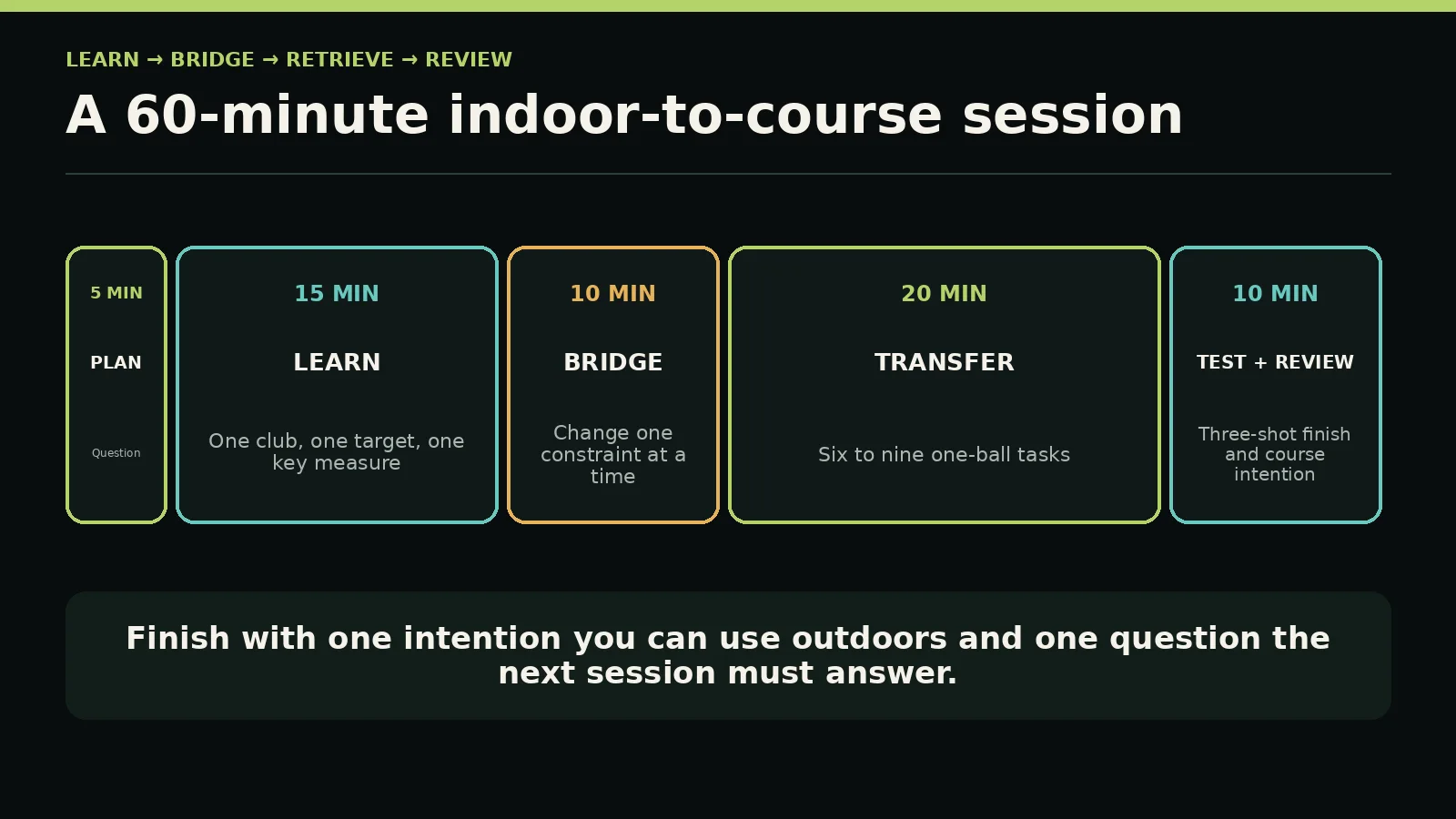
Use the first five minutes to define the day’s question and warm up without scoring. Spend the next fifteen minutes on one acquisition or calibration block. Keep the club, target and key feedback stable. Stop if the block becomes mindless; more balls do not automatically add learning.
Compare the Swing Suite 60-minute golf practice plan ↗
Use ten minutes for the bridge. Change one constraint at a time: two targets, then two trajectories, or alternate the training club with a familiar club. Predict the result before viewing the data. Note where the skill becomes less stable.
Use twenty minutes for transfer. Build six to nine changing tasks, one ball each, with club and target decisions made before the shot. Apply a simple scoring rule and complete the normal routine. Use the final ten minutes for a three-shot pressure test and review. Write one course intention and one question for the next session.
Common mistakes that stop indoor work transferring
- Hitting the same club to the same target until the late-session pattern looks better than the first attempts.
- Treating a virtual course as representative while rushing decisions and accepting automatic targets.
- Watching every available parameter without deciding which number answers the session question.
- Using immediate correction balls after every miss, even during a one-ball transfer test.
- Changing club, target, trajectory and technical cue simultaneously, then being unable to identify why performance changed.
- Scoring only perfect outcomes and ignoring useful, playable and severe misses.
- Practising exotic shots that are unrelated to the golfer’s real course demands.
- Turning a short sample into a permanent claim about carry, dispersion or pressure performance.
- Comparing virtual scores directly with outdoor scores despite different lies, conditions and putting behaviour.
- Ending the session immediately after the technical block, with no bridge or retrieval test.
- Rehearsing one course shot repeatedly and assuming the exact indoor answer will survive new outdoor information.
- Judging the decision solely by the result instead of reviewing planning and execution separately.
Questions golfers often ask
Should I stop hitting blocks of balls?
No. Blocked repetition can help you understand a movement, calibrate a club or stabilise contact. Give the block a narrow purpose and a clear finish. Then use a bridge and a transfer test. The problem is not repetition itself; it is treating repeated-task performance as proof that the skill is ready for one-ball golf.
How many shots should a transfer test contain?
Use enough changing tasks to reveal a pattern without turning the test into another warm-up. Six to twelve shots can be practical for one session, but the number is not a universal benchmark. Repeat the same structured test on another day. A small sample should guide the next question, not support a sweeping claim.
Should I hide the launch-monitor data?
Not completely. Select the data that answers the practice question and reduce its frequency as the task becomes more representative. Predict before looking. In a transfer block, outcome, start, curve, strike and target relationship may matter more than a full technical dashboard after every ball.
Is playing virtual golf enough for transfer?
It can help, but only if you treat each shot as a decision. Choose the target and club, use the routine, accept the result and review the plan. A rushed virtual round can become entertainment or rapid repetition. A deliberate round can test retrieval, strategy and emotional reset under changing tasks.
How do I know whether a swing change is ready for the course?
Test whether the intended ball flight survives target changes, club changes, pauses and one-ball tasks. It does not need to be perfect, but it should appear often enough that you can plan around it. If it exists only after several rehearsals with one club, continue the bridge rather than demanding immediate course performance.
What should I take from the simulator to the first tee?
Take one ball-flight intention, one simple routine and honest club windows. Leave behind the full diagnostic dashboard. On the course, use new information from lie, wind, temperature and ground conditions. The indoor session should make you better at adapting, not make you dependent on recreating the indoor picture.
Turn the session into course evidence
Choose one transfer test that matches a real need. If approaches are the priority, create nine changing shots with clear safe sides. If driving is the priority, rotate through different landing corridors and keep club choice open. If wedges are the priority, vary carry and finish windows. Write the tasks before you start.
Complete the technical block, bridge and one-ball test. Record both decision and execution. Then take one intention to the course and observe it without forcing a verdict from the first result. After the round, compare the outdoor decisions with the indoor test. The useful question is not “Did the simulator fix my game?” It is “Which part of the process remained available, and what changed when the environment changed?”
Indoor golf practice is most valuable when it combines controlled measurement with honest uncertainty. Use the technology to learn, calibrate and test. Change the problem before repetition becomes a crutch. Make the target matter, give yourself one attempt, and let the session produce a clear next question.
Book measured practice support
If your indoor numbers look good but the shots do not travel to the course, a focused lesson can help separate movement learning, club calibration and transfer practice. Measured feedback can show what changes when the target, club and consequence change, while a representative practice plan can connect the evidence to real golf decisions. Use the live booking page for current Swing Suite lesson availability rather than relying on copied times or venues.