
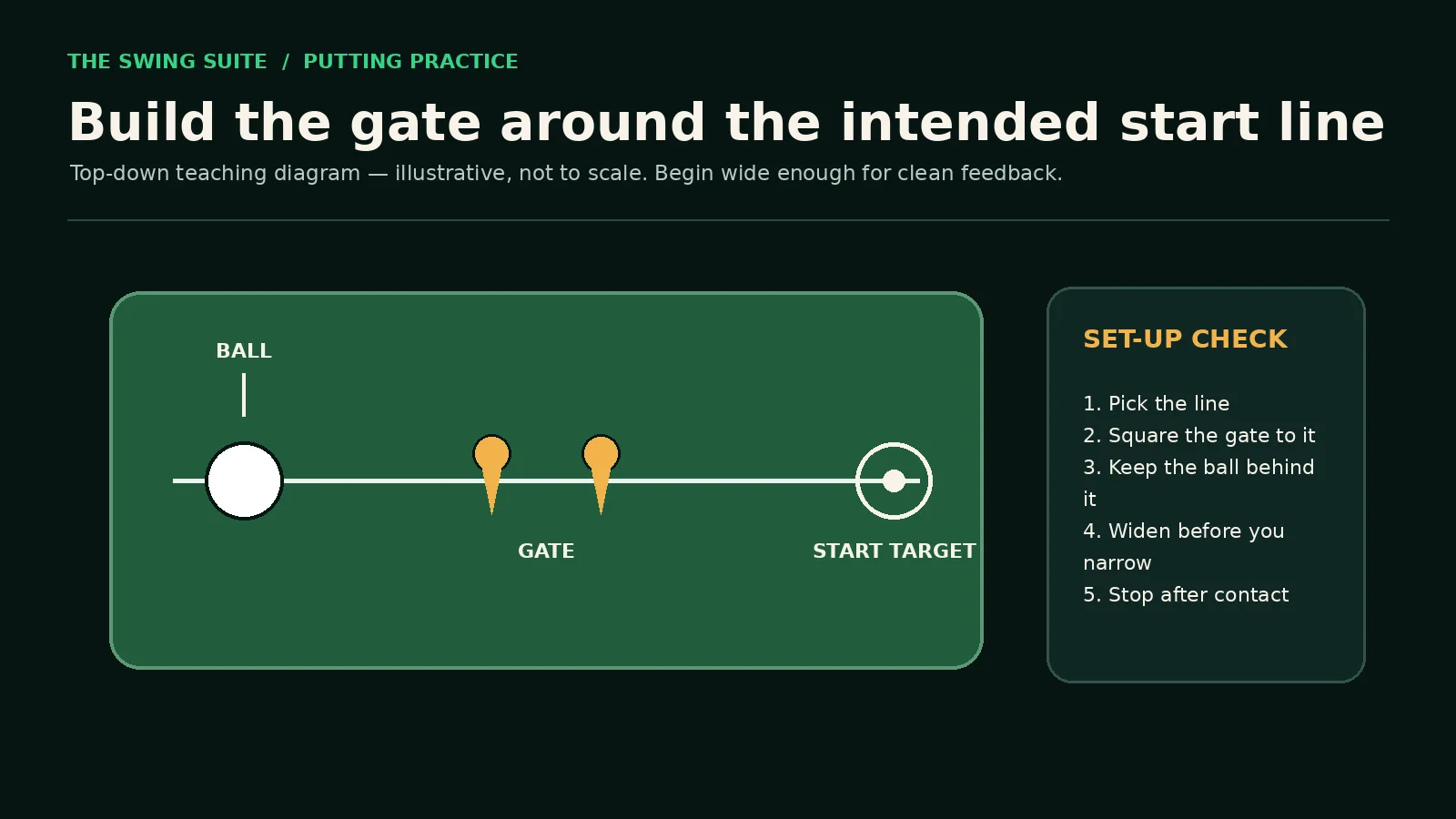
A short-putt gate test helps you practise start direction without confusing it with whether the ball happens to finish in the hole. Choose a straight or gently breaking putt, establish the intended start line, place two tees or safe markers just wider than the putter or ball path, and roll a small scored set. Record whether each ball passes cleanly through the gate, touches the left marker or touches the right marker. Then add pace and outcome as separate notes.
The gate is feedback, not a punishment. Start wide enough that a centred roll can pass without the test becoming a trick. If the ball repeatedly clips one side, confirm that the gate is actually aligned to the intended line before changing your stroke. If clean starts miss the hole, review read and pace rather than narrowing the gate or inventing a face-control problem.
This guide gives you a fair set-up, a simple scorecard, a changing-target progression and a matched retest. Every distance, gate width and score is illustrative. Adjust the task to the surface, your skill, the markers you are permitted to use and the amount of attention you can maintain. Never place equipment where it can damage a green, distract another player or create a trip hazard.
The direct answer: separate the start from the result
Build the gate on the line you intend the ball to begin on, not automatically on a line drawn straight at the centre of the hole. Position the ball behind the gate, complete your normal routine and roll ten representative putts. Score the gate first: clean, left contact or right contact. Only after that should you note whether the pace was useful and whether the ball finished where you intended.
A clean pass means the ball began through the window you created. It does not prove that your read was correct, that the pace was ideal or that the putt had to be holed. A gate touch means the start missed that window, but it does not identify one universal movement fault. It may reflect face orientation, strike, alignment, set-up, aim or a gate that was built carelessly.
When the set is complete, look for a directional pattern. Repeated left touches are different from alternating left and right touches. A group of clean starts with short finishes is different from a group that hits both gate markers but occasionally falls into the cup. Choose the earliest useful problem, make one change and repeat the same scored set.
Judge the matched retest from the whole pattern. If clean passes increase while pace and commitment remain useful, the change has earned another session. If the gate score improves only because you steer the putter slowly or abandon your normal routine, the test has become less representative. The aim is a start-direction skill that survives a real target decision.
What start direction means in putting
Start direction describes where the ball begins horizontally relative to the chosen target line. TrackMan’s official putting definition reports launch direction relative to that line and, in its measured environment, evaluates the direction a short distance after impact. That distinction matters because a player needs a declared target line before a start can be called left, centre or right.
The target line is not always the line from the ball to the middle of the hole. On a breaking putt, your chosen start may sit above or below the cup. The gate should represent that chosen start, while the final roll reflects the combination of line, pace and surface. If you build every gate directly at the hole, you can train a straight start that is wrong for the putt you are trying to roll.
TrackMan’s putting material also treats face angle as the horizontal orientation of the putter face relative to the target line. Face orientation is an important part of the start-direction conversation, but the gate does not directly measure every delivery variable. It observes whether the ball passed through a physical window. Use measured data or coaching when you need to distinguish face, path, strike and aim more precisely.
Keep the language observational. Write “touched left gate” rather than “pulled it with my shoulders”. Write “clean start, fast pace” rather than “perfect stroke”. A useful test preserves what happened before it supplies a technical story.
Review TrackMan’s official putting launch-direction definition ↗
A gate tests one layer of a successful putt
A putt has several connected layers. You choose a read, aim the putter and body, deliver the face and path, strike the ball, start it on a line, supply speed and let the surface shape the roll. The hole gives one final outcome, but that outcome cannot tell you which layer succeeded or failed.
A ball can pass cleanly through the gate and miss because the read was wrong. It can pass cleanly and miss because it was too fast or too slow. A ball can touch the gate yet be deflected or still fall into the cup. If you score only holed or missed, those different attempts collapse into the same binary label and the feedback becomes noisy.
TrackMan’s line-and-pace material emphasises that putting performance is a partnership between direction and speed. The practical consequence is simple: use the gate to organise start feedback, then keep a pace note beside it. Do not demand that one small apparatus explain the complete putt.
This separation protects your practice decisions. Repeated clean starts with poor distance suggest that pace or read deserves attention. Repeated gate contact with useful pace makes start direction the earlier problem. Mixed starts and mixed pace may require a simpler target, a wider gate or a shorter block before you choose a technical change.
Read TrackMan’s putting principles for line and pace ↗
Choose the right putt for the baseline
Begin on a surface that is safe, reasonably smooth and free from another player’s line. A straight putt is easiest for learning because the intended start is obvious. A gentle break can be useful once you can build the gate accurately. Avoid beginning on a severe slope where uncertainty about read and pace overwhelms the start-direction feedback.
Use a short distance that lets you roll with normal intent. The task should be demanding enough that direction matters but not so long that pace dominates every result. Three to six feet can be a practical range for many golfers, but it is only an illustrative starting point. Choose the distance that produces attentive, representative strokes rather than fear or careless repetition.
Find the intended line before placing the markers. Read from behind the ball and, if useful, from the low side. Choose a speed picture as well as a line. A ball intended to finish gently beyond the hole may need a different start from one hit firmly. The gate belongs to the putt you have chosen, not to a generic diagram.
Roll two or three unscored calibration putts without the gate if you do not know the surface. This is not permission to search for a perfect rehearsal indefinitely. It is a short check that the read and pace picture are plausible. Then reset and build the scored task.
Build a gate that gives fair feedback
Place two tees, coins, flat markers or approved training gates across the intended start window. On a practice green, follow the facility’s rules and avoid forcing tees into a surface where that is not permitted. Flat markers are safer where the turf or setting makes tees unsuitable. Indoors, use objects that cannot damage the floor or alter the ball unexpectedly.
Start with a generous width. The first job is to learn the relationship between your intended line, your address and the roll. A gate only a fraction wider than the ball can become an advanced precision challenge; it is a poor baseline if almost every reasonable putt touches a marker. Widening the gate is not failure. It is how you create readable feedback.
Position the gate far enough in front of the ball that contact reflects the ball’s initial travel, but close enough that slope and surface do not dominate before it arrives. The exact distance depends on your markers and surface. TrackMan’s measured parameter is defined at one foot from the ball, but a home practice gate is not TrackMan and does not need to imitate that geometry exactly. Use a repeatable position and record it.
Square the gate to the intended line. A gate angled across the line makes one side effectively closer and can create false contact. Use a string, chalk line where permitted, alignment rod outside the ball’s path or a careful visual check. Remove any guide that could interfere with the ball or another player before the scored set.
Place the ball in a repeatable area behind the gate, but do not turn the test into a millimetre-perfect laboratory. Marking a small start position can help indoors. On grass, vary the exact spot slightly when needed to protect the surface. The comparison remains useful if the intended line, gate position and scoring stay clear.
Protect the set-up from common alignment errors
The gate points at the hole instead of the chosen start
This is the most common conceptual error on a breaking putt. The golfer reads outside the cup but places the gate on a straight ball-to-hole line. A correctly started putt then touches the marker, while a wrongly started ball may pass cleanly. Rebuild the gate around the intended start line before changing the stroke.
The gate is square, but the ball position moves
If the ball shifts left or right behind a very near gate, the apparent start window changes. Use a small reference area and a normal address. Do not contort your stance to satisfy the apparatus. If a stable ball position feels impossible, move the gate slightly farther away or widen it.
The gate is too narrow for the baseline
A narrow gate can turn contact noise, turf imperfections or a tiny set-up error into constant failure. Begin where several normal putts can pass. Record a baseline, then narrow only after clean starts become common. Difficulty should reveal the next limit, not erase all useful feedback.
The marker changes the ball after contact
A putt that clips a tee may deflect and still finish near the hole. Score the start contact first and the outcome separately. Do not let the fortunate finish rewrite the gate event. If the marker moves excessively or creates an unsafe rebound, replace it with a flatter or softer approved option.
Use a scorecard that preserves the evidence
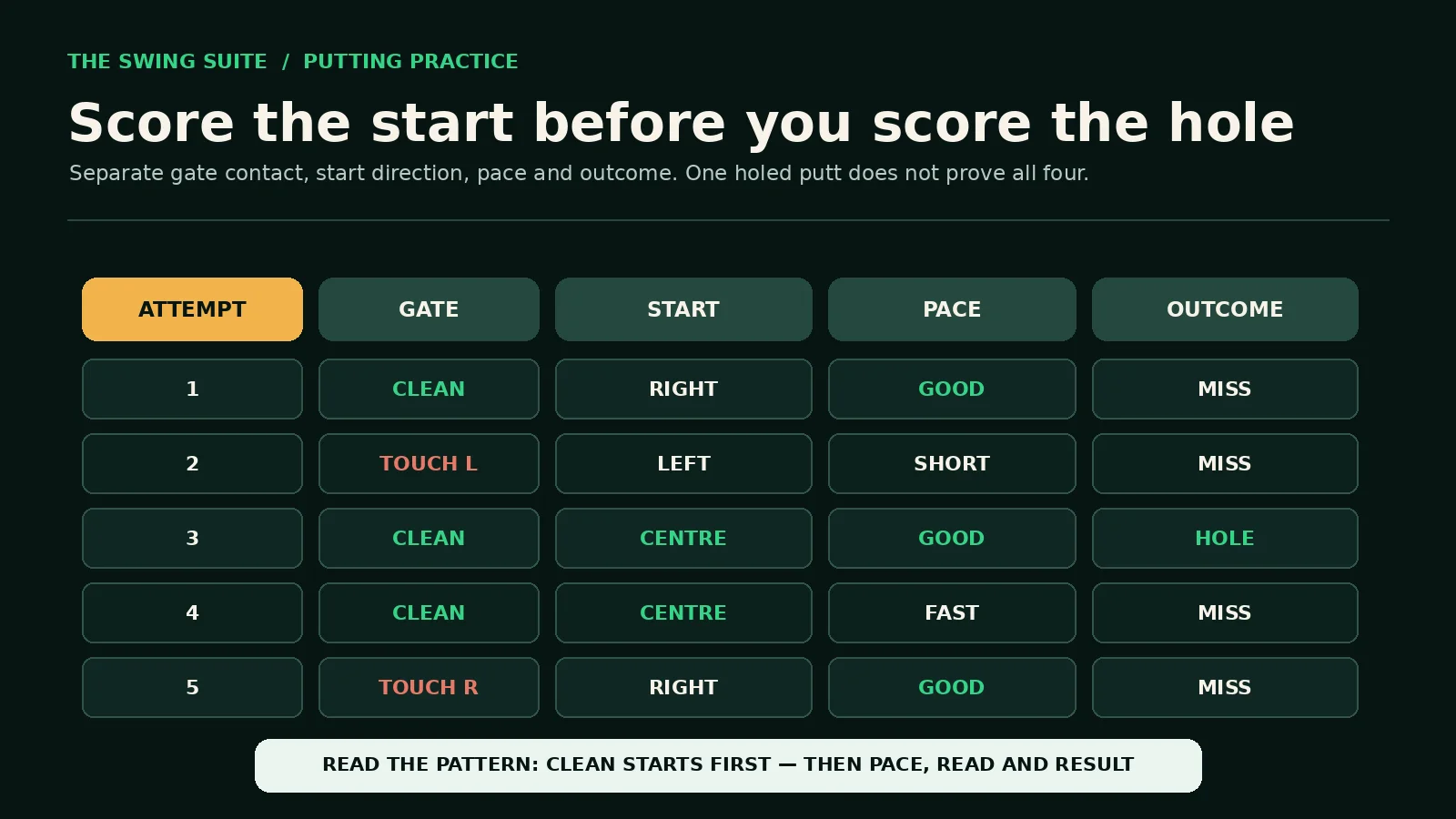
Create five columns: attempt number, gate result, start note, pace note and outcome. The gate result can be clean, left contact or right contact. The start note can be left, centre or right if you can observe it reliably. Pace can be short, useful or fast relative to the chosen finish window. Outcome can be holed, missed left, missed right, short or long.
Numbering matters because sequence can reveal reactions. A left touch may lead to an overcorrection and a right touch. Three clean starts may be followed by rushed strokes as confidence rises. A final table that counts only totals hides those transitions. Keep the notes brief enough that you can preserve your routine between attempts.
Define exclusions before the set. If a leaf moves the ball, another player interrupts the stroke or the marker is knocked out of place before impact, record the attempt as excluded with a reason. Do not replace every poor roll. A valid miss belongs in the pattern; an invalid trial should be transparent.
Use the same scorecard for the matched retest. If you change the category names midway, comparison becomes subjective. You can add a note, but keep the core fields stable. The scorecard is valuable because it makes an ordinary set reviewable after the emotion of the last putt has faded.
Read the pattern before changing technique
Repeated contact on the left gate
First confirm the gate is aligned to the intended line and the ball has not crept across the start position. If the apparatus is sound, repeated left contact shows a directional bias in this task. It does not prove one body or putter fault. Check aim, face orientation, strike and delivery with one simple intervention or measured support.
Choose a change that has a clear job. You might use a more visible start target, recalibrate the putter face, rehearse the intended roll from behind the ball or simplify the routine. Keep the gate width stable and retest. If the pattern moves to alternating sides, the intervention may have introduced steering rather than control.
Repeated contact on the right gate
Use the same order: verify the set-up, describe the bias, then test one change. Do not automatically apply the mirror image of a tip used for left misses. The cause may differ even when the gate result appears opposite. A measured lesson can separate aim, face and path rather than relying on symmetry.
Alternating left and right contact
A two-sided pattern suggests variability or active correction. The golfer may be reacting to the previous putt, changing pace, aiming differently or losing the normal routine. Widen the gate, return to one clear target and hit a small set without technical rescue. The first priority is often reducing oscillation rather than choosing a side.
Watch sequence. If every left touch is followed by a right touch, the feedback itself may be driving the correction. Review after groups of three rather than after every attempt. If the alternation remains, use coaching or measured data to investigate the delivery without guessing from gate contact alone.
Clean starts with misses on one side
This is evidence that the gate and outcome are measuring different layers. Reassess the read and pace. The ball may be starting where intended but the intended line may be unsuitable. It may also be passing through a gate that is too wide to distinguish the pattern. Do not narrow automatically until you have checked the chosen line.
Clean starts with mixed short and long finishes
Start direction may be stable while pace is not. Move to a distance-control task or add a finish window beyond the hole. Keep a few gate checks so direction remains visible, but do not spend the whole session changing face or path when the earliest variable is speed.
Holed putts with frequent gate contact
Do not treat the hole as proof that the starts were good. Marker contact, deflection, excessive pace or an accommodating edge can produce a holed result. Preserve both facts: the putt was holed and the gate was touched. Your practice decision should follow the repeatable pattern, not the most satisfying outcome.
Change one variable for the practice block
After the baseline, write one priority in plain language. Examples include “reduce left-gate contact while keeping useful pace”, “preserve clean starts when the target changes” or “stop alternating corrections after a miss”. A useful priority names the pattern and the condition. “Fix my putting” is too broad to retest.
Choose one intervention. It may be a clearer visual start point, a face-alignment check, a consistent ball reference, a quieter review interval or a routine that separates read from execution. Avoid stacking grip, stance, backswing, head and tempo thoughts into one block. If the result changes, you need to know what was actually tested.
Use six to nine practice putts with the intervention. They are discovery attempts, not the final comparison. Review in small groups, retain useful pace and stop if the task becomes forced. If the change moves the bias in the wrong direction, return to the baseline instead of adding a second correction.
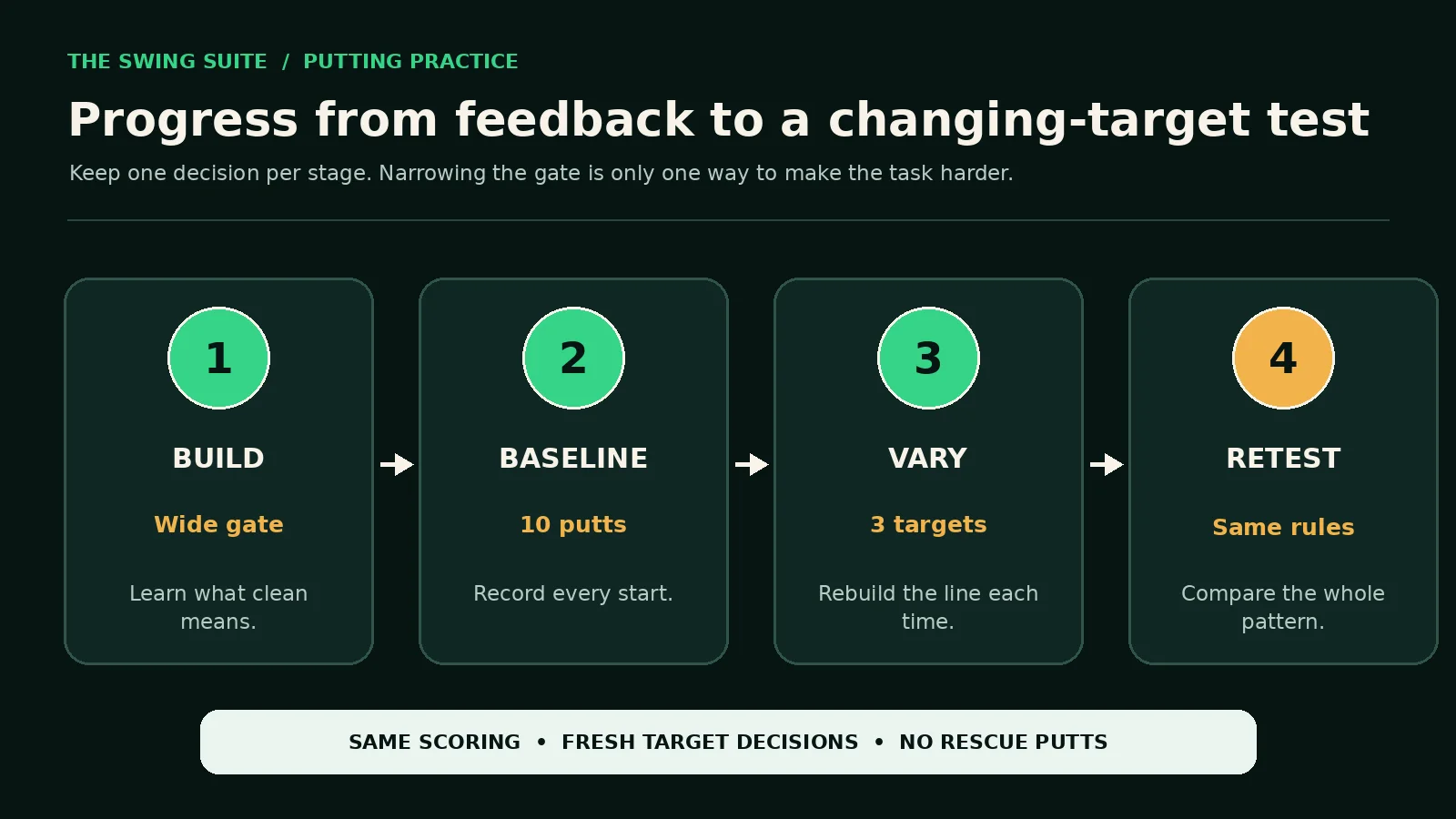
Then remove any temporary guide that was not part of the original baseline and repeat the exact scored set. Keep distance, target, gate width, routine and categories stable. The matched retest is the evidence. The practice block is only preparation for it.
Progress the test with changing targets
Blocked repetition can improve a familiar set-up without proving that you can choose a fresh line. Once clean starts become reasonably stable, rotate among two or three nearby short putts. Rebuild the intended line for each target, use one ball and complete the routine. The gate becomes part of the decision rather than a permanent rail.
TrackMan’s Performance Putting Evaluator is built around changing putt locations and records several measured performance categories. A simple practice-green version should borrow the decision quality, not pretend to reproduce the technology. Change the target, preserve the scoring and label your data as a small practice sample.
Use a fixed sequence at first: target A, B, C, then repeat. Later randomise the order. Keep distances similar enough that start direction remains the main focus. If one target has much more break or speed, record it separately rather than averaging unlike tasks into one score.
Rebuild or re-aim the gate carefully for each putt. This can be slow, which is useful if it protects a deliberate read, but it should not become an engineering exercise. A portable putting gate or flat marker pair can make the change efficient. On a busy practice green, use a virtual start window or a single intermediate mark if physical gates would obstruct others.
Finish with a no-gate transfer set. Choose three new short putts, identify a start window and roll one ball to each. Predict whether the start was left, centre or right before looking at the result. This tests whether external feedback has improved your awareness rather than becoming a permanent dependency.
See TrackMan’s changing-target Performance Putting Evaluator ↗
A 35-minute short-putt start-direction session
Minutes 0–6: read the surface and warm up
Roll a few unscored putts to understand the immediate speed and break. Use your normal routine and protect the green. Select one short baseline putt whose intended start is clear. Decide the finish pace before placing the gate.
Check the permitted marker type and build a wide, square gate. Roll two calibration balls to confirm that the window represents the intended line. If both seem obviously wrong, rebuild the apparatus rather than beginning with a false target.
Minutes 6–14: baseline set
Roll ten putts with one ball or a small identical set. Step away between attempts. Record clean, left or right gate contact first, then pace and outcome. Make no technical correction during the set. A poor attempt remains useful evidence if the routine and apparatus were valid.
At the end, count the gate pattern and read the sequence. Do not lead with holes made. Identify whether the earliest issue is a directional bias, two-sided variability, changing pace or an unsuitable read. Write one priority and one intervention.
Minutes 14–22: focused practice
Use six to nine putts with the selected intervention. Review after groups of three. Keep the target and gate unchanged. If the task becomes tense, widen the gate and recover a free roll. Precision that destroys pace and rhythm is not progress.
Stop the block once the intervention has produced enough information. More repetition is not automatically better. Reset the ball, remove any temporary cue that was not in the baseline and prepare the matched retest.
Minutes 22–30: matched retest
Repeat the same ten-putt set with the original gate width, distance, target and scorecard. Use normal intent. Compare clean starts, directional contact, pace and outcome. Look for a change across several attempts rather than one dramatic putt.
If the retest improves, retain the priority for a later changing-target session. If it does not, discard or modify the intervention. Do not change the record to protect a favourite tip. The value of the gate is that it lets a change fail clearly and safely.
Minutes 30–35: transfer
Choose three nearby short putts. Use no physical gate if the area is busy or the markers would slow play. Identify a visual start window, roll one ball and predict the start before judging the finish. Record the result in the same start, pace and outcome categories.
Finish with one sentence: what remained stable, what changed and what the next session should test. For example, “Clean starts improved on the straight putt, but the bias returned when the target moved left.” That is a useful next question. “Putting felt better” is not enough detail to guide practice.
How to make the gate harder without making it less useful
Narrowing the window is the obvious progression, but it should not be automatic. First ask whether the current gate still separates successful and unsuccessful starts. If almost every representative putt passes cleanly and the pace remains natural, reduce the width by one clear step and record the new setting. If the narrower version immediately creates steering, tension or constant contact, return to the previous width and use a different challenge.
Distance is another variable. Moving the gate farther from the ball gives the start direction more space to reveal itself, but slope and surface also have more opportunity to influence the roll. Change only the gate distance, keep the putt and width stable, and label the new set. Do not compare a near wide gate with a far narrow gate as though one variable changed.
You can also increase decision demand rather than precision demand. Alternate two start lines, change the target after every ball or require a complete read-and-pace routine before the stroke. These progressions often transfer better than an extremely narrow rail because they ask the golfer to rebuild the intention. Preserve the same clean, left and right categories so the extra decision can be compared with the baseline.
A final progression is delayed feedback. Roll three putts without checking the gate score until the mini-set is complete, then predict each start before reviewing any video or measured data. This reduces ball-by-ball correction and tests awareness. Keep safety and green care first; the task should never require leaving loose markers where another player may stand or roll a ball.
Use the drill indoors without pretending the surface is a green
A mat or carpet can make gate practice convenient, but it is a different surface. Use flat markers that cannot damage the floor, confirm that the ball rolls freely and keep the task focused on start direction. Do not carry an exact pace result from carpet to a practice green. The indoor session can train alignment, routine and centred starts; outdoor practice must recalibrate read and speed.
Choose a visual target beyond the gate rather than staring only at the markers. A strip of tape outside the ball path, a printed start point or the edge of a distant object can preserve the intention to roll through the window. Remove adhesive or guides that could affect the ball, floor or shared space. Record the mat, ball and gate setting if you want a repeatable comparison.
Transfer remains essential. End an indoor session with several ungated putts to different targets on the same surface, then repeat the start-window idea on a real green when possible. If the skill disappears as soon as pace and break return, that is not failure; it shows which layer the controlled environment did not test.
Common short-putt gate mistakes
- Pointing the gate at the hole instead of the chosen start line on a breaking putt.
- Making the first gate so narrow that almost every reasonable roll fails.
- Moving the ball or markers between attempts without recording the change.
- Counting a holed putt as a clean start after it touched or deflected from a marker.
- Ignoring pace because the exercise is labelled as a direction test.
- Changing technique after every ball and creating a left-right correction cycle.
- Using a marker that can damage the surface or obstruct another golfer.
- Combining unlike distances and breaks into one score without labels.
- Narrowing the gate before a stable baseline exists.
- Keeping the gate forever instead of testing a changing target and no-gate transfer.
The correction is to make the task honest. Choose the line and pace, build a fair window, record the start separately from the result, change one variable and repeat the same test. Difficulty is useful only when the feedback remains interpretable.
Troubleshoot the test
Every putt touches a marker
Widen the gate and verify its alignment. Move it slightly farther from the ball if the near geometry is exaggerating tiny set-up changes. Roll two unscored calibration putts. If the ball still starts unpredictably, simplify the distance or use measured coaching rather than making the apparatus harder.
The gate score improves but the stroke feels steered
The golfer may be guiding the ball through the markers instead of rolling to the target. Widen the gate, restore a normal pace picture and look beyond the apparatus. Use the gate as a checkpoint in the first part of the roll, not as the destination.
The ball passes cleanly but misses low on breaking putts
Review read and speed. The chosen start line may be too low for the intended pace, or the ball may be travelling faster than the read assumed. Keep start and pace notes separate. Rebuild the intended line only after you have stated the pace you are trying to create.
The ball alternates between markers
Stop reacting after every putt. Use a wider gate and roll a three-ball mini-set with one clear intention. Review only after the group. If alternation remains, check aim, face and strike with measured feedback or a coach instead of cycling through opposite tips.
Practice results disappear without the gate
Reduce dependency gradually. Use three gated putts followed by one ungated putt to the same start window. Predict the ungated start before judging the finish. Then change target. External feedback should calibrate awareness, not replace it.
Connect start direction to distance control
The previous Swing Suite pace-ladder guide focuses on long-putt distance control. The same separation is useful here: line and pace cooperate, but they can be trained with different primary feedback. In this short-putt test, the gate makes the start visible while the finish note prevents speed from disappearing.
A golfer who starts the ball well but leaves every putt short needs a pace task, not a narrower gate. A golfer who controls the finish window but clips one side repeatedly may need start-direction work. A golfer who changes both from ball to ball should simplify the decision and establish a baseline before choosing either priority.
Read Improve Long-Putt Distance Control With a Simple Pace Ladder ↗
Questions golfers often ask
How wide should the putting gate be?
Wide enough to create some clean starts with a representative stroke. There is no single correct width for every golfer, marker distance or surface. Begin generous, record a baseline and narrow only when the current window no longer distinguishes the pattern. Write down the width or marker reference so the retest is fair.
How far should the gate be from the ball?
Use a repeatable position close enough to reflect the early start and far enough to avoid crowding the stroke. The exact distance depends on the tool. TrackMan’s measured launch-direction definition uses one foot, but a physical practice gate is a different system. Do not claim equivalence; choose a safe, stable distance and label it.
Should I use the hole as the target?
Use the hole as the final target, but build the gate around the intended start line. On a straight putt those may align. On a breaking putt they will not. Decide the pace as well, because a different intended speed can change the appropriate line.
Does touching the left gate mean the face was closed?
Not by itself. The gate shows the ball crossed that marker. Face orientation can influence start direction, but aim, path, strike, set-up, gate alignment and surface can also matter. Confirm the pattern and use measured data or coaching before assigning one cause.
How many putts make a useful baseline?
Ten is a practical small set for this exercise, not a scientific threshold. Six may suit a short session; more may suit an experienced player who can maintain attention. Stop when fatigue, turf wear, frustration or repetition makes the stroke unrepresentative.
Should I practise until I hole every putt?
No. The purpose is to improve the start pattern while retaining useful pace and decision quality. A perfect streak can encourage repeated use of one familiar line without transfer. Finish with changing targets and no-gate predictions rather than chasing an arbitrary run.
A simple gate test to use this week
- Choose a safe short putt and state the intended line and finish pace.
- Build a generous, square gate around that start line.
- Roll ten representative putts with a normal routine.
- Record clean, left or right gate contact before pace and outcome.
- Check the sequence for one-sided bias or left-right correction.
- Choose one priority and one intervention.
- Run a matched retest with the same distance, gate and scoring.
- Finish with three changing targets and no-gate start predictions.
Keep the first version plain. The gate should answer one question: can you start a representative short putt through the intended window? The scorecard then protects the rest of the putt from being forgotten. Read and pace still matter, and a hole is still satisfying, but neither should overwrite the start evidence.
Reliable short putting is not built by forcing every ball through the narrowest possible gap. It is built by choosing a clear line, rolling with useful pace, seeing the directional pattern and carrying that skill to a fresh target. Build a fair gate, record the start and let the matched retest decide whether the change helped.
Build a clearer putting pattern with measured coaching
If your gate pattern mixes left and right contact, clean starts with unsuitable pace or different results when the target changes, measured coaching can separate aim, face orientation, path, strike, launch direction and speed. A Swing Suite lesson can turn the pattern into one practical priority. Current options, venues and availability remain on the live booking page rather than being hard-coded here.