
Long-putt distance control improves when you practise changing the destination of the ball rather than trying to repeat one perfect stroke. Build a simple pace ladder with a near, middle and far finish zone. Roll one ball to each destination, climb the ladder, come back down, then randomise the order. Judge where the ball finishes relative to the chosen zone, not only whether it happens to go in.
The practical aim is to arrive at every long putt with a clearer picture of the required roll. Read the broad slope, choose a start line that matches that pace, make one distance-relevant rehearsal and send the ball towards a defined finish area. Afterward, use the actual finish as feedback. A ball that stops short, races past or misses on the low side is information for the next decision; it is not a verdict on your putting identity.
This guide gives you a repeatable ladder, a finish-zone scoring method and a 35-minute practice session. All distances, times, scores and zone sizes are illustrative. Adapt them to the space, speed, slope, weather and safety of the green in front of you. Do not create a drill that interferes with other players or damages the practice surface.
The direct answer: calibrate three paces, then randomise them
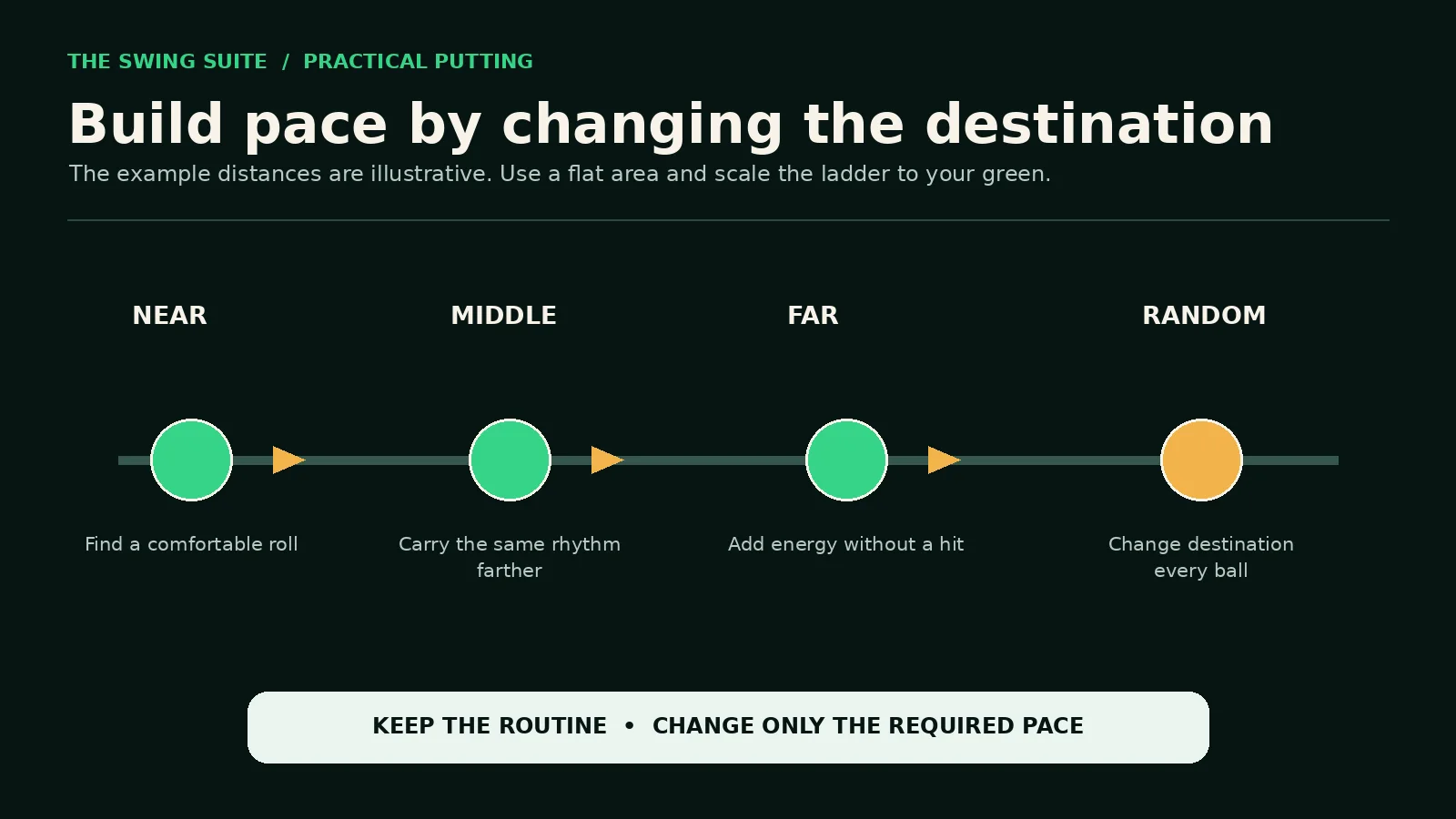
Choose a reasonably straight part of the practice green. Mark three destinations that feel meaningfully different: near, middle and far. They do not need to be fixed universal distances. For one golfer they might be roughly six, nine and twelve metres; for another the available space may make them shorter or longer. The purpose is to create three distinct rolls while keeping the set-up, attention and rhythm recognisable.
Start at the near destination and roll one ball. Move to the middle destination with the next ball, then the far destination with the third. Come back down: far, middle, near. That is one pace ladder. Avoid hitting a pile of balls from one distance before moving on. The changing destination is the useful difficulty because it requires a new read, a new energy decision and a fresh commitment each time.
Once the ladder feels organised, call the destinations in a random order. Use one ball if possible. Complete the full routine, record the finish, retrieve the ball and begin again. The session should gradually look less like blocked repetition and more like golf: one opportunity, changing information and a consequence you can observe without pretending every putt should be holed.
Keep the first score modest. The purpose of the opening session is to establish a baseline you can understand, not to pass a test. Note which destination produces the largest error, whether misses cluster short or long, and whether the descent differs from the climb. Those observations give the next session a specific job. They also prevent a single holed putt from disguising a pace pattern that remains unreliable.
Why long putting is a pace problem before it is a make problem
From long range, the hole is a very small final target compared with the area in which a useful first putt can finish. That does not make direction irrelevant. It changes the priority of the task. The ball still needs a chosen start line, but the quality of that line depends on the intended pace because a faster and slower ball can take different routes across the same slope.
TrackMan’s putting principles describe performance from longer distances as strongly influenced by distance control and green reading. The useful coaching implication is not that you should ignore the putter face or start direction. It is that a technically tidy start cannot rescue a completely unsuitable pace, while a sensible pace gives the chosen line a chance to work and leaves a more manageable next task.
Treat holing as one possible outcome rather than the only score. A long putt can miss the cup and still show an excellent decision. It can also drop after being hit too firmly, taking a fortunate line or striking the back of the hole. If you reward only makes, the occasional lucky result can teach the wrong lesson. Finish-zone scoring keeps attention on the repeatable part of the task.
Read TrackMan’s putting principles for line and pace ↗
Define a useful finish zone before every putt
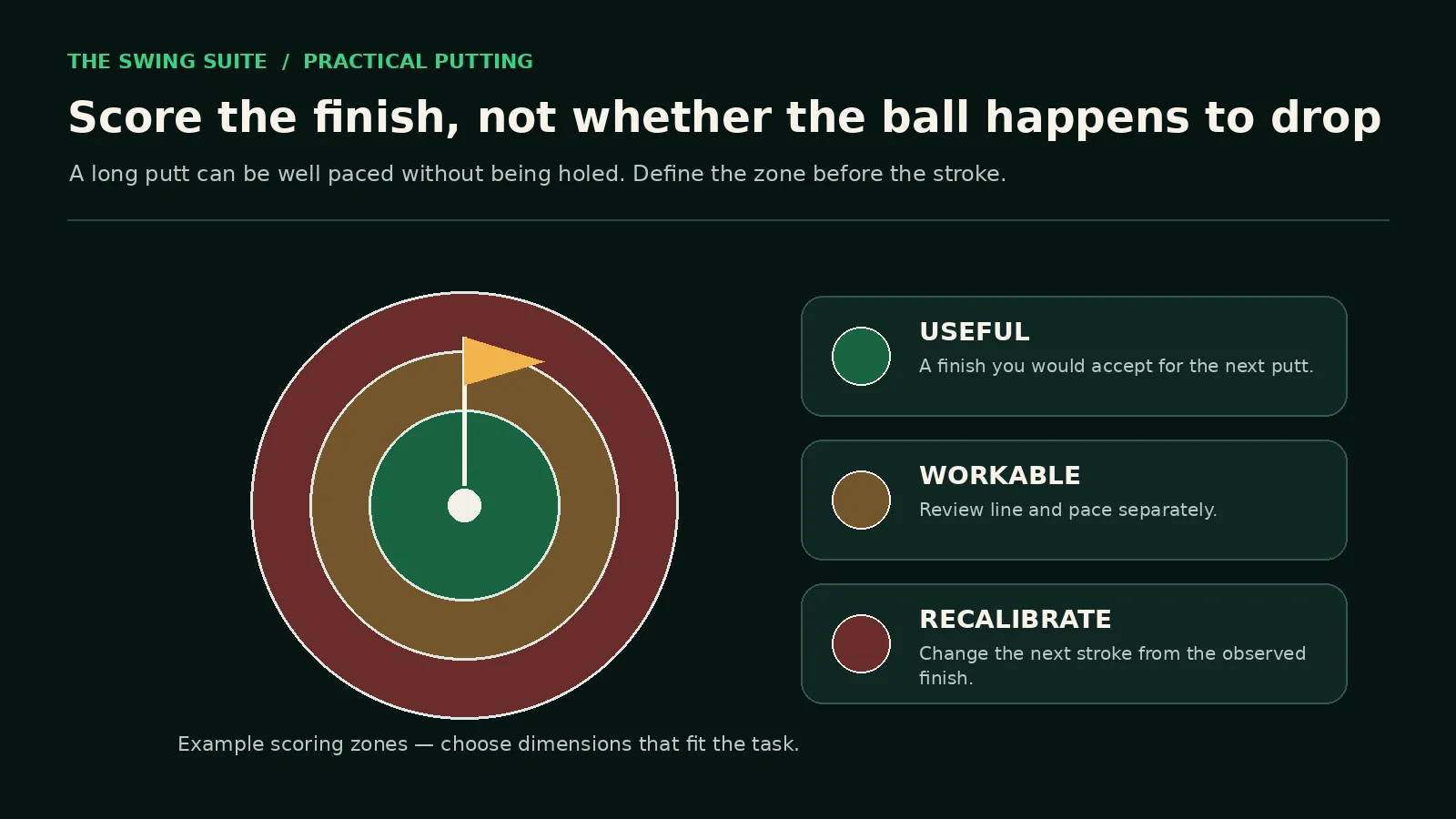
A finish zone is an area in which you would accept the ball stopping for the next putt. It may be roughly circular on a straight putt, but it does not have to be. On a steep downhill putt, the useful area may be wider and shorter beyond the hole because racing past creates a difficult return. On an uphill putt, you may accept a slightly firmer finish because the slope is helping to slow the ball.
Choose the zone before you stroke the putt. If you draw it only after seeing the result, the score becomes negotiable. Use flat markers placed safely away from the line, a chalk-free visual reference, or features already on the green. Do not place objects where they can deflect another player’s ball. The zone should be visible enough to guide the task without becoming a second obstacle.
Use three simple outcomes. Green means the ball finished inside the useful area. Amber means the pace was workable but the finish deserves review. Red means the next putt would be substantially harder or the ball failed to reach the intended section. The colours are only a training language. The dimensions should change with the putt rather than pretending one ring is correct for every distance and slope.
Separate start, roll and finish in your feedback
After each putt, record three facts in order. First, where did the ball start relative to your chosen line? Second, what did the ball do through the main slope? Third, where did it finish relative to the zone? This prevents one visible miss from becoming a vague judgement such as “bad stroke” or “poor read”.
A ball can start on the chosen line, roll with the intended pace and still miss because the read was wrong. It can start offline but finish close because the pace reduced the error. It can start and read well but finish far beyond the target because too much energy was delivered. Those are different problems. A useful practice session identifies which layer needs the next adjustment.
Keep the description factual. “Started left of my line and finished long” is more useful than “pulled it terribly”. “Started as intended, turned less than expected and finished pin-high” points towards the read. The language does not need specialist technology. It needs enough precision that the next putt has one clear change rather than a complete rebuild.
Build the ladder on the simplest surface available
Begin on a section with modest slope and a clean run. The aim of the first ladder is to calibrate energy, not to solve the most dramatic putt on the green. A severe slope can hide whether the problem came from the stroke, the read or the speed of the surface. Once you can change destinations on the simple section, add slope deliberately.
Look for safe spacing. The line should not cross a busy route between holes. Leave enough room beyond the far destination for an over-hit ball. If the practice green is crowded, shorten the ladder, use a quiet edge or practise to a non-hole destination. The drill remains valid when the target is a towel edge, a flat marker or an imagined line, provided it creates a clear finish task.
Use one consistent starting point for the first calibration. That makes the destination the main changing variable. Later, move the start point as well. Changing everything at once can create variety without learning. Good progression changes one demand, observes the response and then adds another demand only when the first remains understandable.
Choose destinations that are different enough to require a new decision
If the near and middle destinations feel almost identical, the ladder becomes disguised repetition. If the far destination requires a desperate hit, the ladder may teach a movement that does not resemble your normal putting. Choose gaps that make you alter the size or energy of the stroke while preserving balance, contact and a clear roll.
The exact spacing should reflect the green and your current skill. A beginner may benefit from closer destinations that create success and clear contrast. A more experienced golfer may extend the range or use a smaller finish zone. Progress is not proved by choosing the longest possible putt. It is proved by making better pace decisions across destinations that matter to your golf.
Name the destination in a way that directs the roll: front edge of the zone, centre of the zone, or through a particular speed window. Avoid vague commands such as “hit this one harder”. Harder describes effort but not the intended ball behaviour. “Roll this to finish in the far zone” gives the stroke a destination and lets the finish answer whether the energy was suitable.
Use a rehearsal that carries distance information
A practice stroke should help you organise the required roll. It might connect your eyes with the destination, establish rhythm or let you sense a longer or shorter motion. It should not become a search for one mechanically perfect backswing length. The same visible length can produce different ball speeds when rhythm, strike or tension changes.
Stand where the rehearsal is safe and relevant. Look at the destination, make one or two movements with a clear purpose, then step in. If each rehearsal becomes progressively larger because you are waiting for certainty, stop and reset the decision. The goal is enough information to commit, not a feeling that guarantees the outcome.
Compare rehearsal and result over several putts. If the ball repeatedly finishes short after a rehearsal that feels appropriate, your internal picture may need recalibration. Adjust the destination picture or energy cue before adding technical instructions. If contact is inconsistent, move temporarily to a shorter, simpler task and restore centred contact before returning to the ladder.
Keep rhythm recognisable while the stroke size changes
Distance changes require a change in delivered energy. Golfers often create that change by altering the length of the motion, the speed of the motion or both. There is no need to force one universal formula. The practical test is whether the ball starts predictably, rolls cleanly and finishes near the intended area without a sudden hit or deceleration.
Use a recognisable rhythm as an anchor. The far putt may have a longer motion, but it should not feel like a different sport. The near putt may be shorter, but it should not be jabbed because the hole is close. If the ladder reveals a dramatic change in tempo at one destination, reduce the gap and build a smoother transition before extending it again.
Avoid trying to hold the putter back through impact to control a fast downhill roll. Choose a smaller, committed motion that still moves through the ball. On an uphill putt, avoid replacing commitment with a last-second shove. Read the slope, choose the finish, rehearse the required energy and let the planned motion deliver it.
Understand that slope changes the effective pace of the green
A green does not have one experienced speed in every direction. TrackMan’s Effective Stimp parameter is designed to describe how the effective pace changes with slope and roll direction. You do not need a measured number to use the principle. The same physical stroke can send the ball a different distance uphill, downhill and across a slope.
Build that awareness into the ladder. First complete the destinations on a relatively level line. Then repeat a shorter version uphill and downhill. Do not compare the stroke sizes as if they should match. Compare whether each ball finishes in the chosen zone. The destination stays meaningful while the movement adapts to the effective pace.
On side slopes, pace also influences break. A slower ball spends more time being affected by gravity; a faster ball may hold a straighter route but finish farther away if it misses. Therefore choose line and pace together. Do not read a line, then separately decide how hard to hit it as if the two choices were independent.
See TrackMan’s definition of Effective Stimp ↗
Climb the ladder, descend it, then break the pattern
Climb: near to far
The climb introduces increasing energy in an orderly sequence. Use one ball at the near destination, one at the middle and one at the far. Complete the routine each time. Notice how your rehearsal and destination picture change. Do not leave the previous ball beside the zone if it becomes a convenient backstop or visual aim point; retrieve it or move it safely aside.
The climb is not complete because the balls form a neat line. It is complete when you can describe the intended finish and observe whether the changing pace produced it. If all three finish short, recalibrate the general energy picture. If only the far ball is short, the transition to the longest task needs attention.
Descend: far to near
Coming back down is often more revealing. After producing the largest roll, you must reduce energy without becoming tentative. Use far, middle and near in that order. Watch for a common pattern: the middle putt remains too strong because the previous motion is still influencing the decision, then the near putt is steered because you fear repeating the long finish.
Reset fully between balls. Step away, look at the new destination and make a new rehearsal. The descent teaches subtraction: the ability to reduce the required roll while retaining commitment. If you merely remember the previous stroke and try to take a little off, your attention remains anchored to the wrong destination.
Randomise: remove the predictable order
Ask a partner to call near, middle or far, use shuffled cards, or choose from a simple random list prepared before the session. One destination per ball. The random phase prevents you from solving the ladder as a sequence. It asks whether you can produce a fresh pace decision without the previous result telling you what comes next.
Keep the random set small enough to review. Nine or twelve putts may be enough for one round. Record the selected destination and finish-zone colour. A bigger sample can be useful, but endless repetition can lower attention and hide fatigue. Stop while each putt still receives a genuine decision.
Add slope only after the flat ladder is understandable
Once the basic ladder produces useful feedback, rotate it onto an uphill line. Shorten the destinations if space requires. Keep the same near-middle-far structure and observe how the uphill roll changes the rehearsal. Then use a downhill line with generous safety beyond the target and a larger initial finish zone.
Treat uphill and downhill as separate calibrations, not tests of the same stroke. The downhill version may require smaller movements and more conservative finish areas. The uphill version may need a stronger commitment to the destination. If the slope is severe enough that a missed ball could leave the practice area or interfere with others, choose a safer section.
For a side slope, use two destinations rather than three at first. Define both the starting window and the finish zone. Change one variable at a time: keep the start point fixed and alter distance, or keep distance fixed and alter slope. This lets you see whether the pace choice or the read is producing the largest error.
Use TrackMan data to support the task, not replace it
When measured putting data is available, parameters such as ball speed, launch direction, roll speed and estimated green pace can help separate delivery from outcome. TrackMan defines ball speed as the speed shortly after impact and provides putting-specific parameters for how the ball launches and rolls. Those measurements can make an observation more precise, but the practice task still needs a destination and a decision.
For example, repeated long finishes may come from higher launch speed than intended, from a faster effective section of green, from a different strike or from a read that sent the ball onto a steeper route. Use the data with the visible roll. Do not chase one number without understanding the putt. A parameter is useful when it changes the next practice choice.
The TrackMan Performance Putting Evaluator uses multiple putts across changing distances rather than judging one repeated station. That supports the structure of a ladder and random phase: vary the task, keep the feedback clear and compare decisions across a range. Your home session does not need to copy the evaluator’s exact distances or scoring to use the same principle of representative variation.
Review TrackMan putting data parameter definitions ↗
Read about the TrackMan Performance Putting Evaluator ↗
Score a session without turning it into a punishment
Use a simple record with destination, start, finish and zone. Give yourself one point for a green finish, a half point for amber and zero for red if that helps attention. The exact scale is illustrative. Define it before the session and keep it stable for that session. Do not change the boundaries after a good or bad result.
Also record whether the putt started on the chosen line. A green finish with a poor start may reveal that pace rescued direction. A red finish with a good start may show that energy was the main issue. Over several sessions, the combination tells you more than a single total score. The aim is to choose the next practice priority, not to create a flattering number.
Review in groups rather than after every emotional miss. Complete one ladder, then look for the pattern. Were the far putts consistently short? Did downhill putts finish long? Did random putts perform worse than predictable ones? A group of results can support a decision; one ball should rarely trigger a full technical change.
A 35-minute pace-ladder session
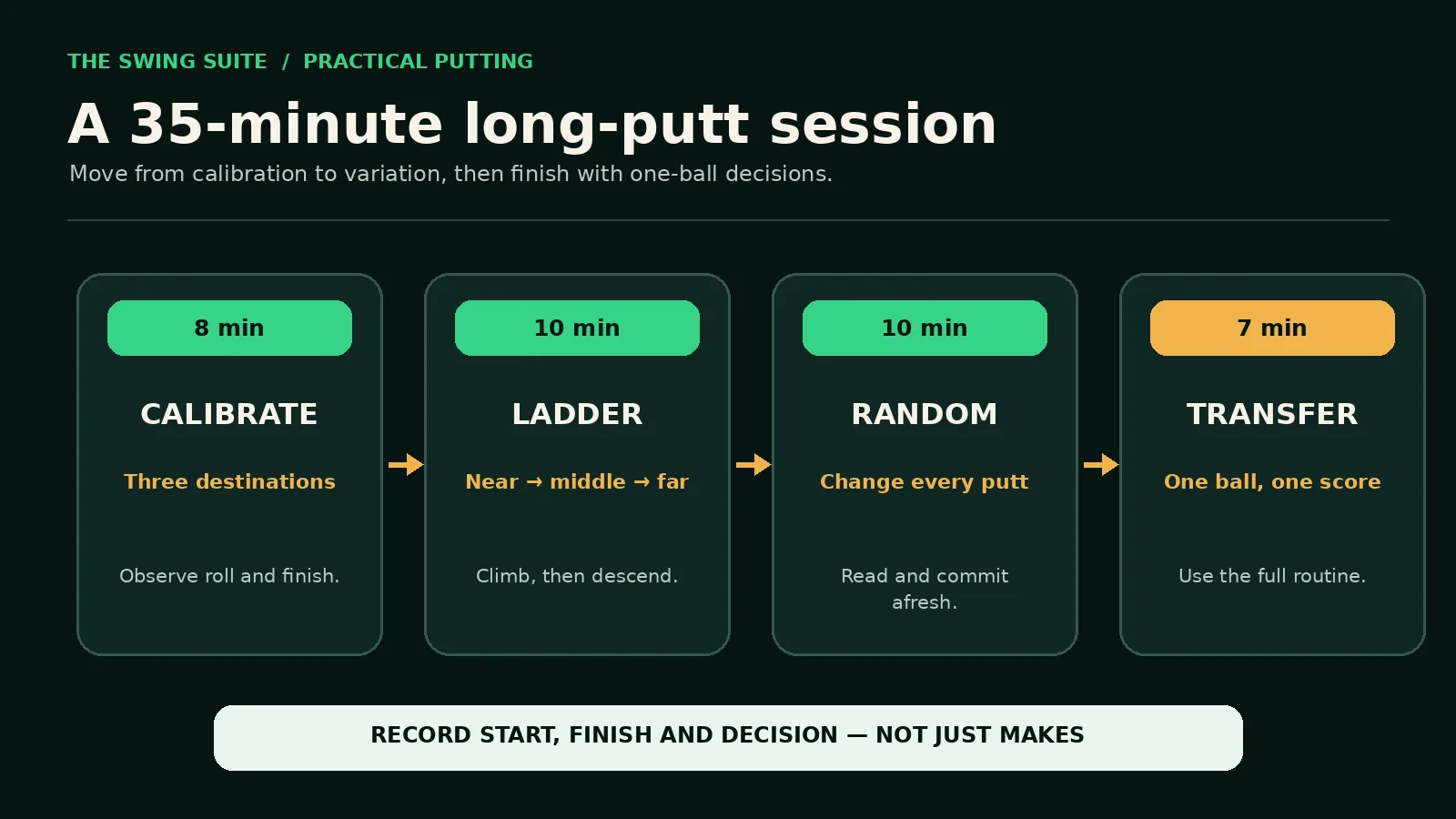
Minutes 0–8: calibrate three destinations
Choose the line and define near, middle and far. Roll two balls to each destination, but alternate them rather than hitting both from one station. Use the first six putts to understand the surface. Record only the finish-zone colour and one factual note. Do not attempt to fix every miss during calibration.
At the end of eight minutes, choose one adjustment. It might be a clearer visual destination, a smoother transition to the far putt or a smaller downhill motion. Keep that adjustment for the next phase. If contact is too inconsistent to judge pace, shorten the distances and restore a solid roll before continuing.
Minutes 8–18: climb and descend
Complete two full ladders: near-middle-far and far-middle-near. Use one ball and the full routine. Score both start and finish. The order is predictable, so demand a clean reset between destinations. Do not stand over the next ball while still analysing the previous one.
After each six-putt set, compare climb and descent. If the descent is weaker, work on reducing energy without steering. If the climb is weaker, make the far destination more vivid or reduce the distance gap. Keep the correction connected to the observed pattern.
Minutes 18–28: random destinations
Use nine random calls. Include at least two of each destination. Retrieve the ball after every putt so the surface remains uncluttered. Use the same score and finish zones. The purpose is to test whether calibration survives a changing task, not to manufacture pressure with an unrealistic punishment.
If a putt finishes red, the next destination still comes from the random order. Do not repeat the miss immediately. Delayed repetition is useful because golf rarely gives you the same putt again. You must retain the lesson, clear the emotion and apply the appropriate pace to a different task.
Minutes 28–35: one-ball transfer
Finish with a small course-like sequence. Choose one long uphill putt, one long downhill putt and one side-slope putt. Use one ball, a complete read and the routine you intend to use on the course. Score the quality of the decision and the finish, then move on.
End by writing one sentence: “Next session I will practise…” Choose the earliest repeated failure. If the ball started well but finished long, work on pace calibration. If pace looked suitable but the ball repeatedly missed on one side, inspect start line and read. If the random phase collapsed, practise changing destinations rather than adding another mechanical thought.
Practise a pace decision, not a backswing ruler
Some golfers try to assign an exact backswing length to every distance. A reference can help, especially in measured coaching, but the course changes too much for one ruler to solve every putt. Slope, effective green pace, wind, grain, moisture and strike can alter the outcome. Use stroke size as one part of calibration, not as a promise.
A better question is: what motion produces the intended roll here? The ladder gives repeated opportunities to answer it. You may notice that a longer destination uses a larger motion with similar rhythm, or that a downhill destination uses a smaller motion while the attention stays on the same finish zone. Those are practical relationships, not fixed laws.
If a ruler helps you organise practice, keep the measurement honest. Mark the start and destination, record conditions and compare several putts. Do not turn one successful ball into a universal conversion table. Re-test when the surface or slope changes and retain enough flexibility to respond to the actual green.
Common long-putt practice mistakes
- Rolling a large pile from one distance and mistaking familiarity for adaptable pace control.
- Scoring only makes, which rewards lucky outcomes and hides useful misses.
- Choosing a finish zone after seeing where the ball stopped.
- Changing line, pace, mechanics and equipment after one poor result.
- Using destinations so close together that the ladder requires no fresh decision.
- Choosing a far station that forces a hit rather than a recognisable putting motion.
- Ignoring slope and assuming the green has one effective speed in every direction.
- Leaving practice balls around the target so they become backstops or visual crutches.
- Practising across a busy route or without enough space beyond the far destination.
- Ending the session with blocked repetition instead of one-ball transfer.
The correction is usually to simplify the task and improve the feedback. Use fewer balls, clearer destinations and one observation per putt. Keep the routine stable. Change the pace requirement. Let the finish decide what the next adjustment should be.
Troubleshoot the pattern you actually see
Everything finishes short
Check whether the destination is vivid enough and whether the rehearsal reflects the full journey. Look at the finish zone during preparation rather than staring only at the ball. If contact is centred and the roll is clean, increase the intended energy through a slightly larger or freer motion. Avoid solving short finishes with a sudden strike at impact.
Everything finishes long
Make the acceptable finish explicit before you putt. On a fast or downhill line, enlarge the safety area and shorten the ladder. Use a smaller committed motion rather than decelerating. If balls still finish long from every destination, recalibrate the effective speed of that section before continuing the score.
Near is good, far becomes a hit
Reduce the gap between middle and far. Build an intermediate destination until the movement changes gradually. Keep the rhythm recognisable and allow the motion to become larger without a last-second burst. Return to the original far station only when the transition remains balanced.
Far is good, near becomes steered
The golfer may be carrying the previous large motion into the near decision and then trying to prevent it through impact. Step away, make a new destination-relevant rehearsal and trust the smaller motion. Descending ladders are particularly useful for this pattern because they practise reduction without fear.
Random performance drops sharply
That is useful information. Blocked or ordered practice may be doing more work than the routine. Keep the random phase but reduce it to two destinations until each decision is clear. Restore the third destination when the golfer can reset and recalibrate without relying on sequence.
Take the ladder onto the course
On the course, you cannot place three stations around every hole. Transfer the decision process instead. Read the broad slope, identify a useful finish area, choose the start line that matches the pace, rehearse the roll and commit. The ladder has trained the ability to change destination; the course supplies the destination.
Use the first few greens to observe effective pace rather than declaring the whole course slow or fast after one putt. Compare uphill and downhill rolls, shaded and exposed areas, and the way the ball slows near the hole. Keep observations factual and update the next decision. Conditions can change during a round.
After a long first putt, treat the finish as feedback for the next similar task, not as a reason to overhaul the stroke immediately. If several putts show the same pattern, note it for practice. The course is for decisions and execution; the practice green is where you can isolate and test the cause.
Connect the ladder to a reliable putting routine
Use the same order on every ladder ball: read, choose, rehearse, commit and reset. Decide the pace and start line outside the ball. Once you step in, avoid reopening the full discussion. If the destination picture disappears, step away and rebuild it rather than making a half-decided stroke.
The existing Swing Suite pre-shot routine guide explains how to separate decision space from execution space. For long putting, that separation is especially useful. The read and finish zone belong in the decision space. Over the ball, the task becomes starting the ball with the chosen roll, not conducting another tour of every possible break.
Build a reliable pre-shot routine for better golf decisions ↗
Questions golfers often ask
Should I always practise to a hole?
No. A hole gives a clear reference, but a flat marker or imagined finish line can focus attention on pace without making the session about makes. Use a hole when it is available and safe, but keep the finish zone visible in your mind. The target is the roll and finish, not only the cup.
How many balls should I use?
One ball creates the most course-like decision. Two or three can help early calibration, provided each has a new destination and the previous balls do not become backstops. Avoid emptying a large basket from one spot. Retrieval time also creates a useful pause and reset.
What is the correct leave past the hole?
There is no single public number that fits every long putt. The useful finish depends on slope, speed, next-putt difficulty and the risk beyond the hole. Define an acceptable area for the actual task. On dangerous downhill putts, stopping close but short may be a far better outcome than racing beyond.
Should I look at the hole during the stroke?
Some golfers experiment with target-focused putting, but it is not required for this ladder. Use the visual routine that lets you start the ball and control the roll safely. If changing where you look, test it in practice rather than introducing it during an important round. Keep only changes that improve the observed pattern.
How often should I repeat the ladder?
Repeat it often enough to compare patterns but not so mechanically that attention disappears. A short pace ladder can fit into a weekly practice session or pre-round warm-up. Adjust the destinations to the day’s surface. The value comes from fresh calibration, not preserving yesterday’s exact stroke size.
A simple pace ladder to use this week
- Choose a safe, modestly sloped line with room beyond the far destination.
- Define near, middle and far finish zones before the first putt.
- Roll one ball near → middle → far, then far → middle → near.
- Record start line, finish and zone colour with factual language.
- Randomise nine destinations and reset fully between every ball.
- Finish with one uphill, one downhill and one side-slope decision.
- Write one next-session priority based on the earliest repeated failure.
Keep the first version simple. If you cannot explain the destination and score before you stroke the ball, the drill is too complicated. The ladder should sharpen the decision, not decorate it. Use clear zones, changing distances and one ball that must be accepted wherever it finishes.
Long-putt distance control is not built by finding one magical stroke and preserving it forever. It is built by repeatedly matching a familiar process to a changing roll. Calibrate the surface, choose a useful finish, adapt the energy, observe the result and begin again. Pace over perfection is not a lower standard; it is a more practical definition of what the first putt must achieve.
Build your pace control with measured coaching
If your long-putt pattern mixes start-line, strike, read and pace problems, measured coaching can help separate them. A Swing Suite lesson can connect the visible roll with putting data and a practice task suited to your current pattern. Current lesson options and availability remain on the live booking page rather than being hard-coded here.