

A reliable pre-shot routine is a short decision process that helps you choose the shot, prepare for it, commit to it and then reset. It is not a promise that every swing will be good, and it is not a performance that must look identical for every club. The useful part is the order: read the situation, choose a clear target and shot, make one relevant rehearsal, step in with commitment, then accept the result and move on.
The routine should make golf simpler at the moment when your attention can easily become scattered. Before you stand over the ball, decide what matters. Once you step in, stop reopening the whole technical discussion. Use one final external intention, such as the start line or shape you have chosen, and let the swing happen. If doubt returns strongly enough that you cannot commit, step away and restart rather than making a half-decided swing.
This guide shows how to build that sequence, test it in practice and adapt it for the course without becoming slow or rigid. Any scores, shot counts, times or examples are illustrative. Your routine should fit your mobility, skill, playing environment and pace-of-play responsibilities. It should support a decision; it should never become an excuse to delay the group.
The direct answer: decide first, then execute
Separate the shot into two spaces. The first is the decision space, usually behind or beside the ball. Here you gather information, choose the target, select the club, picture the shot and make a rehearsal if one is useful. The second is the execution space over the ball. Here you aim, settle, look and swing. Mixing those spaces is one of the main reasons a routine becomes anxious: the golfer is still comparing clubs, checking trouble and running through several swing changes while already at address.
A dependable routine therefore has a clear commitment point. It might be the moment you put the club behind the ball, the moment you take your final look at the target or the moment your feet finish settling. The exact marker is personal. Its purpose is to say: the choice has been made; now perform the chosen shot. If you cannot cross that point honestly, step out and decide again.
After the shot, use a brief reset. Notice factual information that may help the next decision — strike, start, curve, carry, lie or wind — but do not conduct a full lesson in the fairway. Accept the outcome, choose any practical lesson, and return your attention to walking, safety and the next shot. The reset prevents one poor result from occupying the decision space of the next ball.
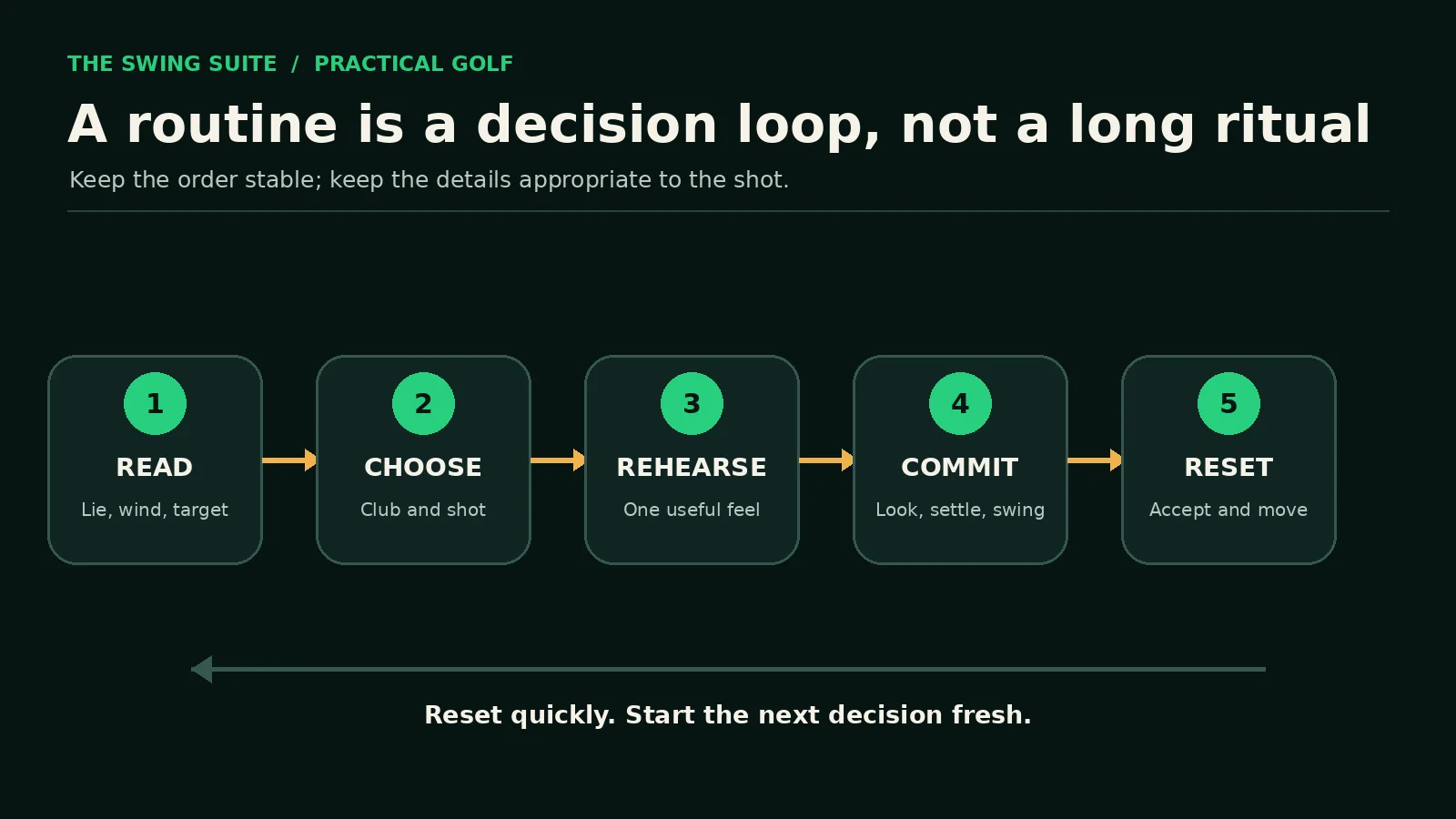
Why a routine is more than “do the same waggle”
Golfers often describe a routine by its visible movements: two practice swings, a look at the target, a waggle and then the shot. Those actions can be useful, but copying the appearance misses the job. The routine exists to organise attention and decisions. A repeated waggle without a chosen target is repetition, not preparation. A perfect-looking rehearsal followed by a doubtful change of club has not created commitment.
Treat visible actions as tools. A rehearsal can remind you of the intended strike or trajectory. A look can reconnect you with the target. A breath can reduce the urge to rush. None of those actions needs mystical meaning. Keep an action only if it helps you answer the shot’s question and still allows you to play promptly.
Consistency does not mean forcing every shot into one exact number of seconds. It means that the same useful questions appear in a familiar order, even when the answers change. A difficult recovery may need more checking than a short putt. A routine remains recognisable when the golfer still reads, chooses, rehearses if useful, commits and resets instead of adding or deleting steps according to the emotion left by the previous result.
Build the routine around one primary question
The primary question is not “How do I make a perfect swing?” It is “What shot am I choosing here?” That question has enough structure to direct attention without pretending you can control every outcome. It leads naturally to the lie, target, club, intended flight and acceptable miss. Technique matters, but on the course it should serve the shot rather than replace the decision.
For a tee shot, the question may be which side of the fairway gives your usual pattern the most room. For an approach, it may be whether the pin deserves attention at all. Around the green, it may be which landing area and club give the simplest route. In each case, the routine should end with one specific task that you can picture and attempt.
This is also why a routine should not contain five equal swing thoughts. If your head is moving through grip, posture, takeaway, wrist position and finish, you have not chosen a priority. In practice, work on technique deliberately. On the course, choose at most one relevant cue, preferably connected to the task: start the ball over that leaf, land it on that patch, finish balanced towards that window.
Use four questions before you step in
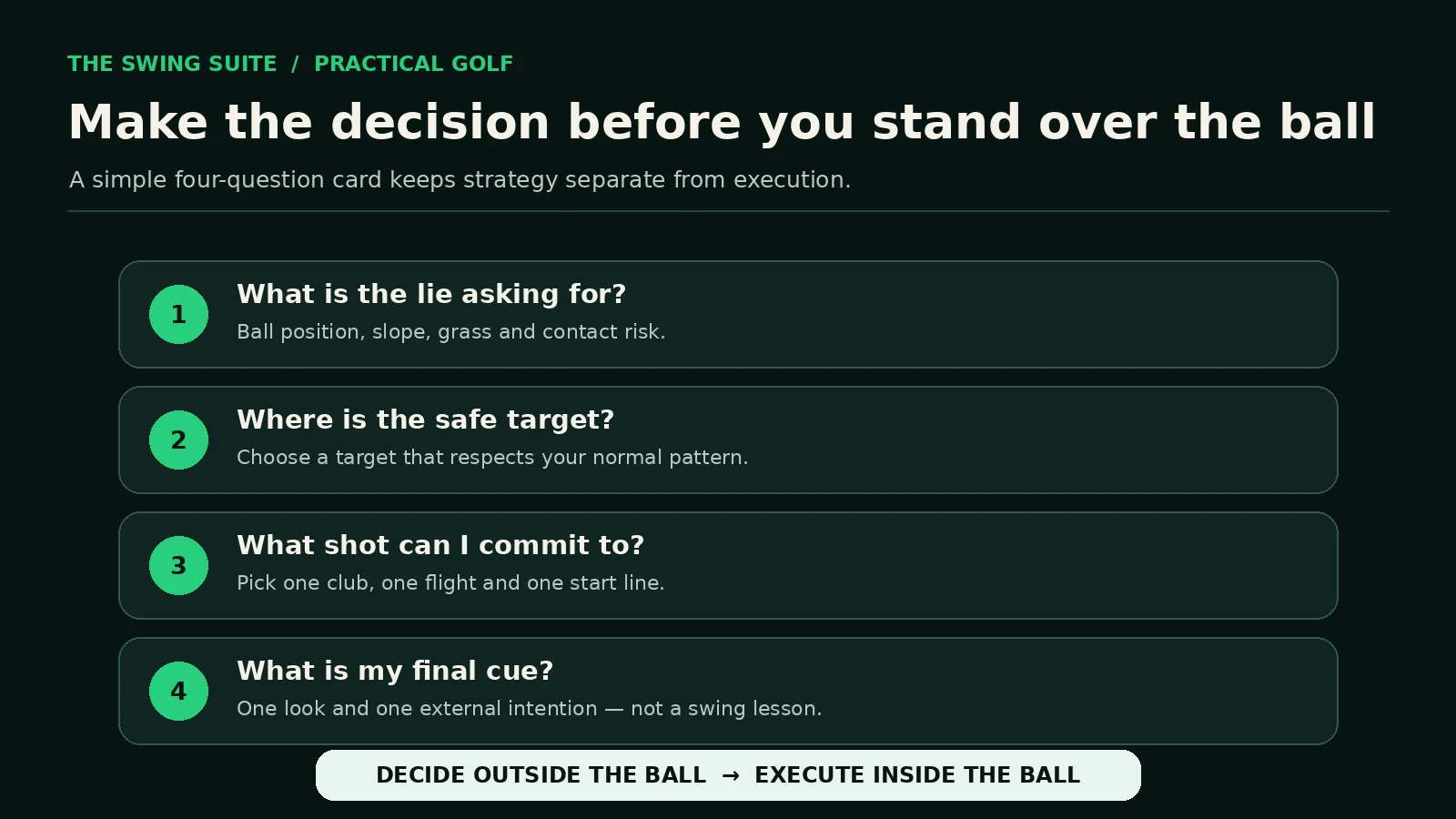
1. What is the lie asking for?
Read the lie before choosing a favourite club. Notice whether the ball is sitting up, down, on a slope, in thick grass, on firm turf or near an obstruction. Check your stance and the space for the swing. A difficult lie may reduce how much speed, height or curve you can predict. The routine should make that constraint visible before ambition takes over.
Use simple categories rather than pretending to calculate certainty. You might call the lie clean, playable with caution or recovery-only. That language is not universal; it is a decision aid. The important point is that the shot choice changes when the lie changes. A pre-shot routine that always produces the same heroic option is not reading the situation.
2. Where is the safe target?
Choose a target that gives your normal shot pattern room. Start with the broad area, then select a precise start line within it. Precision does not require aiming at the flag. A centre-green target can be precise. A line inside the edge of a fairway bunker can be precise. “Somewhere up there” is vague; “over the left edge of that distant tree into the wide part of the fairway” is actionable.
Your target should account for the expected miss rather than the shot you hope to hit once. If your recent pattern spreads mostly right, a target close to the right edge may leave no room for the ordinary result. The existing Swing Suite guide on shot patterns explains how to use a group of shots rather than one best ball when selecting targets.
Read how to choose targets from your shot pattern ↗
3. What shot can I commit to?
Name the shot in plain language: club, trajectory, start line and useful finish area. “Seven-iron, normal flight, start at the centre of the green” is clearer than “Do not hit it in the bunker.” A recovery may be “Pitch back to the widest fairway section.” A chip may be “Land it on the front third and let it release.” The description should tell you what to do, not only what to avoid.
Commitment does not mean certainty. You can make a committed choice while knowing the outcome is variable. It means you have compared the realistic options and stopped negotiating with yourself. If new information appears — a gust changes, a group enters range, the lie looks different — step away and update the decision. Otherwise, keep the chosen shot.
4. What is my final cue?
The final cue should be small enough to survive under pressure. It may be a picture of the flight, the rhythm of a rehearsal, the landing spot or a balanced finish. Choose one. The cue is not a last-second repair manual. Its job is to connect the decision to the movement.
Test whether the cue directs attention towards the task. “Do not go right” keeps the hazard prominent but gives no useful action. “Start over the left-centre tree” creates a line. “Do not top it” names the feared result. “Brush the grass beyond the ball” gives an external contact intention. The cue should suit the shot and the golfer; no phrase is universally correct.
Create a clear commitment point
Without a commitment point, the routine can loop endlessly. The golfer chooses a club, changes target, rehearses one motion, remembers another, takes the stance and then looks back at the hazard. Define one moment after which you will not add new instructions. For many golfers, that moment is stepping towards the ball after the final rehearsal.
Use a physical marker that is easy to recognise. Stand behind the ball to choose the line. Make the rehearsal to the side. When the decision feels complete, cross an imaginary line and walk in. Over the ball, allow normal aiming and settling, but do not reopen club selection or strategy. If the commitment is genuinely gone, step back across the line and restart rather than remaining frozen.
This boundary is especially useful after a mistake. The previous shot may create a strong urge to steer the next one. Keep that reaction in the decision space: acknowledge it, choose the sensible shot, then cross the line with the new task. The boundary is not theatre. It is a way to prevent old information from leaking into execution after it has already been considered.
Keep the routine flexible without making it random
A routine should have a stable order and flexible content. The order might remain read, choose, rehearse, commit and reset. The content changes with the shot. A short putt may need little calculation and no full practice stroke. A recovery from trees may need more time to check the opening, safest route and landing area. A routine that demands identical movements for both can become artificial.
Flexibility also means responding to pace and safety. Do useful preparation while others play when it is safe and courteous: check the distance, read the lie, select a likely club and understand the broad target. When it becomes your turn, confirm the information, make the choice and play. Do not wait until the group is watching before beginning every part of the process.
The R&A’s Rule 5.6 encourages prompt play and recommends making the stroke in no more than 40 seconds once a player is able to play without interference or distraction, usually more quickly. That is a ceiling within pace guidance, not a target duration for your ritual. Build a routine that reaches commitment efficiently.
Read the R&A guidance on prompt pace of play ↗
Use a rehearsal that matches the shot
A rehearsal is useful when it carries information into the shot. For a wedge, it may calibrate length and landing intention. For a sloping lie, it may help you feel balance. For a recovery, it may confirm that the club can pass safely through the available space. A full-speed generic swing made before every shot may add movement without answering the current question.
Decide what the rehearsal is for. If it is rhythm, make it rhythmic. If it is low-point location, use a safe brush that reflects the intended contact. If it is a putting stroke, connect it to distance. Then stop. Repeating the rehearsal until one feels perfect can turn preparation into a search for certainty that golf cannot provide.
Keep the rehearsal clear of other players, equipment and the line of play. On a tee or crowded practice area, choose a smaller movement if a full swing would create risk. The routine should improve readiness without reducing awareness of the people around you.
Aim with enough precision to free the swing
Good aiming is completed before the swing begins. Select a distant target or start line, then use an intermediate reference only if it genuinely helps alignment. Walk in while holding the picture of the line. Set the club and body in the order you have practised. Once settled, avoid repeatedly checking every alignment relationship; endless inspection usually signals that the decision is not complete.
Aiming and body alignment are related but not identical. Different shots and golfers may use different relationships. The routine does not need a rigid formula such as clubface first for everyone. It needs a repeatable process that produces the intended starting picture. Test it with a coach, alignment references and measured ball flight rather than assuming it is correct because it feels square.
The aim should be specific enough that the final look has meaning. When you look towards the target, see the start window and useful flight, not the entire catalogue of trouble. This does not deny the hazard. You already used the hazard to choose the target. The final look is for execution.
Use the final look to connect attention to the target
The final look should be part of a continuous action rather than a separate exam. Look, return your eyes to the ball, settle and go. Some golfers prefer one look, others two. The number matters less than whether it stays recognisable and avoids a long freeze. A routine that normally flows but suddenly includes six checks is giving you information: commitment has weakened.
If the target picture disappears as soon as your eyes return to the ball, simplify it. Choose a clearer start line or broader window. Use the rehearsal to establish the flight, then let the last look confirm direction. Trying to hold a photographic image while also controlling several body parts can overload the moment.
Practise the transition between final look and movement. On the range, notice whether you become static, grip harder or add another technical thought. Do not force a universal countdown. Find a comfortable flow and test it under changing targets. The result should feel ready rather than rushed.
Learn to step away without treating it as failure
Stepping away is a skill when the conditions or decision have changed. A noise, gust, moving person, sudden loss of balance or genuine strategic doubt can justify restarting. The step-away protects safety and commitment. It is not evidence that the routine has failed.
However, repeated restarts can become avoidance. If you step away because no option feels certain, simplify the decision rather than seeking a perfect feeling. Choose the safer target, reduce the ambition or select the club that makes the task clearer. Then restart once. The routine should resolve indecision, not provide infinite opportunities to delay it.
Practise the restart deliberately. During a range session, interrupt one shot after address, step out, breathe, rebuild the decision and return. That rehearsal makes the behaviour available on the course without drama. It also shows whether your routine has a real starting point or is only a collection of movements.
Reset after the shot in less time than the shot deserves
The reset has two jobs: collect useful information and close the event. First, state what happened without exaggeration. The ball started left, curved right, carried short, struck low on the face or found the intended window. Second, decide whether that information changes the next choice. If not, let it go.
Avoid technical diagnosis from one ball. A poor shot may come from execution, decision, lie, wind, contact or simple variability. The course rarely gives enough controlled evidence for a complete rebuild. Save detailed analysis for a practice session where you can compare several shots and measure the pattern.
Use a closing action if it helps: put the club away, take one breath, write a brief factual note or say “next decision”. The action should not hide emotion; frustration is normal. It should stop frustration from becoming the primary input to the next club and target choice.
Practise the routine before judging it on the course
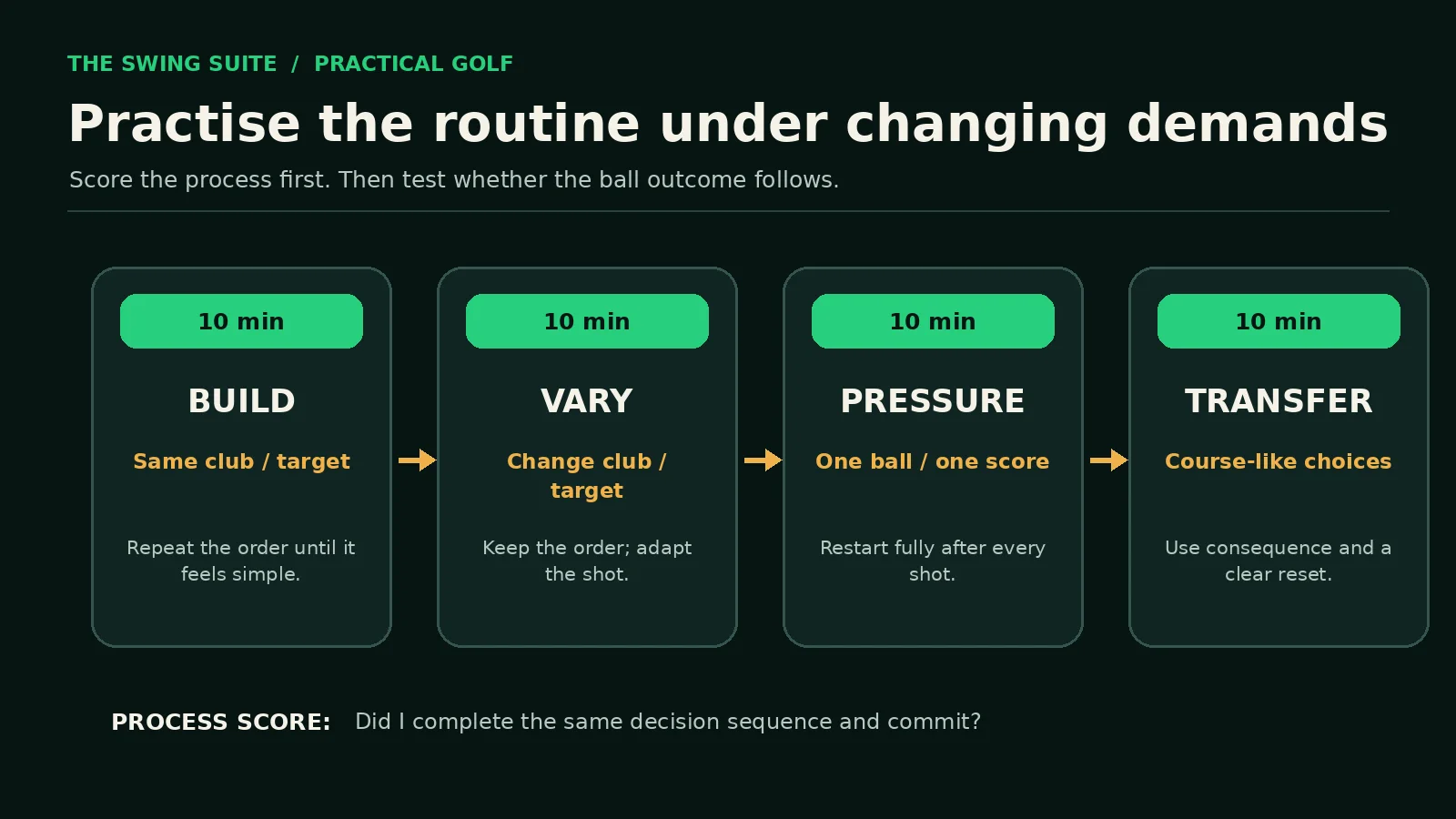
Stage 1: build the order
Start with one club and one target for about ten minutes. Complete the full routine before every ball even though the shot is familiar. Name the lie as normal, choose the target, make one rehearsal, cross the commitment line, look and swing. Afterward, reset and step away from the hitting position.
Score the process, not only the ball. Give one point if you completed the intended order and committed without adding another thought. Record the ball separately. A poor result after a complete routine is not a process failure. A good result after a rushed, undecided routine is not proof that the process is reliable.
Stage 2: vary the shot
Change club or target after each ball. The sequence remains stable, but the content must update. Read the new task, choose the new shot and rehearse what matters now. This exposes routines that work only when repetition removes the need for decisions.
Use realistic but safe variation: high and low targets, different carry windows, straight and shaped intentions, or a wedge followed by a longer club. Keep every example within your ability and environment. The aim is not to display every shot. It is to practise making a fresh decision without losing the structure.
Stage 3: add consequence
Create a one-ball game. Define a fairway or green with boundaries, then score the outcome. Every ball requires a complete restart. If you miss, move to a realistic next task rather than replaying the same shot until you succeed. Consequence makes the routine carry attention, but the score should not become punishment.
For example, play nine imaginary holes with a clear tee target, approach area and simple recovery rule. Keep the process score alongside the golf score. If the golf score worsens while the process remains stable, the shot choice or skill may need work. If the process collapses only when the score matters, practise the commitment and reset stages.
Stage 4: transfer to the course
On the course, give the routine one modest goal: use the same decision order on every full shot for a set number of holes. Do not demand a personal-best score at the same time. Notice where the routine becomes rushed, too long or technically crowded. Those observations are the next practice brief.
Keep a small tally only if it does not distract from play. One mark can mean completed and committed; another can mean restarted appropriately; a third can mean no clear decision. Review the tally after the round. The purpose is to learn where the process breaks, not to grade your character.
Use a process score and an outcome score
Outcome matters in golf, but it is noisy over a small sample. A well-chosen shot can take a bad bounce. A poor decision can be rescued by an unusually good strike. Record both layers. The process score asks whether you read, chose and committed. The outcome score asks whether the ball finished in the intended or acceptable area.
Over several sessions, compare the layers. If the process score improves but outcomes do not, inspect the quality of the target, club choice or technical skill. If outcomes improve while process remains random, do not assume the routine is solved. You may be benefiting from a favourable short run. The separation helps you choose the right next practice problem.
Keep the scale simple. A three-point process score can be enough: zero for no clear decision, one for a partial routine with doubt, two for a complete committed routine. Define it before the session. Avoid changing the definition to reward a good shot after the fact.
Troubleshoot the routine from the first point of failure
When the routine breaks, identify the earliest stage that failed. A rushed swing may begin with a poor read of the lie. A frozen address may begin with two competing targets. A negative reaction may begin with an unrealistic expectation attached to the shot. Fixing only the visible final symptom can leave the original decision problem untouched.
If the read was incomplete, improve preparation before it is your turn. Confirm the distance, lie, wind and broad target while staying aware of the group. If the choice was weak, make the target wider or the shot simpler. If the rehearsal introduced a second idea, remove it. If commitment disappeared at address, define a stronger step-away rule and a clearer commitment point.
Use video or a practice partner only to observe the order and timing, not to judge personality. Ask whether the golfer paused repeatedly, changed club late, added rehearsals or remained over the ball after the final look. Compare several shots. One unusual interruption is not a pattern; repeated changes at the same stage give you a useful practice target.
Prepare for pressure without inventing a different routine
Pressure often makes golfers speed up, slow down or search for extra control. The answer is not a special tournament routine with more steps. Keep the ordinary order and make the decision more explicit. Name the target, club and acceptable miss. Use the same commitment point. The familiar structure should carry the important information when emotion is louder.
In practice, create mild consequence rather than pretending to reproduce a major competition. Finish a session with three one-ball challenges, change club after every shot, or require a clear recovery choice after a miss. Keep the stakes proportionate. The aim is to notice whether the routine changes, not to punish yourself until the range feels threatening.
Under pressure, success may mean making the sensible decision and completing the routine even when the ball result is poor. That does not excuse repeated technical misses; it separates two questions. First, did you choose and commit well? Second, can you execute that shot often enough for it to remain a good choice? The answers guide different practice.
Fit the routine into the group and the course
A personal routine operates inside a shared game. Be ready when it is safe to prepare. Carry or place equipment so that you can leave the green efficiently. Watch the other shots without standing in a distracting position. Begin reading your own situation early, but do not create risk by moving or practising while another player is making a stroke.
If the group falls behind, remove wasted time rather than deleting every useful decision. Walk with purpose, prepare the likely club, keep conversations moving and limit repeated reads. A clear routine can support pace because it prevents late indecision. A long ritual is different: it consumes time without improving the choice.
Course conditions may also alter the sequence. In strong wind, you may need a final confirmation before commitment. In rain, handling equipment and grip becomes part of readiness. On an unfamiliar course, the broad target may need more checking. Keep the same decision spine while allowing the environment to change the content.
Common routine mistakes
- Copying a professional’s visible timing without understanding the decision it supports.
- Adding a new swing thought after the commitment point.
- Using the routine to seek certainty instead of choosing a sensible shot.
- Rehearsing a generic full swing that does not match the lie or intended flight.
- Aiming at trouble while verbally telling yourself not to go there.
- Waiting until it is your turn before checking distance, lie and likely club.
- Judging the routine only by the first few ball outcomes.
- Skipping the reset and carrying the last shot into the next decision.
The correction is usually subtraction. Return to the basic order and remove actions that do not help. If the routine is slow, prepare earlier and reduce repeated checks. If it is rushed, create a clear decision space and one deliberate final look. If it is technical, move the swing work back into practice and take one task to the course.
Adapt the routine for different shots
Tee shots
Confirm the hole shape, trouble and useful landing width before choosing the club. Select the side of the teeing area only when it supports the target and view. Picture a start line and acceptable finish area. The rehearsal should match the intended rhythm or flight, not become an attempt to generate maximum speed before every drive.
Approach shots
Read lie, distance, elevation, wind and the shape of the safe green area. Decide whether the flag is relevant. Choose a carry target and club that respect your normal pattern. Once the choice is made, keep the final cue connected to start and strike rather than reconsidering the bunker during the backswing.
Wedges and chips
Choose the landing area, trajectory and release before selecting the motion. The rehearsal can calibrate length and turf interaction. Look at the landing spot, not only the hole. If the lie makes the preferred shot unreliable, change the shot rather than trying to force the routine to create confidence.
Putting
Read the broad slope, choose the start line and pace, then make a distance-relevant rehearsal. At address, confirm the start picture and roll the ball. Avoid rereading the entire putt after you have settled unless something genuinely changed. On short putts, the routine may be shorter, but the decision and commitment still matter.
Recovery shots
Safety and a clear next position come first. Check branches, roots, people, equipment and the space for stance and follow-through. Choose the largest reliable window, not the most impressive one. A recovery routine should often become simpler: identify the safe exit, select a club that fits it, make a controlled rehearsal and commit.
Questions golfers often ask
Should my routine take exactly the same time?
No. Different shots require different information, and unexpected conditions can interrupt play. Aim for a recognisable range and order rather than one exact second count. Large timing changes may reveal doubt or distraction, but forcing a stopwatch can create another concern. Prompt play and a clear decision matter more than theatrical consistency.
How many practice swings should I take?
As many as have a clear purpose, usually fewer than golfers think. One relevant rehearsal is often more useful than several generic swings. If the first rehearsal gives you the intended feel and picture, continuing may add doubt. If no rehearsal is needed, do not include one merely because the routine says you must.
What if I have several swing thoughts?
Choose one for the course and keep the others in practice notes. If you cannot decide, use an external task such as start line, landing spot, strike location or finish balance. Several technical thoughts compete for attention and can reopen the decision after you have stepped in.
Should I use breathing?
A normal deliberate breath can mark the transition from deciding to executing, but it does not need to be a special technique. Avoid breath holds or forced patterns that make you light-headed or uncomfortable. If anxiety is persistent or severe, seek appropriate professional support rather than treating a golf routine as medical care.
What if the routine works on the range but not on the course?
The range may remove club selection, consequence, waiting and uneven lies. Add those demands in stages. Change target and club every ball, keep a score, wait between shots and play simulated holes. Then take one process goal to the course. Transfer improves when practice contains the decisions that the routine must organise.
A simple routine to test this week
- Behind the ball: read the lie, distance, wind and widest useful target.
- Choose: name the club, intended flight, start line and acceptable finish area.
- Rehearse: make one movement linked to that shot.
- Commit: cross your line, aim, take the final look and swing without adding instruction.
- Reset: record one fact, accept the result and begin the next decision fresh.
Use that version for one practice session before changing it. Score whether you completed the sequence and whether you committed. Then adjust only the part that repeatedly failed. If the decision was unclear, improve the target question. If the transition froze, simplify the final look. If the reset lasted three holes, make the closing action more definite.
The goal is not to look composed for its own sake. The goal is to make better choices available when golf becomes uncertain. A useful routine does not remove variability. It gives you a stable way to respond to it: read what is present, choose the sensible shot, commit to one task, and meet the next ball without dragging the last result with you. Keep the first version simple enough to remember without a card, then let repeated practice — not decoration — earn any extra step.
Build your routine with measured feedback
If your routine breaks because the target, club choice and ball flight do not connect, measured coaching can help separate decision quality from strike and delivery. A Swing Suite lesson can use the current shot pattern and launch information to build a routine around your actual game rather than a copied performance. Current lesson options and availability remain on the live booking page.