

Reliable iron contact begins with controlling where the club reaches the bottom of its arc. For a ball resting on the ground, the useful pattern is normally ball first and turf second: impact happens while the club is still travelling down, and the low point occurs on the target side of the ball. You do not need to chase a tour-player number or dig a large divot. You need a repeatable relationship between the ball, the swing arc and the surface.
The practical route is to diagnose before you change. Observe where the ball strikes the face, where the club meets the ground and what the ball does. Collect a small set rather than judging one shot. Then test one adjustment at a time. A useful practice session moves from a baseline, to one clear intervention, to changing targets and one-ball tests. That process makes low point a coachable pattern instead of a vague instruction to “hit down”.
This guide explains what low point and attack angle mean, how to read fat and thin strikes without guessing, how to practise safely on grass or a mat, and how to decide whether an apparent improvement is ready for the course. Any positions, scores, shot counts or distances used as examples are hypothetical. Your useful pattern depends on your club, speed, intended flight, body, lie and current skill.
The direct answer: move the bottom of the arc beyond the ball
Imagine the clubhead travelling on a curved path. At some point that path reaches its lowest height and begins to rise. With an iron struck from the ground, impact should occur before that bottom point. TrackMan defines Low Point as the distance from the clubhead’s geometric centre to the lowest point on the swing arc at maximum compression, and describes it as before or after impact. Its Attack Angle measure describes whether the clubhead is moving up or down at maximum compression.
Those definitions explain the contact sequence without prescribing one ideal number. A negative attack angle means the club is travelling down at impact, which places the bottom of the arc after impact. The exact amount that is useful cannot be copied blindly. TrackMan notes that shots from the ground should have a negative attack angle for trajectory, while also cautioning slower-speed golfers against simply trying to become excessively steep.
Read TrackMan’s definition of Low Point ↗
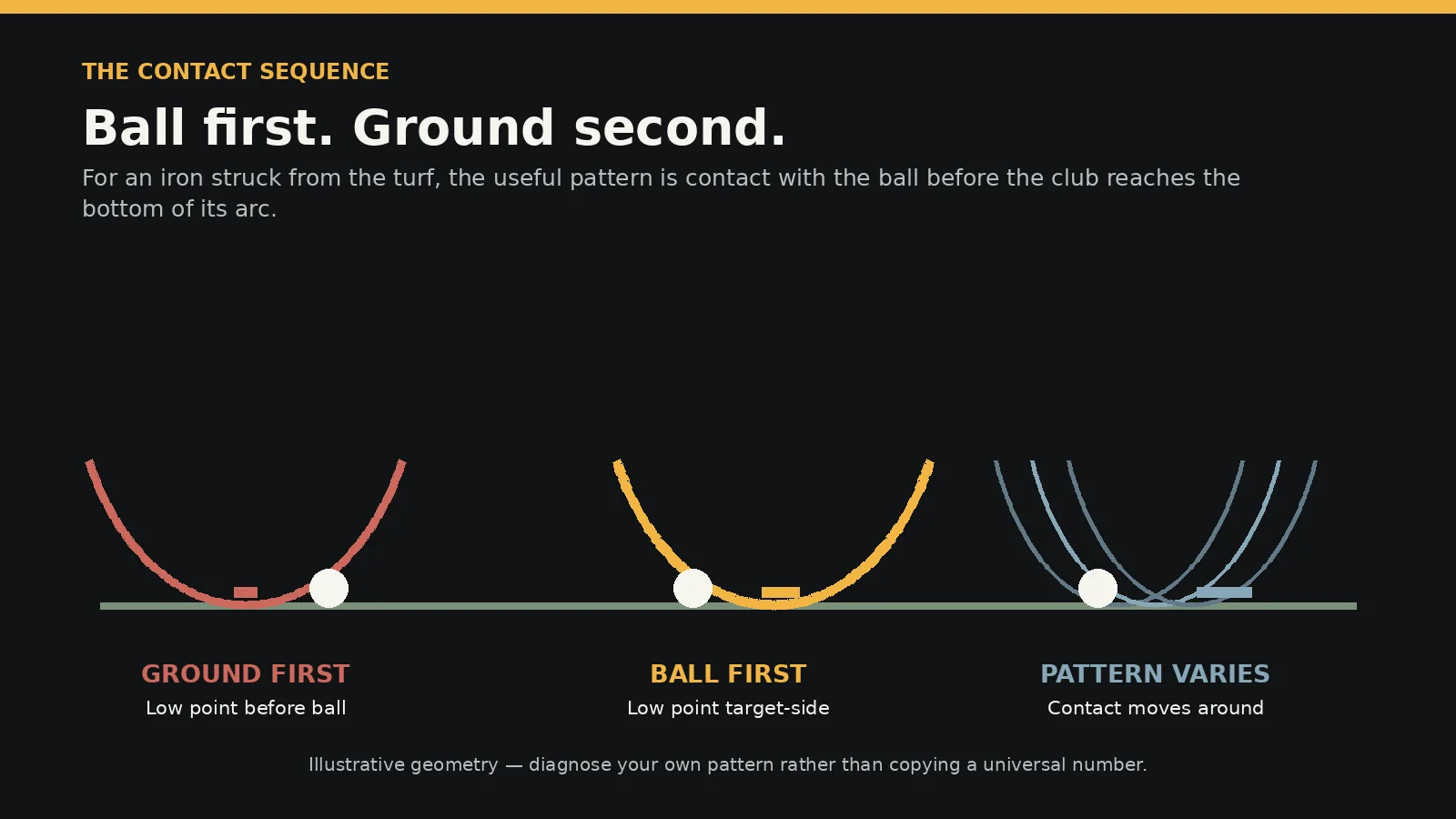
The goal is therefore not “take a divot” as an isolated instruction. A divot is evidence of turf interaction, not proof of a good strike. The club can enter the ground after the ball yet still produce an unsuitable face strike, direction or flight. It can also brush firm turf with little visible mark and produce a functional shot. Judge the complete task: contact sequence, strike location, launch, direction, curve and carry.
Why low point changes the quality of iron contact
When the bottom of the arc moves behind the ball, the club may reach the ground first. The surface slows or redirects the club before impact, and the strike can feel heavy. On a forgiving mat the club may skid or bounce into the ball, disguising how early the ground contact occurred. The result can still fly, which is why ball flight alone is not enough evidence indoors.
When the bottom of the arc is too high, too far forward, or inconsistent from swing to swing, the club may catch the upper part of the ball or strike low on the face. Golfers often call this thin contact. A thin shot is not automatically proof that the low point was behind the ball; the vertical height of the arc and the face strike also matter. Treat the result as a question to investigate, not a diagnosis by itself.
Low point also interacts with attack angle and club delivery. TrackMan’s current material distinguishes the measured movement of the club at impact from where the arc bottoms out relative to the ball. Two swings can show a downward delivery while producing different ground contact, strike and flight because their arc height, face delivery, speed and timing differ. Use the parameters together rather than turning one reading into the whole swing.
Read TrackMan’s explanation of Attack Angle ↗
Start with three layers of evidence
A useful diagnosis combines three layers: the clubface, the ground and the ball flight. None is complete alone. The face tells you where the ball met the club. The ground tells you where the club met the surface. The flight shows the combined result of strike and delivery. When all three tell a similar story across several shots, you have a better basis for choosing what to change.
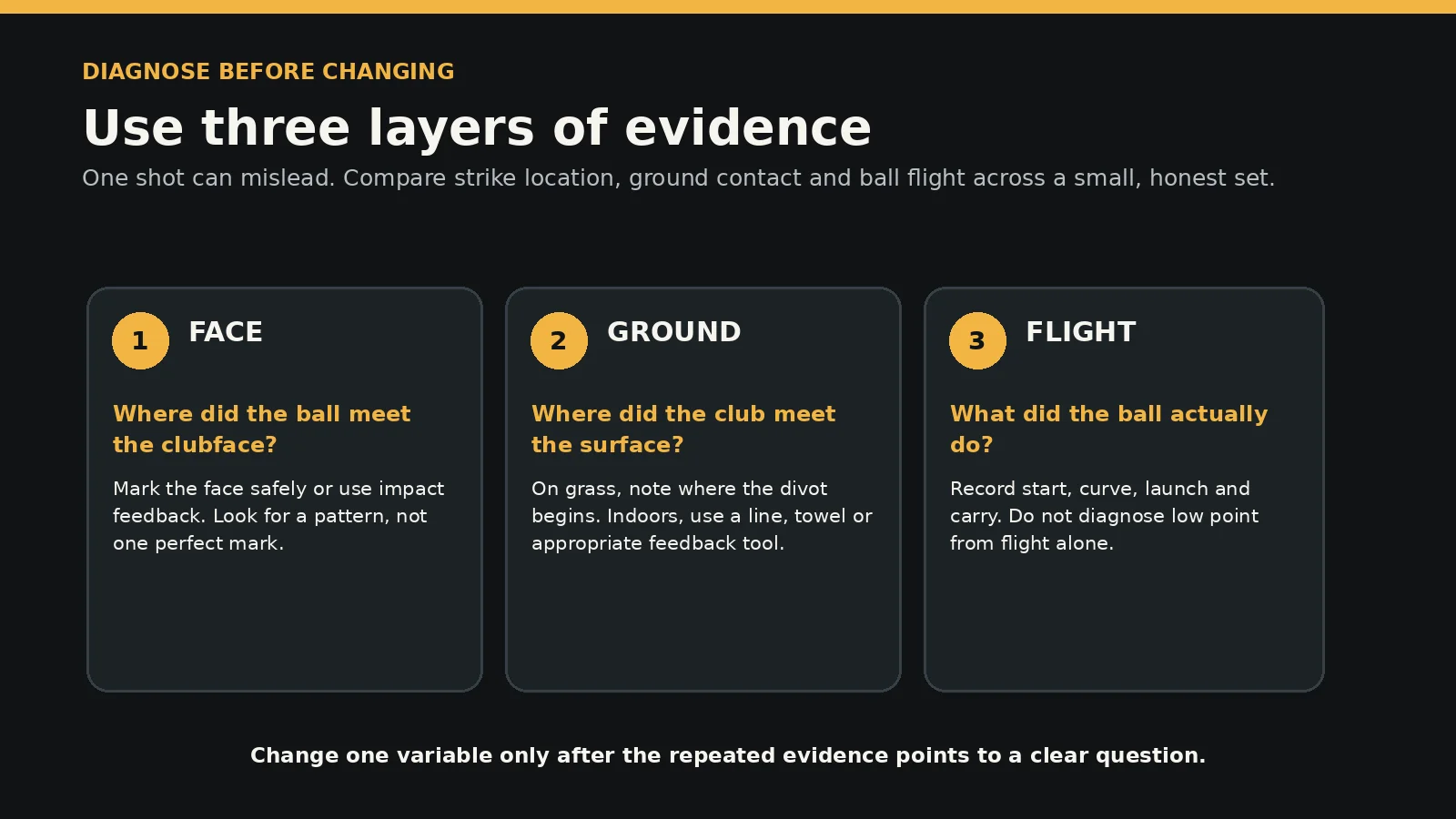
1. Mark the strike location
Use an appropriate impact spray, face tape or another safe method that will not damage the club. Check the manufacturer’s guidance before applying anything to the face. You are looking for a pattern: consistently low, high, heel-side, toe-side or scattered. Clean and remark the face when the marks become difficult to separate. A single centred mark after several poor contacts should not erase the rest of the evidence.
Low-face contact often accompanies a thin feel or a low launch, but do not assume one cause. The bottom of the arc may be too high, the ball position may have changed, the golfer may be standing up, or the club may be delivered differently. Heel and toe contact can coexist with a suitable low point. Keep horizontal strike and vertical contact as separate observations until the evidence connects them.
2. Locate the first ground contact
On grass, look for where the turf mark begins relative to the ball position. Use a clear reference line if the practice area permits it, and repair divots according to the venue’s rules. Do not move repeatedly onto damaged turf and assume the new lie is equivalent. On firm or wet ground, the visible mark can be subtle; feel and sound can help, but they are less objective than a clear reference.
On a mat, use a non-damaging line, towel, low-profile strip or purpose-made feedback aid placed safely behind the ball. The task is to reveal early contact, not to create a hazard for the club or golfer. Leave enough clearance that the aid does not interfere with a normal swing. If you are unsure whether an aid is safe or permitted, use measured launch-monitor feedback with a coach instead.
3. Record the ball flight
Write down only the flight information that answers the question: start direction, curve, launch window, carry and obvious speed loss. A fat strike may produce a short carry, but a short carry can have many other causes. A thin strike may launch low, but a low intended flight is not automatically poor contact. Compare the chosen shot with the actual result.
Use repeated categories rather than emotional labels. “Heavy, started right, finished short” is more useful than “terrible”. “Low-face, no ground mark, launched below the intended window” creates a testable picture. The language should help you decide what to observe next, not turn one shot into a verdict about your swing.
Build a baseline before using a drill
Hit a small set of normal shots before changing technique. Use a familiar mid-iron, a comfortable target and your usual routine. Five to eight shots can be enough to identify a question for that session, but it is not enough to establish a permanent truth about your game. Keep every shot in the record. Deleting the poor contacts turns the baseline into a highlight reel.
For each ball, note strike location, ground contact category and flight. Keep the categories simple. Ground contact might be before, around or after the reference. Strike might be low, centred, high, heel, toe or unclear. Flight might record start, curve and carry band. If the pattern is scattered in every dimension, the first goal may be improving the repeatability of the set-up rather than moving one number.
Do not begin with a prescribed low-point target. First ask what problem you are solving. Is the club repeatedly reaching the mat before the ball? Is the face strike consistently low despite no early ground contact? Does the pattern change with one club, one target or one ball position? A good baseline narrows the problem before a drill adds another variable.
Repeat the same baseline on another day before treating it as your permanent pattern. Fatigue, warm-up, surface and the target can all change the evidence. A repeated result across comparable sessions is more useful than one unusually good or poor basket, and it gives the next intervention a fairer test.
Check the set-up without turning it into a formula
Ball position changes the relationship between the ball and the swing arc, but it is not a universal cure. Moving the ball back can make it easier to contact the ball earlier in the arc, yet it also changes launch, face delivery, path relationship and the intended shot. If the ball has drifted from the golfer’s normal reference, restore the reference. Do not keep moving it backwards until the symptom disappears.
Check stance width, posture, distance from the ball and alignment. A set-up that changes between shots can move the perceived bottom of the arc even when the motion feels the same. Use two alignment sticks outside the hitting area or another safe visual reference. Rebuild the set-up for each ball rather than raking the next ball into a worn patch without looking.
Pressure distribution and body position matter, but avoid static slogans. Starting with more pressure on one foot does not guarantee the correct movement through impact, and a perfectly centred address does not guarantee poor contact. Use set-up changes only when they have a clear purpose and can be tested against strike, ground and flight evidence.
Understand the difference between moving down and digging
Golfers often react to a fat shot by trying to hit more sharply down. That can shift the low point forward, but it can also make the delivery excessively steep, reduce useful loft, change path and create a different contact problem. TrackMan explicitly warns that players with slower club speed should be careful not to hit too far down with irons. More negative is not automatically better.
A functional downward strike is the result of the club still descending at impact, not an order to drive the leading edge deep into the ground. The sole, bounce, turf firmness, club design and intended shot all affect the interaction after the ball. The useful question is whether the contact sequence and flight suit the shot, not whether the divot looks dramatic.
Separate depth from location. The ground mark can begin after the ball yet be too deep for the intended shot. It can be shallow and still begin in a useful place. If the club repeatedly sticks in the turf, do not keep chasing a farther-forward low point without checking angle, speed, face, equipment and the lie. A measured lesson can distinguish those factors more safely than a generic drill.
Use a line drill as feedback, not as a performance test
A simple line drill can reveal where the club meets the ground. Draw or identify a safe line perpendicular to the target. Place the ball just forward of the line according to the drill design, then observe whether the first mark begins on the target side. On a mat, use a removable line or purpose-made feedback surface. Follow the facility’s rules and do not mark or damage a hitting bay.
Begin without a ball only if the surface and environment make that safe. Brush the ground on the intended side of the line with a small motion. Then add a ball and retain the same external task. The line is not a command to force the hands forward or lunge at the target. It is feedback about where the club meets the surface.
Use small sets. After three or four attempts, step away and review the pattern. If every swing is a rehearsal over the line, the golfer can become good at the drill while losing the normal target and routine. Move quickly from the line to a ball-flight task, then return only if the original pattern reappears.
Use the towel-behind-the-ball drill with sensible clearance
A towel or flat headcover behind the ball can expose early ground contact, but its position must match the golfer and the task. Placing it extremely close creates an artificial challenge and can encourage a steep or anxious response. Start with generous clearance, use a short iron and a controlled swing, and move the object only when the contact and flight remain functional.
The drill provides binary feedback: the club either touches the object or misses it. That simplicity is useful, but it does not prove the resulting strike was good. A golfer can avoid the towel by lifting the arc and then hit the ball thin. Continue to check the face mark and flight. Passing one constraint is not the same as solving the whole contact problem.
Keep the object low, soft and safely outside the expected clubhead path. Never use a hard object that could rebound or damage the club. If the golfer changes direction suddenly to avoid the aid, increase the clearance or choose a different task. Feedback should clarify the movement, not create fear.
Use a forward-brush task to connect the ball and the turf
Some golfers respond better to an external task beyond the ball. Choose a small patch or visual mark on the target side and intend to brush the surface there after contact. The task can organise the motion without asking the golfer to manipulate individual body parts. It also keeps attention on the sequence rather than on making a large divot.
Set the mark close enough to represent the intended contact but not so exact that the golfer stabs at it. The brush is a direction for the motion, not a demand to strike one square centimetre. If the ball starts, curves or launches outside the chosen window, the task may need adjustment even if the ground mark appears better.
Alternate one rehearsal with the brush intention and one normal shot to a target. This tests whether the improved contact survives when attention returns to golf. If it disappears immediately, use a simpler bridge: keep the same club and target but remove the visible mark for one ball, then restore it for the next.
Change one cause at a time
Low point can be influenced by ball position, body movement, pressure shift, swing centre, hand and shaft delivery, club choice, lie and the golfer’s response to the target. Changing several of these together may improve the next shot, but it prevents you from knowing why. Pick one intervention that fits the repeated evidence and keep the rest of the task stable.
For example, if the set-up reference has visibly drifted, restore it before adding a motion cue. If the set-up is stable but the ground mark remains behind the ball, test one external task such as brushing beyond the ball. If the ground contact improves but the strike moves to the heel, do not call the whole intervention successful. The evidence has changed the question.
Keep a short note: “change tested”, “contact response”, “flight response” and “next decision”. That prevents a productive session from becoming a list of swing thoughts. It also helps a coach see what you tried, what changed and which apparent fixes failed when the target or club changed.
Use measured data without becoming dependent on one number
A launch monitor can make the relationship clearer by measuring attack angle and, on supported systems, low point. TrackMan announced full-bag Attack Angle and Low Point for TrackMan iO in June 2026, including irons and wedges. It also notes that some ground-first hits may not display data when accuracy is affected. Missing data on a poor strike should therefore not be silently treated as a perfect zero or removed from the practice record.
Read the current TrackMan iO Low Point update ↗
Use the number to answer a question. Is the club consistently travelling down at impact? Does the low-point pattern change when the target changes? Does the measured delivery improve while face strike or carry worsens? The aim is not to produce the same value on every shot. The aim is to connect a suitable delivery to the intended flight and a repeatable contact pattern.
Do not compare values across devices or measurement methods without understanding their definitions. TrackMan’s club-data documentation explains that its Club Speed, Attack Angle and Club Path references use the clubhead’s geometric centre and pre-impact movement at maximum compression. A number from another system may use a different reference. Keep comparisons within a known setup unless the methods are genuinely comparable.
Avoid copying tour averages
Tour averages describe groups of highly skilled players, not a prescription for your next swing. They combine different clubs, speeds, trajectories and delivery patterns. Copying an average attack angle can distract from the actual problem: perhaps your low point is inconsistent, your strike is low on the face, or the chosen launch window does not suit your speed.
Use your baseline and intended shot. A useful change should improve the relationship between contact and flight while remaining repeatable enough for the course. If a number moves towards a published average but the carry, direction or strike becomes less functional, the session has not produced a useful answer.
A coach may use reference ranges as context, but the decision still belongs to the individual pattern. Club design, shaft, lie, ball, turf and physical capability matter. Treat any target as provisional and connected to a shot, not as a permanent badge of technical quality.
Practise from grass and mats without confusing the feedback
Grass gives direct evidence about turf entry, but the lie changes after every shot. Move to fresh turf in a pattern approved by the practice ground. Keep the ball on a comparable lie, and do not use a deep previous divot as the reference for the next swing. Ground firmness and moisture can change how the club enters and exits, so record the conditions when they materially affect the task.
Mats provide a stable lie and make repeated measurement convenient. They can also allow the club to slide or bounce after early contact. Add a line or safe behind-ball constraint, listen for the contact sequence and compare carry or speed loss. If possible, transfer the pattern to grass before declaring the issue solved.
Neither surface perfectly predicts the course. On the course the ball may sit above or below the feet, in rough, on a slope or on firm ground. Build the basic contact pattern first, then add representative lies with guidance. Do not demand the same low point or divot from every lie and every intended trajectory.
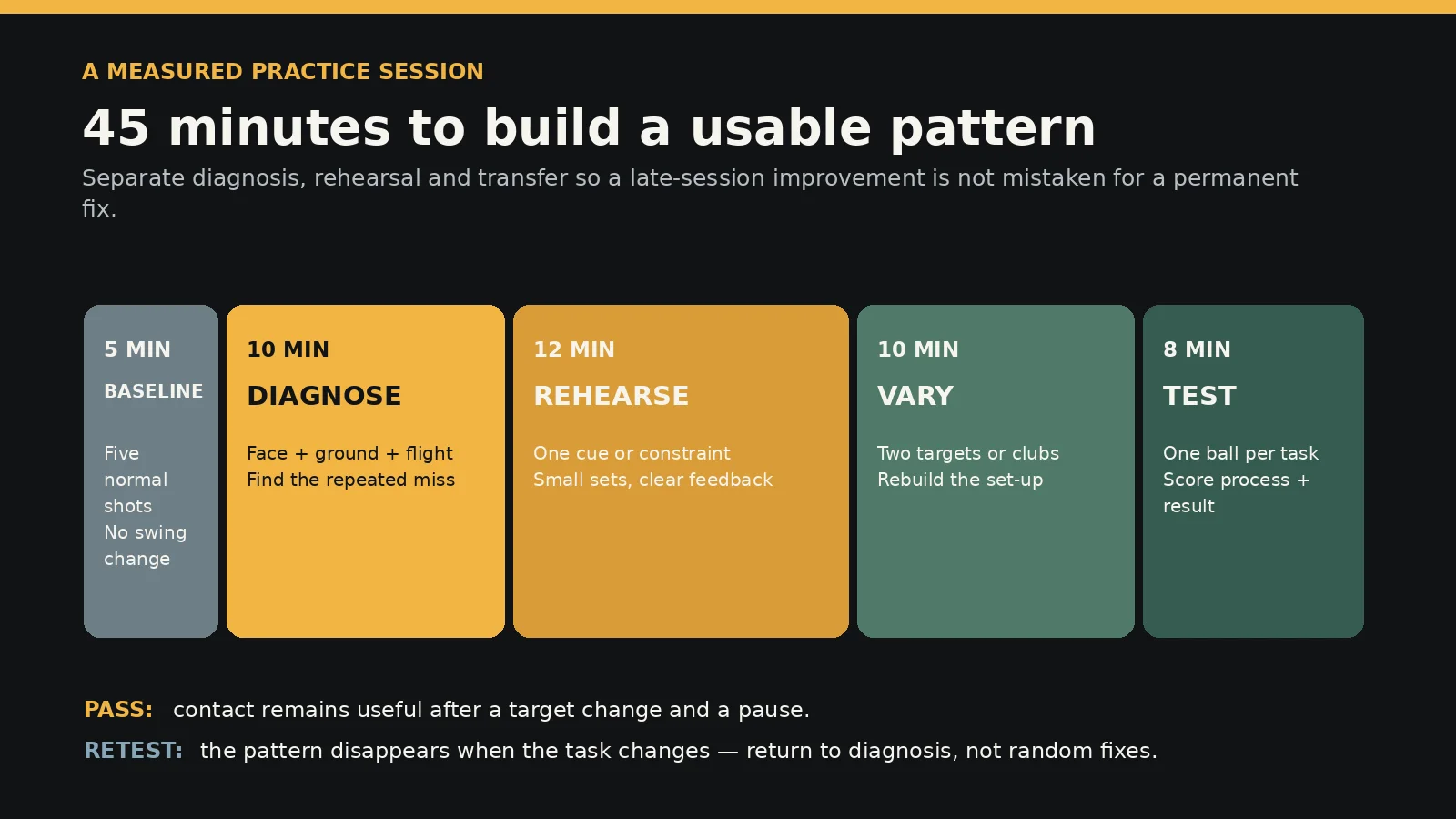
Build a 45-minute low-point practice session
Use the first five minutes for a baseline. Warm up, then hit five normal shots with one iron to one target. Record every strike, ground-contact category and flight. Do not use a drill yet. Write one question from the repeated pattern, such as “Does the club meet the mat before the ball when the target changes?”
Use the next ten minutes to diagnose. Confirm ball position and alignment, mark the face, and add one safe ground-contact reference. Hit small sets with pauses. If the evidence is inconsistent, simplify the task rather than selecting a dramatic fix. Your goal is to identify the most useful variable to test.
Use twelve minutes to rehearse one intervention. Choose a line drill, generous towel clearance, forward-brush task or coach-provided cue. Keep the club and target stable. After each small set, record whether ground, strike and flight improved together. Stop the drill if it creates a new problem or an unsafe motion.
Use ten minutes to vary the task. Change between two targets or alternate two suitable irons. Rebuild the set-up and routine each time. Keep one ball per task and avoid immediate correction balls. This stage reveals whether the contact depends on repetition and whether the intervention can survive a fresh decision.
Use the final eight minutes for a test. Create six hypothetical approach tasks with clear target and safe-miss zones. Score the routine, contact and result separately. Finish by writing one course intention and one question for the next session. The test is evidence from one day, not proof of a permanent change.
Progress from blocked contact to variable golf shots
Blocked practice is useful while you are learning the feedback. The club, target and constraint remain stable, allowing you to notice the relationship between the intervention and contact. Keep the block short and purposeful. Once the intended pattern appears, remove some support rather than hitting thirty more identical balls.
The bridge can be simple. Keep the club and move between two targets. Keep the target and alternate a normal flight with a slightly lower flight that you already own. Alternate one drill ball with one normal ball. Step away between attempts. The contact pattern must be rebuilt, not carried by rhythm from the previous swing.
Variable practice then changes the decision as well as the picture. Choose club, target and intended trajectory before each ball. Use the normal routine and accept the result. If low point becomes unreliable only after a longer club or a different target, that is useful diagnosis. Return to the smallest bridge that preserves the golf task.
Separate a contact problem from a direction problem
A heavy strike that starts right and curves right can tempt the golfer to fix everything at once. Low point, face angle and path relationship are different parts of the delivery. Improve the contact sequence while monitoring direction, but do not assume moving the low point will automatically square the face or produce the intended curve.
Likewise, a centred strike can finish far from the target. That does not make the contact work useless; it means the next question concerns start or curve. Keep the practice notes separated into contact, direction and distance. This prevents a directional miss from sending you back into random low-point drills.
If changing the contact task repeatedly changes the curve, seek measured help. A setup or motion change can influence several delivery parameters at once. The solution may be a coordinated adjustment rather than a stronger version of the same drill.
Know when the divot is giving you false confidence
A divot after the ball can look convincing even when the strike is low, the face is open or the carry is inconsistent. Turf can also hide the exact first contact once several swings overlap. Use fresh references and continue checking the face. The divot is one layer of evidence, not the final score.
Deep divots can be mistaken for commitment. If the player is using excessive effort to drive the club down, the result may be difficult to repeat and poorly matched to firm turf. A shallow mark can be entirely functional for a particular player and shot. Judge location, depth, strike and flight together.
On a mat there may be no divot at all. That does not prevent useful practice, but it increases the need for a line, safe constraint, sound, feel and measured data. Be honest about what the surface can and cannot show.
Common mistakes when practising low point
- Trying to hit down harder after every fat shot without checking strike, launch or the depth of the turf interaction.
- Moving the ball progressively farther back until the symptom changes, while ignoring the new launch, path and target relationship.
- Judging the session from the best three shots and deleting the heavy or thin contacts from the record.
- Using a towel or obstacle so close that the golfer makes an anxious, steep or lifting response.
- Calling a drill successful because the constraint was avoided even though the face strike and flight became worse.
- Copying a tour attack-angle value instead of diagnosing the golfer’s own club, speed, trajectory and repeated pattern.
- Treating a mat as if it gives the same ground-contact evidence as grass.
- Changing ball position, pressure, posture and hand action at the same time, then being unable to identify the useful cause.
- Hitting repeated correction balls after a miss and never testing whether the contact can be produced on the first attempt.
- Assuming a visible divot proves good contact or that no divot proves poor contact.
- Using one missing or extreme launch-monitor reading as a complete diagnosis.
- Taking a technical cue straight to the course without testing it against changing targets, clubs and pauses.
Questions golfers often ask
Should the divot always start after the ball?
For a standard iron shot from the ground, ball-first contact with the low point target-side is the useful model. The visible turf mark depends on the surface, club and shot, so it may be shallow or difficult to see. Do not demand a large divot. Use face, ground and flight evidence together.
How far after the ball should the low point be?
There is no single distance every golfer should copy. The useful relationship depends on club, speed, intended trajectory and delivery. Establish your own measured pattern with a coach or launch monitor, and judge it by the resulting strike and flight rather than by one universal target.
Does a negative attack angle guarantee good iron contact?
No. It shows that the clubhead is moving down at impact under the measurement definition. Strike location, arc height, face delivery, path, speed and the exact low-point relationship still matter. A downward delivery can coexist with a poor face strike or unsuitable turf interaction.
Can I practise low point indoors?
Yes. Use a safe line or low-profile feedback aid, mark the clubface appropriately, and compare the flight or measured data. Remember that a mat can disguise early ground contact by allowing the club to slide or bounce. Transfer the pattern to grass when possible.
Why do I strike it well in the drill but poorly on the course?
The drill may provide a stable target, repeated club and immediate feedback that disappear on the course. Add a bridge: remove the aid, change targets, alternate clubs, pause between shots and use one attempt. If the pattern vanishes, the skill needs more representative practice rather than a more complicated swing thought.
Should I keep the same swing thought for every iron?
Not necessarily. A useful external intention may transfer across several clubs, but the set-up and shot demand change. Test the principle with different irons and targets. If it works only with one club after several rehearsals, treat it as an early learning cue rather than a course-ready solution.
Take one simple intention to the course
Do not carry the full diagnosis onto the first tee. Choose one short intention that survived the variable test: perhaps rebuild the ball-position reference, complete the normal routine, or brush the turf beyond the ball while sending the shot through a chosen window. The intention should support the shot rather than turn the course into a laboratory.
Observe the first few iron shots without rushing to a conclusion. Lies, slopes, wind and turf will change the contact. Record whether the pattern appears and whether the intended flight remains playable. A poor first result does not erase the practice, and a perfect first result does not prove the change is permanent.
After the round, compare course evidence with the practice test. Did the contact fail after a long wait, a different lie or a demanding target? Did the set-up drift? Did the cue survive with shorter irons but disappear with longer clubs? Use that answer to design the next session rather than returning to a generic basket of balls.
Build reliable iron contact from evidence
Controlling low point is not about forcing one position or producing a dramatic divot. It is about making the bottom of the swing arc occur in a useful place for the shot, then repeating that relationship when the club, target and environment change. The reliable sequence is simple: diagnose face, ground and flight; test one intervention; remove the support; and finish with a representative one-ball task.
If the contact remains unpredictable, measured coaching can reduce the guesswork. TrackMan data can show how the club is moving at impact, while face and ground feedback show how that delivery meets the ball and surface. The value is not the number alone. It is the connection between the measurement, the strike you can feel, and the flight you are trying to create.
Compare this with the indoor-to-course practice guide ↗
Book measured help with your iron contact
If you regularly hit the ground before the ball, catch irons thin or see contact change from shot to shot, a focused lesson can identify which part of the pattern is moving. Use the live Swing Suite booking page for current lesson options, venues and availability rather than relying on copied details.