
To prepare for your first golf lesson, confirm the venue and start time, bring the clubs you normally use, wear clothes and shoes that let you move comfortably, and arrive with one or two clear questions. Do not try to repair your swing the night before. The coach needs to see your normal shot, your normal routine and the problem as it actually appears. Be ready to describe what you want from golf, mention any pain or movement limits, and leave with one priority, one practice task and one way to judge whether it is working.
Your first lesson is not an audition. You do not need a complete set, a polished swing, a low handicap or a technical vocabulary. You are not expected to impress the coach with your best shots. The useful starting point is honest information: what you play now, what tends to happen, what you have tried and what would make the lesson worthwhile for you.
This guide is written for a first lesson with Scott Winyard or another golf coach, including an indoor TrackMan session. It does not assume that you are a complete beginner. “First lesson” can also mean the first time you have worked with a particular coach, the first lesson after a long break, or the first time you have used measured ball-flight feedback.
The direct answer: prepare the context, not a perfect swing
The most useful preparation happens away from the ball. Check the practical details, decide what you want help with, gather only the information that clarifies that goal, and arrive early enough to settle. Once the lesson starts, make your normal swing unless the coach asks for something different.
A coach can learn from a topped shot, a heavy strike, a push, a pull or a ball that curves more than you wanted. Those results show the current pattern. If you spend the previous evening copying a new tip, changing your grip or forcing a different backswing, the opening swings may show a temporary experiment rather than the motion you actually take to the course.
Prepare to talk as well as swing. A short conversation about your golf, body, practice time and aims helps the coach choose the right starting point. The same technical change can be unsuitable if one golfer practises three times a week and another can spare fifteen minutes at home. A good plan must fit the golfer as well as the ball flight.
What to check when you book
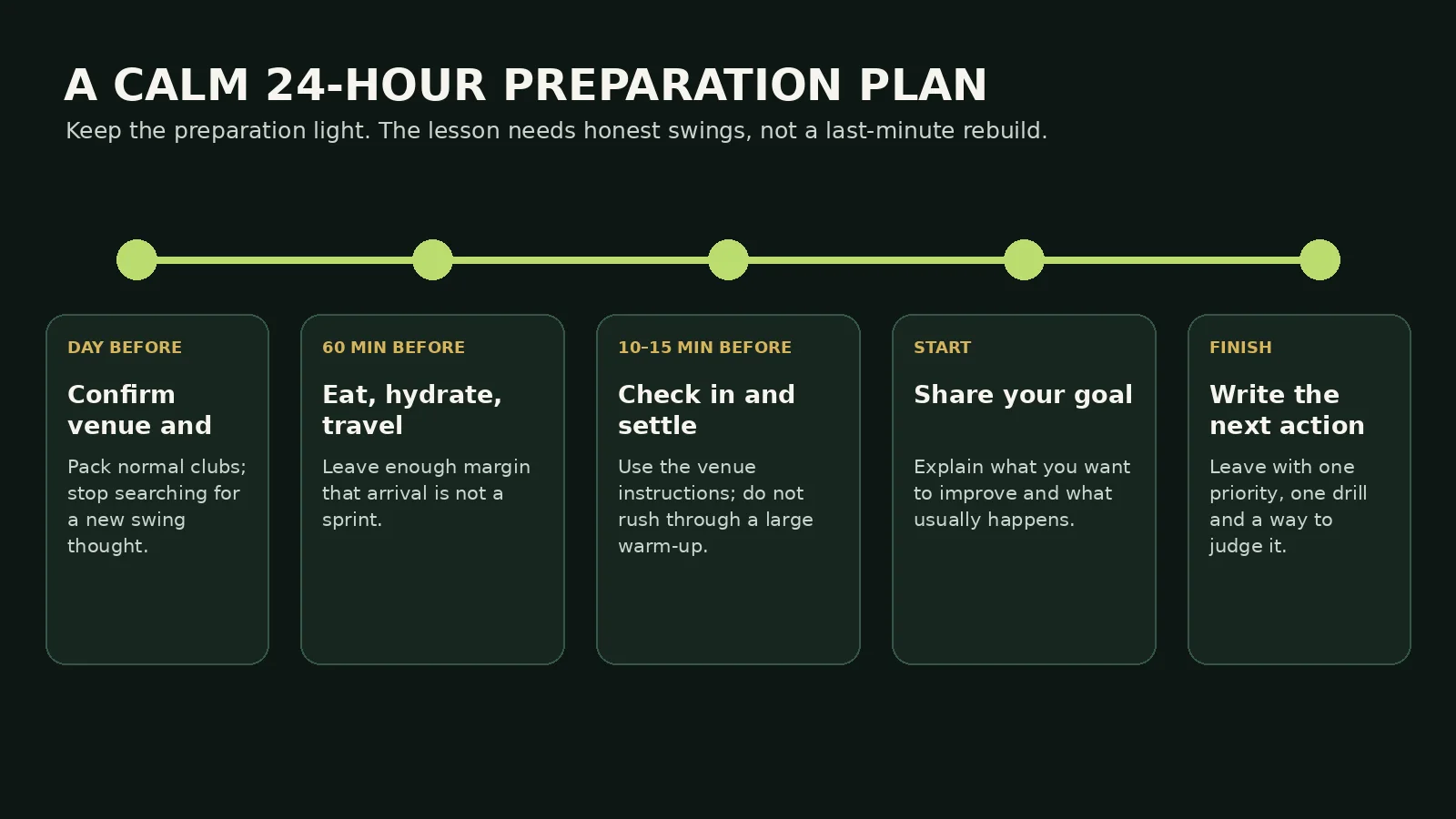
Read the live booking confirmation rather than relying on an old message or memory. Confirm the date, start time, lesson duration, venue and any arrival instructions. Indoor coaching venues can have separate entrances, reception arrangements or simulator bays, so the name of the area alone may not be enough to find the correct door.
If you are choosing between lesson lengths, think about the job you want the session to do. A shorter appointment may suit one focused question or a quick review. A longer lesson gives more space for assessment, explanation, practice and transfer. That is a planning consideration, not a promise that more minutes automatically create a better result.
Use the current Swing Suite booking page for live lesson and venue options. Availability changes, and the booking page is a better source than a price or timetable copied into an article.
View current Swing Suite lesson availability ↗
Choose one useful outcome for the lesson
“Fix my swing” is understandable, but it is too broad to guide a first session. A more useful outcome names the situation that causes difficulty. You might want to understand why iron shots start right, make more reliable contact with a mid-iron, learn a basic setup for a beginner, stop losing tee shots to one side, or leave with a practice plan you can use between visits.
The outcome does not have to be technical. You can ask for help choosing clubs, building a pre-shot routine, understanding launch-monitor numbers, returning after injury, preparing for a first round or making practice less random. The coach can then decide whether the lesson should begin with movement, impact, equipment, decision-making or a combination.
Choose one primary question and, if helpful, one secondary question. That creates direction without forcing the coach to follow your diagnosis. “My seven iron often starts right and stays right; I would like to understand the main reason” is more useful than “I know I am over the top and need to shallow the club”. The first statement reports an observable result. The second may be correct, but it arrives with a proposed cause and solution that have not yet been assessed.
A simple goal sentence
Complete this sentence before the lesson: “I would be pleased if I left understanding _____ and knowing how to practise _____.” Keep the answer short. If you have several concerns, rank them rather than trying to solve everything in one visit.
For a complete beginner, the sentence may be: “I would be pleased if I left knowing how to hold the club, set up safely and make a small balanced swing.” For an experienced player meeting a new coach, it might be: “I would be pleased if I understood my common left miss with the driver and had one task for the range.” Both are valid starting points.
What to bring to a first golf lesson
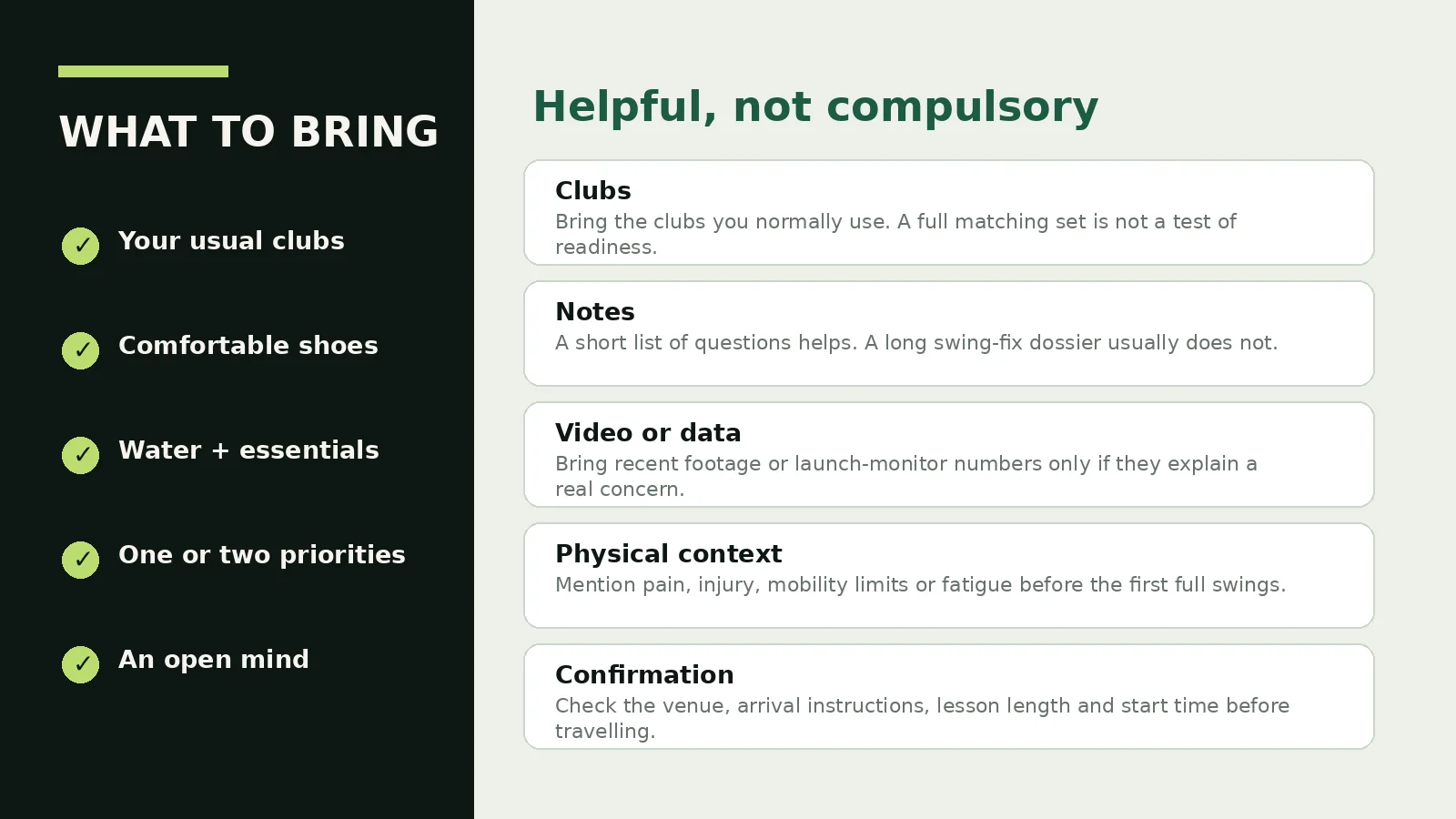
Bring the equipment you normally use if you own it. That might be a full bag, a half set or only a few clubs. The coach benefits from seeing the tools and choices that belong to your real golf, but the number or brand of clubs is not a measure of whether you are ready for a lesson.
If you do not own clubs, check the booking information or contact the coach before travelling. Beginner programmes commonly make equipment available, but that is venue-specific and should be confirmed rather than assumed. Do not buy a full set solely because you think a first lesson requires one.
Pack water and any personal items you need for comfortable movement. Wear clothing that allows you to turn, bend and swing without restriction. Golf-specific shoes can be useful, but the practical requirement for an indoor lesson is stable, clean footwear that suits the venue rules. Check the confirmation if you are unsure.
Bring your glasses, hearing aids, medication or support equipment if they are part of how you normally practise or play. A lesson plan should work with your real needs. There is no advantage in hiding something that affects balance, vision, hearing, fatigue or comfort.
Useful optional information
A short note of recent ball flights can help. Write what the ball usually does with the club that concerns you: where it starts, which way it curves, how the strike feels and where on the course the problem appears. Use plain observations. You do not need launch-monitor terminology.
Recent video can be useful if it shows a pattern that is difficult to reproduce indoors or only appears on the course. Keep it brief and relevant. One face-on clip and one down-the-line clip are more manageable than a library of swings filmed over several years. The lesson still needs fresh observation.
Launch-monitor reports can also provide context, especially if they show repeated outcomes with the same club and conditions. Do not clean the sample until only the attractive shots remain. If you bring data, identify the club, ball, environment and whether the numbers were measured or normalised.
What not to do the day before
Do not schedule a large, exhausting practice session to prove that you have prepared. Fatigue can change speed, coordination and tolerance for movement. It can also make the first lesson feel like a test you have already failed. Light movement or ordinary play is fine if it is part of your routine; an emergency swing rebuild is not.
Avoid collecting ten conflicting tips. Online instruction can be useful, but different drills often address different causes. Combining several without diagnosis makes it difficult to tell what your normal swing is doing and which cue produced which result.
Do not make a major equipment change immediately before the session unless equipment is the subject of the lesson. A new driver setting, unfamiliar grip size or different iron can alter the picture. If you have already changed something, tell the coach when and why.
Do not rehearse a technical label until it becomes your only explanation. Phrases such as “coming over the top”, “lifting my head” or “not rotating” may describe part of the motion, a consequence, or nothing important for the shot in front of you. Bring the observation, then let the assessment test the label.
Prepare your body without turning the warm-up into a workout
Your preparation should help you arrive able to move normally. Sleep, food, hydration and travel time matter more than a complicated pre-lesson routine. If you know that stiffness affects your first swings, allow time for the gentle movements you already use and trust.
Do not copy a new stretching programme just before the appointment. A warm-up is not the moment to test end ranges or force mobility. The coach needs to know if a movement is uncomfortable, restricted or medically limited. Say so before the session becomes more dynamic.
Pain is information, not a challenge to swing through. Explain where it is, what movements provoke it and whether a clinician has given restrictions. A golf coach can adapt tasks and recommend that you seek appropriate medical advice, but should not diagnose an injury.
If fatigue, medication or a recent illness may affect the session, mention it. The lesson can use shorter sets, lower effort, more explanation or a different club. Hiding the context makes the ball flight harder to interpret and can encourage an unrealistic practice plan.
Arrive early enough to become present
Aim to arrive with a small margin, not an hour-long practice agenda. Ten to fifteen minutes is often enough to find the entrance, use the facilities, organise your clubs and let your attention move away from the journey. Follow the specific venue instructions in your confirmation.
If you are late, contact the coach or venue when it is safe to do so. Do not rush the final part of the journey or launch straight into full-speed swings because you feel you must recover lost time. A shorter, calm lesson is more useful than an anxious start.
If balls and a bay are available before the appointment, ask before beginning. A few comfortable swings may help, but a large warm-up can hide the opening pattern, create fatigue or use time and facilities reserved for someone else.
How to describe your golf honestly
The opening conversation is not a handicap interview. The coach is trying to understand the task. Describe how often you play, how often you practise, what clubs you use, the courses or facilities you normally visit and what a typical miss looks like.
Separate frequency from severity. “I slice every drive” may mean that most drives curve slightly right, or it may mean that two tee shots per round leave the course. Those are different problems. If you can, say how often the miss appears, what happens to the ball and what you do in response.
Mention when the problem began. Did it follow a break, injury, equipment change, previous lesson, speed programme or period of better scoring? Timing does not prove cause, but it helps the coach decide what to examine.
Explain what you have already tried. Include the cue, drill or setup change and what happened next. This is not a confession of mistakes. It prevents the lesson from repeating an approach that confused you and may reveal which kind of feedback you understand best.
Tell the coach how you learn
Some golfers respond to a clear external task, such as starting the ball through a gate. Others need to understand the club-and-ball relationship, see video, feel a movement slowly or compare two contrasting swings. You may not know your preferred method yet, but you can say what has helped or overwhelmed you before.
Ask for another explanation when language does not land. Technical knowledge is not a requirement. A coach can restate the idea, change the demonstration or use a different task. Nodding through an explanation you do not understand creates a fragile practice plan.
What may happen in the first part of the lesson
A first session often begins with conversation, observation and a baseline. The coach may ask you to hit several shots without changing anything. The purpose is to see the pattern, not to grade each strike. A useful baseline includes the setup, movement, contact, start direction, curve, carry and the way you respond after a miss.
With TrackMan or another launch monitor, numbers can describe the ball flight and aspects of club delivery. The amount of data can feel impressive, but the lesson does not need to chase every parameter. The coach should select the measurements that explain the priority and connect them to a task you can repeat.
Video may reveal movement and alignment that are difficult to feel. A single frame is not a verdict. Look for the relationship between the picture, the measured shot and the change the coach is asking you to attempt.
The coach may also check grip, aim, ball position, posture, balance and how you organise the shot. Basic does not mean trivial. A setup that repeatedly places the club or body in a difficult starting position can make a complex swing change unnecessary.
How to use TrackMan feedback without being overwhelmed
Treat the screen as feedback, not as a scoreboard. A number is useful when it answers a question. If the lesson is working on start direction, the relevant feedback might be whether the ball begins left or right of the chosen line. If it is working on strike, the coach may use ball speed, carry, spin or impact location alongside what you felt.
Ask what a selected number means, what range is relevant for your task and what you should do when it changes. Do not assume that a tour-player benchmark is your immediate target. The right value depends on club, speed, strike, intended shot and the lesson goal.
One shot can be interesting; a pattern is more useful. A single perfect result after a new feel does not prove that the movement is learned. Repeat the task, vary the target when appropriate and notice whether the useful outcome survives normal variation.
Measured feedback should eventually support a decision you can make without the machine. That may be a start-line window, a contact sound, a balanced finish, a ball-flight shape or a practice score. Ask how to take the lesson away from the bay.
Learn about the current 55-minute TrackMan lesson ↗
Ask questions that improve the next repetition
The strongest questions are close to the task. Ask: “What should I notice on the next swing?”, “Which result tells me I did the drill correctly?”, “Should this feel exaggerated?”, “What is the common mistake when I practise this alone?” or “When do I return to a normal target?”
Ask the coach to distinguish the priority from the supporting details. A lesson may include several observations, but they are not all homework. Write down the one change or task that should organise the next practice session.
If a cue works only when you swing slowly, ask how to progress it. If it works with an iron but not the driver, ask whether the task should transfer yet. If a good shot feels strange, ask whether the sensation is expected to settle or remain part of the routine.
You can also ask what not to practise. A clear exclusion protects the plan from old habits and from adding unrelated online tips. “For the next week, focus on this start-line task and do not try to add speed” can be as useful as a new drill.
Do not judge the lesson by the best shot
A dramatic good shot feels convincing, but the lesson is not complete because one ball flew perfectly. The better test is whether you understand the reason for the task, can reproduce the task at an appropriate speed and can recognise a useful attempt even when the result is not perfect.
Change can temporarily widen the outcome. Attention is being moved to a new place, and the old compensation may no longer fit. The coach should manage the difficulty, but some variation is normal. The question is whether the task creates a clearer pattern and a repeatable route forward.
Equally, difficulty is not automatically evidence that a change is correct. If a movement causes pain, the explanation remains unclear or every swing becomes less functional, say so. The coach can simplify, use a different constraint or revisit the diagnosis.
Judge the session by the quality of the plan you can carry out after it: a named priority, a drill or task, an amount of practice, a feedback measure and a condition for progressing.
Take notes that survive the drive home
Write notes before memory becomes a collection of vague feelings. Keep them short enough to use. A page of technical positions is less helpful than a small sequence that tells you what to do with the next ten balls.
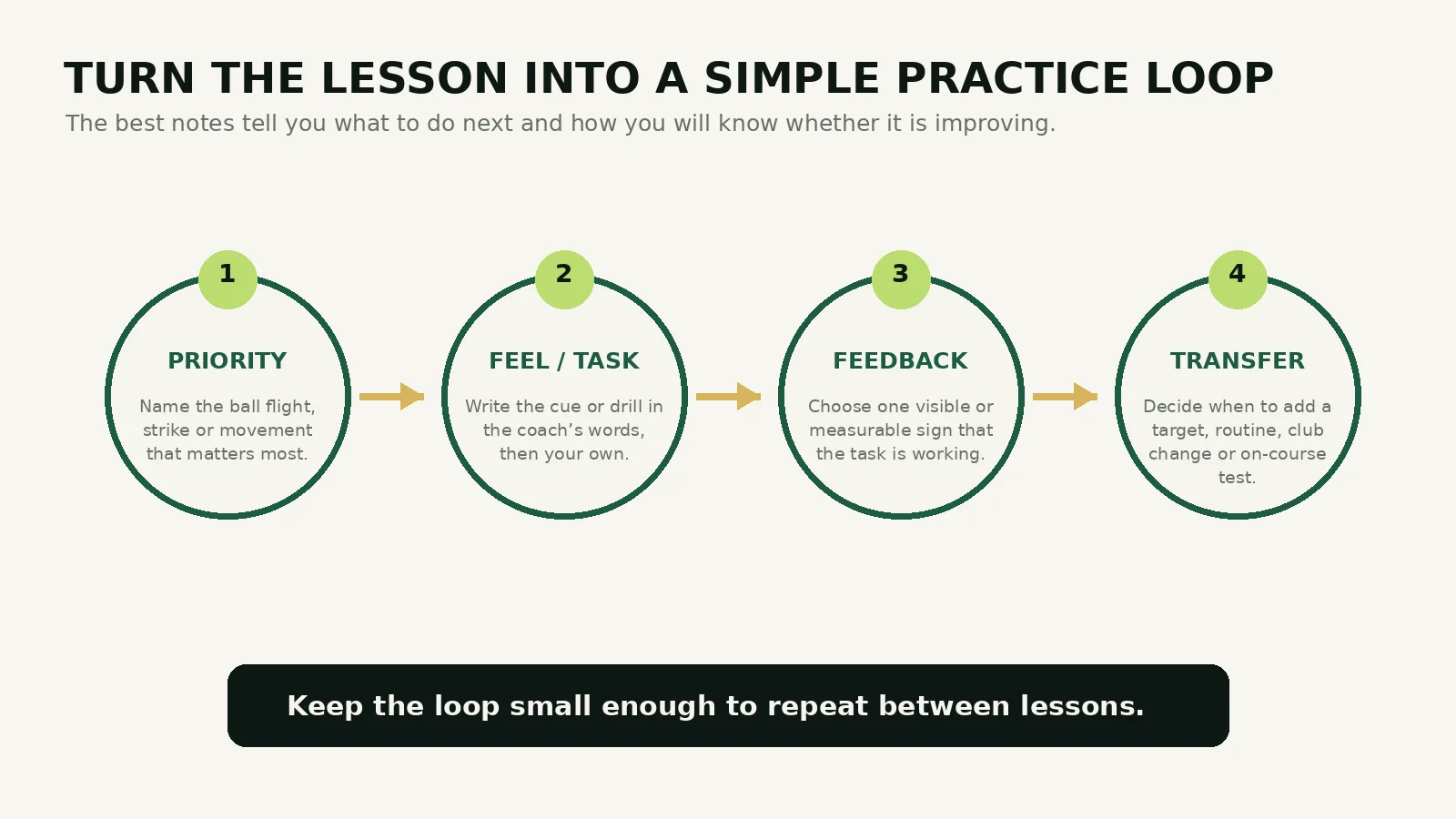
Record the priority in plain language. Then record the task, the dose and the feedback. For example: “Priority: start the mid-iron closer to the chosen line. Task: three rehearsals through the gate, then one ball. Dose: four sets of five balls. Feedback: count starts inside the gate; stop if the movement becomes painful or rushed.” That example is illustrative, not a prescription for your swing.
Add the transfer step. State when you will move from the drill to a normal pre-shot routine, change target or club, or play a short simulated hole. Without transfer, a golfer can become good at the drill while the original shot remains unchanged.
If the coach provides video or a summary, keep your own notes as well. Your words reveal what you understood. Compare them with the coach’s message while the session is fresh and clarify anything that appears contradictory.
Build your first practice session from the lesson
Do not turn the first practice into a sixty-ball examination. Begin with a small number of comfortable shots and the task exactly as agreed. Use the same club, target and feedback that were used when you understood it in the lesson.
Practise in short sets. After each set, note the feedback rather than searching for a new feel after every ball. A stable task allows you to see whether the pattern is changing. Constantly rewriting the cue makes every shot a different experiment.
Include breaks. Step away, restate the priority and begin again. Learning includes the ability to retrieve the task after attention has moved elsewhere. A drill that works only in one uninterrupted block may not yet be available on the course.
Finish with some form of transfer. Use a target, a routine and a consequence. Change club or shot only if the lesson plan says the skill is ready. The goal is not to abandon the drill; it is to connect the drill to golf.
Use this 60-minute golf practice structure after your lesson ↗
Prepare for the environment you have booked
An indoor lesson and an outdoor lesson can examine the same golf problem, but the experience is different. Indoors, ball-flight measurement and video may make patterns easier to compare because the target, surface and weather are controlled. Outdoors, the coach can see the full flight, turf interaction, changing lies and the way you respond to a real practice ground or course environment. Neither setting is automatically better for every question.
For an indoor session, clean the club faces before you travel. Dirt in the grooves and impact tape left from another session can make the equipment harder to inspect and can affect the contact you are trying to understand. Bring the ball you normally play only if the venue permits personal balls; otherwise use the ball supplied and note that it may differ from your on-course baseline.
Expect the screen to make results visible quickly. That can tempt you to chase the longest carry or the straightest single shot. Keep returning to the lesson task. A controlled environment is most valuable when it supports repeated comparisons, not when it turns every swing into a competition with the previous number.
For an outdoor lesson, check the forecast and venue guidance. Bring a layer, hat, waterproof or sunscreen when appropriate, but do not assume that severe conditions will simply be ignored. Wind and temperature can change ball flight, while a wet or firm surface changes the strike and bounce. The coach may use those conditions as part of the lesson or adjust the task.
Outdoor practice also requires awareness of other golfers, range boundaries and the coach’s position. Wait for a clear instruction before swinging when someone is moving near the hitting area. A first lesson should establish safe habits as well as a technical plan.
If the booking is for on-course coaching, the preparation changes again. Bring the equipment you would normally carry, allow time to check in, and tell the coach how many holes or how much time you can comfortably walk. On-course work may focus more on routine, club choice, targets, uneven lies and emotional responses than on repeating one swing change.
Whatever the setting, use the same primary outcome. Do not turn an indoor booking into a complete data audit, an outdoor booking into a ball-striking marathon, or an on-course lesson into a silent playing test. The environment is there to reveal and practise the decision that matters.
Video, privacy and permission
A coach may suggest recording a swing because video can make alignment and movement easier to discuss. You should understand what is being recorded, why it is useful and where it will be stored or shared. A lesson recording for private feedback is different from permission to use your image in public marketing.
Ask before recording the coach’s explanation, especially if other people may appear or be heard. Venue rules and the privacy of nearby golfers still apply. If you want a copy of a demonstration or your own swing, agree the useful angle and the specific clip rather than filming the entire session by default.
Do not post a lesson clip with a claim that the coach, venue or technology has guaranteed a result. A short before-and-after sequence can omit the misses, the temporary nature of a feel and the practice still required. Keep public claims narrower than the evidence.
If you prefer not to be filmed, say so at the start. The coach can use live observation, mirrors, demonstrations, launch data or other feedback. If video is important to the proposed method, discuss the minimum recording that you are comfortable with.
What to do in the first 48 hours afterwards
Review the lesson while the language is fresh. Within the first day, rewrite the main priority, task, feedback and transfer step in your own words. Compare that note with any summary from the coach. If the two versions describe different jobs, clarify before building a week of practice around the wrong interpretation.
Your first practice does not need to happen immediately. If the lesson was physically demanding or the movement is unfamiliar, recovery may be more useful than extra swings that evening. The practice dose agreed with the coach should guide you, not anxiety that the feel will disappear.
When you do practise, reproduce the simplest successful version first. Use the agreed club and target, begin at the agreed speed and keep the set short enough to maintain attention. Record the feedback measure, not a judgement such as “good swing” or “bad swing”. Specific notes make the next lesson more useful.
Expect the sensation to change. A feel is a personal instruction, not a measured position. As the movement becomes less unfamiliar, the original sensation may weaken even while the ball flight improves. Use the agreed external feedback to decide whether the task still works.
Contact the coach if the task causes pain, if you cannot reconstruct the drill safely, or if the written summary seems to contradict what you understood. Do not silently replace it with a different internet drill and then wait until the next appointment to explain that the plan failed.
After two or three practices, summarise the pattern in a few lines: what you practised, how much, what changed, what remained difficult and whether the task transferred to a normal routine. That is more useful than sending only the best swing or the worst result.
Common first-lesson mistakes
- Trying to impress the coach with maximum speed or only your favourite club.
- Arriving with several diagnoses and refusing to show the normal shot.
- Hiding pain, fatigue, fear or a previous change that affects movement.
- Treating every launch-monitor number as a target.
- Changing the task after one poor ball or declaring success after one perfect ball.
- Leaving without a written priority, practice task and feedback measure.
Another common mistake is expecting the lesson to remove uncertainty. Coaching improves the quality of the next decision and the next practice period; it does not guarantee that every shot immediately behaves. A realistic first session establishes a useful direction and a shared language for later work.
Do not compare your lesson with someone else’s clip. Another golfer may receive a different grip, drill, explanation or amount of data because the cause and learning need are different. Specific coaching should look specific.
If you are a complete beginner
Say that you are new. There is no need to learn terminology before attending. The opening priorities may be safety, how to hold the club, how to stand, how to make space for other players and how to create a small balanced motion that sends the ball forward.
Bring curiosity rather than expectations about distance. Early contact can vary widely. A useful beginner lesson gives you a repeatable starting routine and enough success to practise safely, not a complete swing model in one hour.
Ask about the next suitable place to practise, what equipment you need now and what can wait. Buying decisions are easier after you understand the kind of practice and play you intend to do.
If you already play but are meeting a new coach
Bring a concise history. Explain your usual ball flight, current handicap only if it adds context, recent practice, previous coaching and any change that has recently helped or failed. Avoid delivering a long technical autobiography before the coach has seen you hit a ball.
Tell the coach what you want to preserve. A player may want better contact without losing a trusted fade, or more driver control without a large speed reduction. Naming the non-negotiable helps the coach evaluate trade-offs.
Be prepared for the coach to begin somewhere different from the symptom. A right miss may be influenced by aim, strike, face control, path, speed, equipment or the way the player reacts to the target. The first job is to test the relationships, not defend a preferred explanation.
A first-lesson checklist for the morning
- Open the confirmation and check venue, time, duration and arrival details.
- Pack your normal clubs; do not worry if the set is incomplete.
- Wear unrestricted clothing and suitable clean footwear.
- Bring water and any personal support items.
- Write one primary outcome and one secondary question.
- Note any pain, injury, fatigue or movement restriction to mention.
- Leave enough travel time to arrive calm.
- Do not add a last-minute swing fix.
When you arrive, put the checklist away. The lesson should become a conversation between the shot, the coach and you. Preparation has done its job if you can be present, make an honest attempt and respond to the feedback.
The five things to leave with
- A clear priority: the main result or movement you are working on.
- A task: the drill, constraint or cue you can repeat.
- A feedback measure: what tells you the task was completed well.
- A practice dose: how many swings, sets or minutes to use before review.
- A transfer step: how and when to return to a target, routine and changing clubs.
If one of those is missing, ask before the lesson ends. You are not being difficult. You are checking that the coaching can survive outside the bay.
Book the next lesson only when it fits the plan. Some golfers benefit from a quick review; others need time to practise and collect a pattern. Ask what evidence should trigger the next appointment: a particular number of sessions, a stable change, a persistent difficulty or an upcoming playing goal.
Ready for your first lesson?
You do not need to arrive with a good swing. Arrive with the truth about your golf, a body that is ready to move, and enough attention to understand one useful next step. Let the lesson reveal the starting point.
The practical sequence is simple: confirm the details, bring your normal equipment, choose one outcome, disclose relevant physical context, make honest opening swings, ask what the feedback means, and leave with a small practice loop.