
A reliable wind-adjusted iron carry window starts with a calm reference and a truthful description of the air. Label wind direction and strength relative to the intended start line, hit a small matched set, record strike before interpreting the flight, and keep carry, peak shape, curve and finish attached to each ball. The useful result is a conditional range with short, long and side boundaries—not a universal percentage or a memorised “one club” rule.
The practical outcome is a dated map for recognisable conditions: calm reference, representative headwind, helping wind and crosswind. Each entry should show the lower, central and upper carry edges, the normal strike description, the flight pattern and the target room required. It should also state when the wind is too changeable, the strike too different or the landing area too narrow for that map to support the shot.
All yardages, wind labels, charts and scorecards in this guide are hypothetical unless they come from your own measured practice. Wind speed changes with height and exposure, while temperature, altitude, humidity, ball, club, speed, strike, launch and spin can also affect flight. There is no responsible universal wind adjustment that replaces an observed window and a target with enough room.
The direct answer: reference, label, strike, flight, target
First, build a calm or low-wind reference with one iron and one broad target. Record representative strike, launch category, carry and finish. Keep ordinary misses. This establishes what the club and player are producing today rather than relying only on an old stock number.
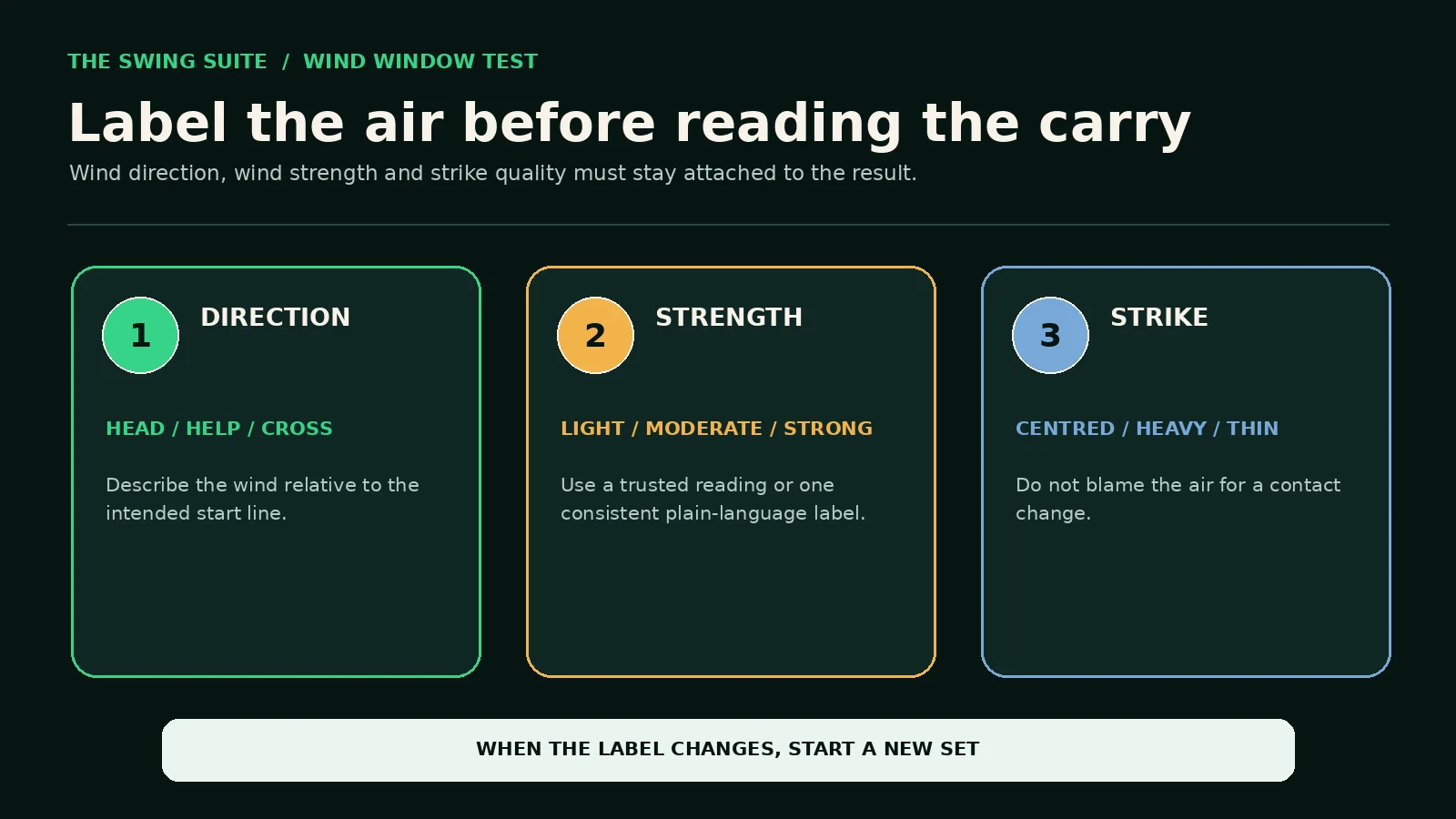
Second, label the wind relative to the shot: mainly into, mainly helping, from the left, from the right or quartering. Add one consistent strength label or a trusted reading. Start a new set when the direction or strength changes materially. Record the strike before looking at carry so a heavy or thin result is not silently blamed on the wind.
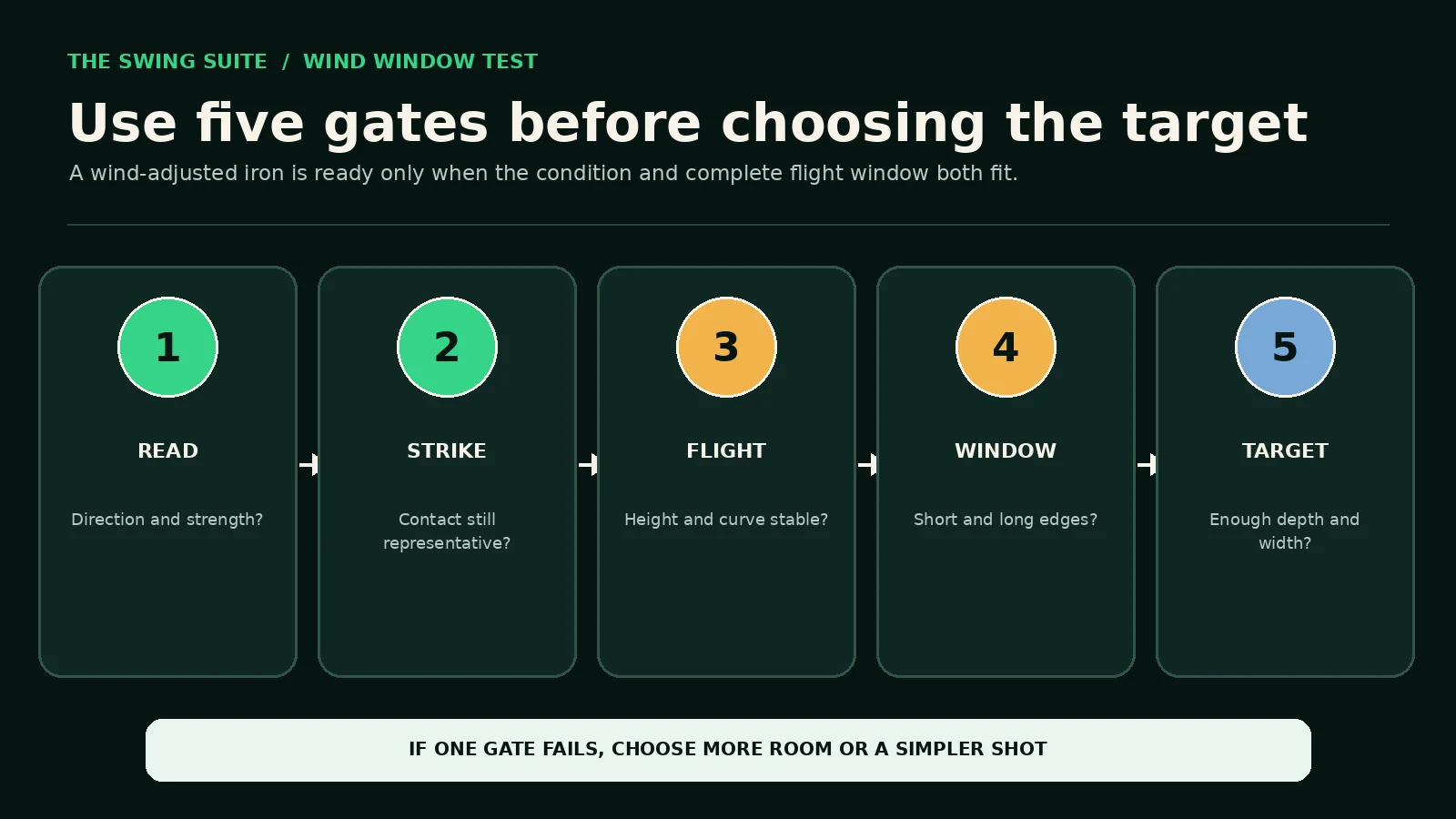
Third, choose the course target from the complete observed flight window. Protect the short edge into the wind, the long finish with help and the side corridor in a crosswind. If the live condition does not match the tested label, or if the air is gusting beyond the window, use more room or a simpler shot.
Why wind needs its own carry map
A stock iron number is normally built under a reference condition. Wind changes the air through which the ball travels, and the result depends on the flight the golfer actually produces. Two players can start with the same calm carry and need different course decisions because their launch, spin, speed, strike pattern and landing behaviour are different.
The same golfer can also create different responses on different days. A headwind may coincide with a harder swing, a lower strike or more dynamic loft. A helping wind may tempt the player to guide the ball. Those movement changes belong in the evidence because the course receives the combined result, not a laboratory wind effect isolated from the person hitting the shot.
Treat wind as a condition label rather than a correction dial. The map should answer: under this recognisable direction and strength, with a representative strike and flight, what carry and finish window do I need to contain? That question is slower to build than a slogan but much more useful when a green has real front, back and side consequences.
Define wind relative to the intended start line
“Into” and “helping” are incomplete until the shot direction is chosen. A wind that is straight into the flag may be quartering into a safer centre-green line. A wind from the left can become partly helping when the player aims farther right. Record the intended start line with the condition so the result cannot be transferred silently to another direction.
Use broad labels before exact numbers. Into, helping, left-to-right, right-to-left and quartering are enough to organise the first tests. Add light, moderate or strong if those words remain consistent for you. If a trusted instrument is used in an allowed practice setting, retain its reading as context but do not assume the speed at ground level perfectly describes the air across the whole flight.
A flag, treetop, exposed ridge and sheltered tee can show different movement at the same moment. That is not a reason to guess more precisely. It is a reason to widen the uncertainty, choose a larger target and avoid stretching a narrow practice window into a condition you cannot identify confidently.
Separate wind strength from gust spread
Average strength and variability are different fields. A steady moderate headwind can produce a more usable pattern than a light wind that repeatedly changes direction. Record whether the air feels steady, building, fading or gusting. The spread between quiet and strong moments may matter more than the average label.
During a test, state the condition before each ball. If a gust arrives during the swing or the flag changes direction, mark the shot as a different condition rather than forcing it into the set. Preserve the result, but do not let it define the centre of a stable-wind window.
On the course, a gusty condition deserves a larger margin because one ball must be played at one moment. If the target only works under the average breeze and fails under the stronger ordinary gust, the option is too narrow. The correct adjustment may be a wider part of the green or a lay-up, not another attempt to calculate the air exactly.
Record strike before reading the carry
Strike is the explanation field that protects the wind test from false conclusions. Use plain labels such as centred, slightly heavy, slightly thin, heel, toe or uncertain. Write the label before reading the launch monitor or watching the final distance. The purpose is not a perfect diagnosis; it is to preserve what was visibly different.
Keep ordinary misses in the window. A heavy strike into a headwind may create the costly short edge. A thin strike with a helping wind may create the long finish. If those shots occur during the intended task, they belong in the course decision. Exclude only a clear measurement failure, interruption, wrong ball or deliberately different shot, and record why.
Do not diagnose a wind effect from one number. Similar carry can come from different strike and flight combinations. Different carry can occur even when the wind label looks unchanged. Read the complete sequence—condition, strike, launch, height, curve, carry and finish—before deciding which comparison to repeat.
Use launch and spin as context, not a formula
Launch angle describes the initial vertical direction of the ball, while spin rate describes how quickly it is rotating. Both can help explain why matched iron shots respond differently in the same air. They do not provide one universal wind calculation, and an isolated number does not say whether the target has enough depth or width.
Review TrackMan’s launch-angle definition ↗
Review TrackMan’s spin-rate definition ↗
When measured data are unavailable, use honest observed categories: lower than reference, similar, higher, flatter, more curved or less stable. Do not estimate a launch or spin number from appearance. A smaller set of reliable observations is more useful than a complete-looking table filled with guessed values.
If the wind set changes because the player starts swinging harder, test one calmer intention rather than assuming the club is wrong. If the strike remains stable but the flight window still widens, the target may need more room. The map is meant to narrow the next experiment, not turn every parameter into a technical target.
Carry and finish answer different questions
TrackMan defines carry as the straight-line distance from the starting position to the landing point. Use it to protect front and back carry boundaries. Record total finish separately because landing angle, surface firmness, slope and wind after the first bounce can change what happens next.
Review TrackMan’s carry definition ↗
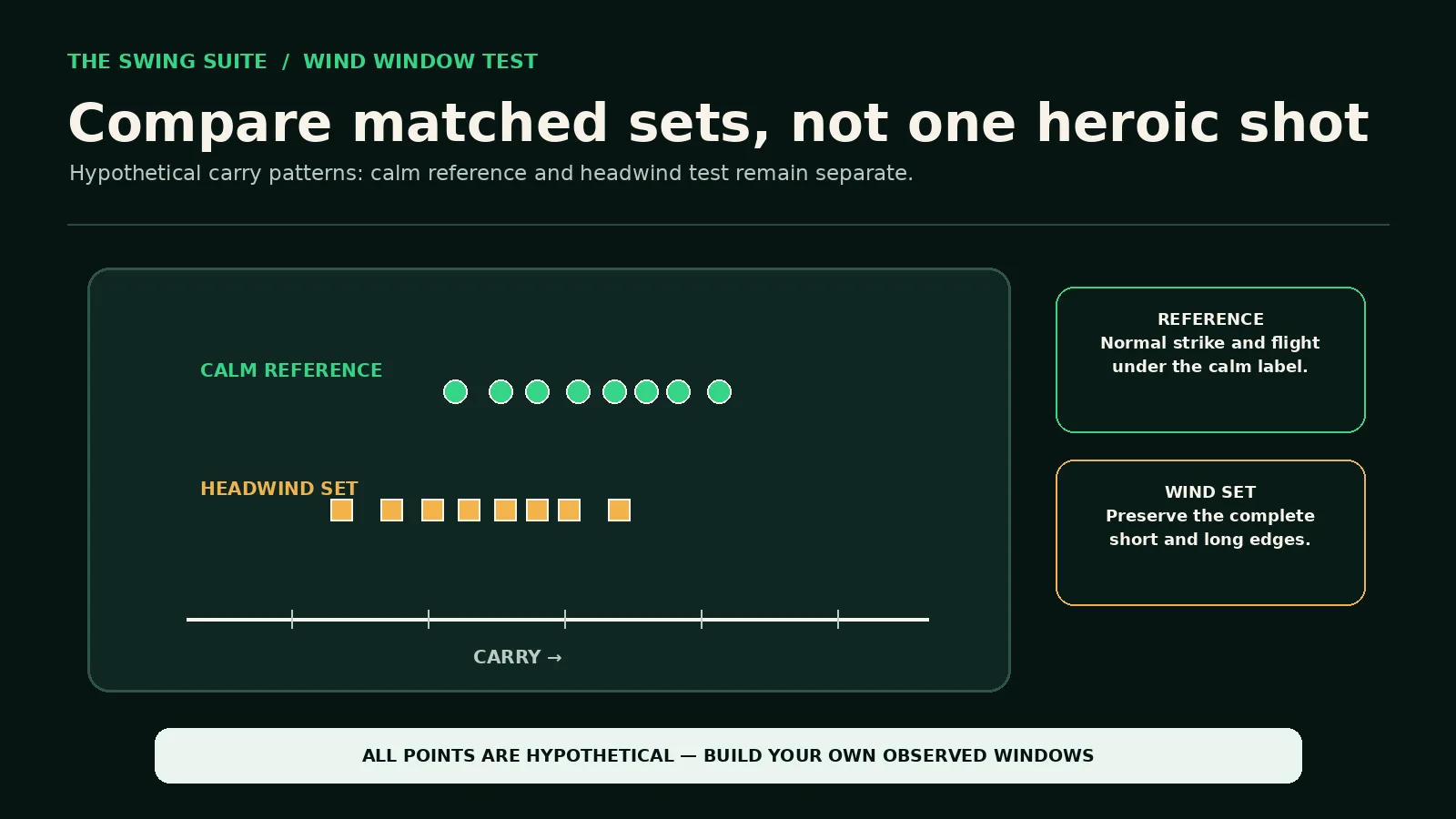
Write the lower, central and upper carry edges for each labelled set. Do not hide the short ordinary miss inside an average or discard the long thin result. A target must contain the relevant pattern, not only the middle number. When the short edge finds a bunker or water, the centre may be irrelevant.
Add a practical finish label: front apron, centre, back fringe, rough, bunker or penalty area. A helping wind may create a familiar carry but a longer total finish. A headwind can create a steeper-looking descent yet still leave a short result. The course decision needs the landing area and the next shot, not just the number in the air.
Use normalisation to compare, not to overwrite reality
TrackMan’s normalisation feature converts measured ball-flight data into a standardised environment. Its purpose is useful comparison across weather, temperature and altitude rather than pretending that the observed outdoor result happened in calm reference air. Keep the normalised and actual values clearly labelled.
Review TrackMan’s explanation of normalisation ↗
For a wind practice session, actual carry describes what the ball did in the labelled condition. Normalised carry can help compare the underlying shot with a reference environment. Do not replace the actual wind result with the normalised number when choosing the course target. The target must contain the flight that the current air is likely to produce.
If normalised carry stays similar while actual carry changes, that may support the view that the shot delivery remained reasonably comparable and the environment altered the flight. If both change, strike or delivery may also have changed. Treat this as a clue for the next matched set, not proof of one cause from one ball.
Build the calm reference first
Choose a day or period with calm or modest steady air. Use one iron, one ball model and one broad landing corridor. Warm up before collecting data. The aim is a representative reference, not the longest possible set. Record strike, launch category, carry, finish and start side for every ordinary ball.
Summarise the lower carry edge, central region, upper edge and common miss. Add measured launch, spin, peak height or landing angle only when captured reliably. Keep the actual values and, if available, the normalised values in separate columns. Date the set and record the surface and weather.
Return to the reference near the end of the session. If the second calm set shifts materially, fatigue or movement may have changed. Preserve both sets. A wind comparison is weaker when the surrounding reference is drifting, and the course rule should become more cautious rather than averaging away the difference.
Test one headwind condition
Use a safe authorised practice area with a broad landing zone. Choose one recognisable headwind label and keep the intended start line fixed. Hit a small set with the same iron and normal intention used for the reference. Record the condition before each ball and the strike before reading the flight.
Summarise the full carry window and the flight pattern. Note whether peak shape, curve or landing behaviour changed, but do not assume every difference was caused only by the wind. Compare the strike labels and normalised values where available. Keep the short edge because it often controls whether a front boundary can be covered.
Then test one practical response: a different club, a slightly different flight intention or a wider target. Change one principal variable where possible. The response succeeds only when its complete representative window fits the real landing area more reliably—not because its best shot reaches the flag.
Test one helping-wind condition
Use the same discipline with a helping wind. Record direction, strength and gust spread. Keep the long carry and total finish visible. A helping wind can create a tempting central number while the upper edge runs through the back of the target. The target must protect that edge as well as the short result from an imperfect strike.
Compare a stock club with one shorter or more containable option. Do not assume that “one less club” is always correct. The useful question is whether the lower edge still reaches a safe landing area and the upper edge stays short of serious trouble. A broad front or centre target may be stronger than a precise flag yardage.
If the helping wind is variable, separate the quieter and stronger ordinary moments. Do not merge them into a smooth average. A decision that works only in the weaker phase is not robust enough when the stronger phase remains likely during the shot.
Treat crosswind as a width problem as well as a carry problem
A crosswind can alter the side corridor and interact with the ball’s existing curvature. Record the start line, initial curve and finish side. A depth window that looks acceptable is not useful if the representative side pattern overlaps trees, a bunker or a penalty area.
Choose the intended start line before labelling the condition. Test whether the flight finishes in one usable band or splits into separate groups. Preserve the widest ordinary result. A strong shot that holds its line does not erase the more common ball that moves towards the exposed edge.
A wider target, different club or simpler flight may be better than aiming farther into trouble and hoping the wind returns the ball. The map should identify the side boundary that cannot be crossed. It should not encourage a golfer to manufacture an exact curve from a condition that is changing.
A 55-minute wind-window session
Minutes 0–8: warm up and choose the corridor
Use a broad safe landing area. Record the ball, iron, intended start line and current weather. Remove any test where people, property or maintenance activity can enter the flight. Warm up until strike and speed feel representative rather than collecting the first loose swings as evidence.
Minutes 8–16: build the reference
Hit a small calm or lowest-wind group. Record strike first, then carry, finish and flight category. Summarise lower, central and upper edges. If the air changes materially, pause or relabel the set rather than pretending the reference remains calm.
Minutes 16–28: collect the wind set
State direction, strength and steadiness before every ball. Keep the club and target stable. Mark gust-affected balls separately. At the end, compare the complete window with the reference and identify whether the short, long or side edge is the practical constraint.
Minutes 28–39: test one response
Change one main variable: club, target or flight intention. Repeat the same recording fields. Judge the response by the complete window and the landing corridor. Do not select it because one shot looked especially controlled.
Minutes 39–47: randomise the decision
Alternate between the reference option and the wind response, or between two target depths. State the condition and target before each ball. This tests whether the decision survives a change of context rather than existing only in a blocked group.
Minutes 47–52: rehearse the refusal condition
Create one target where the wind window does not fit. Choose the wider part of the green, a shorter landing area or a lay-up deliberately. Score the quality of the next position. A refusal rule becomes useful when it is practised rather than merely written.
Minutes 52–55: write the course note
Record the exact condition label, reference window, wind window, response and target-room rule. Mark every number as actual, normalised or hypothetical. Keep the note short enough to use before a shot and date it so later sessions do not silently overwrite the evidence.
Build a scorecard that preserves the flight
Use one row per ball. A compact form can contain wind direction, strength, steadiness, club, strike, launch category, carry, finish, start side and curve. Add actual and normalised values only when both are clearly identified. If the form is too complicated to complete after every ball, remove optional fields.
After the group, summarise the lower carry edge, central region, upper carry or finish edge and side corridor. Keep split patterns visible. If five balls cluster and three ordinary misses form a second group, write both. One average can hide the exact result that makes the flag target irresponsible.
Use cautious language: “observed in a steady moderate headwind”, “short tail attached to heavy contact”, “helping-wind long edge reaches the back”, and “crosswind set needs the centre target”. Avoid “always”, “automatic” and “take two clubs”. The scorecard is conditional evidence, not a law of golf.
Protect the front boundary into the wind
The lower carry edge deserves attention first. Use the representative short results, including ordinary contact losses. If that edge does not clear a bunker, water, false front or rough face, the option needs another club, another target or a simpler objective. The central number cannot rescue a short edge that carries a severe cost.
Match the safety margin to the consequence. Missing a broad front apron is different from failing to carry water. Into a severe front boundary, the club and target should work across the ordinary wind and strike spread. If they require the best strike in the quietest moment, the shot is not ready.
A stronger club may move the whole window, but it can also change launch, spin and strike. Test the complete response rather than adding a memorised number. Sometimes the better answer is the wider side or a lay-up that removes the forced carry.
Protect the back boundary with a helping wind
The upper edge matters when a helping wind combines with a clean or thin strike. Record total finish as well as carry. If the back contains a path, bunker, rough bank or penalty area, preserve that long outcome in the target decision even when most balls finish safely.
A shorter club is useful only if its lower edge still reaches an acceptable landing area. Compare both boundaries. A front-centre target may create room for the short and long results at once. A back flag can remove that room and turn an otherwise manageable flight into a narrow test.
Do not treat a helping wind as free distance. It changes the planning problem. The target should be selected from the full finish window and the quality of the next shot, not from the appeal of hitting less club.
Protect the side boundary in a crosswind
Mark the widest ordinary start and finish sides. If the crosswind set overlaps the exposed edge, aim at a wider section only when the new start line remains safe. Do not aim over severe trouble merely because a strong wind is expected to move the ball back.
The side pattern may widen when the golfer fights the wind or exaggerates a shape. Compare the normal intention with one simpler option. A less ambitious curve, more central target or different club can improve the decision even if the ball finishes farther from the flag.
Score the choice separately from the result. A target gets a pass when it contains the known window, even if the strike is poor. It gets a fail when it requires a precise wind correction the evidence does not support, even if one excellent ball finishes close.
Turn the windows into a course rule
A useful rule names the condition, club or response, target and refusal point. For example: “Steady moderate headwind, representative strike: use the tested stronger option only when the lower edge clears the front and the centre target leaves room long.” Then add: “Gusting or uncertain direction: choose the wider landing area.” The wording is illustrative; the evidence must be yours.
Use the rule only when the live condition resembles the tested label. If the wind is stronger, more quartering or more variable, weaken the rule rather than stretching it. A map from an exposed range may also differ from a sheltered hole where the air changes beyond the trees.
Say the objective before addressing the ball. “Front-centre”, “wide right half” and “lay up short of the cross bunker” create clearer decisions than “adjust for the wind”. If the target cannot be stated simply, the plan probably has competing intentions.
Transfer the test from blocked practice to play
A blocked set reveals the pattern because several shots share one condition. The course offers one ball and one changing observation. Add a transfer phase in which club, target or wind direction changes between shots, and require yourself to state the label and objective before each attempt.
After a round, compare the live condition with the practice label before changing the map. If the exposure, direction or steadiness was different, record a new category rather than declaring the old window wrong. If the condition matched but the representative result fell outside the expected edges, retest and weaken the rule until the evidence improves.
Do not judge the process from proximity to the flag alone. A responsible centre target can finish farther away after an imperfect strike and still be the correct choice. A risky edge target can finish close after a lucky flight and remain a poor policy. The window governs the quality of the decision.
Repeat the condition, not just the favourite result
One session can create a working hypothesis, but it cannot prove a permanent wind formula. Repeat the same label on another day and look for a similar lower, central and upper pattern. Exact values do not need to match perfectly. The question is whether the option still occupies a usable space and the same refusal point remains sensible.
Preserve date, temperature, exposure and ball condition for every version. If the second set is materially wider, confidence should follow the wider evidence rather than a neat average. If the sets agree, the map becomes more useful while remaining conditional on the tested flight and wind label.
Choose the next session from the largest decision uncertainty: the short edge into wind, the long finish with help, the crosswind side corridor or a strike pattern that changes under pressure. Repetition should answer that question rather than merely produce more shots.
Common wind-window patterns and the next test
The headwind set loses carry and strike also worsens
Separate the effects. Compare actual and normalised values where available, and inspect strike labels. Test one calmer motion intention or different club while preserving the same broad target. Do not attribute the entire short edge to the air when contact has changed too.
The helping-wind carry looks manageable but the finish runs long
Keep carry and total separate. Inspect the landing area and the upper finish edge. Test a shorter option or a more forward landing target. Do not use the familiar carry number as proof that the back boundary is safe.
The crosswind result splits into two groups
Preserve both groups. Identify whether strike, starting direction or changing wind separates them. Until the split is understood, choose a target with room for both or use the simpler option. One average finish side describes neither group.
The calm reference is stable and the windy set is not
That may be the real lesson. A wind response should not become a course rule until the ordinary strike and flight are clear enough to support it. Use more target room, reduce the objective and repeat the condition before writing a narrow adjustment.
The first wind set works and the retest becomes mixed
Confidence follows the mixed evidence. Gust spread, fatigue, temperature or movement may have changed. Preserve both sets and make the course rule more cautious. Do not delete the difficult retest because the earlier session produced the answer you preferred.
Common mistakes in wind testing
- Applying a fixed percentage before building a calm reference.
- Calling the wind “into” without recording the intended start line.
- Using one ground-level reading as perfect knowledge of the whole flight.
- Blending steady and gusting conditions in one group.
- Reading carry before writing the strike label.
- Deleting heavy or thin shots because they spoil the average.
- Mixing actual and normalised carry without clear labels.
- Changing club, target and swing intention at the same time.
- Choosing from the best shot instead of the full window.
- Ignoring total finish with a helping wind.
- Ignoring the side corridor in a crosswind.
- Aiming over severe trouble and relying on the wind to return the ball.
- Turning a small practice set into a universal adjustment table.
- Using the flag target before the centre window fits.
The correction is a fixed sequence: choose the start line, label direction and strength, note steadiness, record strike, describe flight, measure carry and finish, compare one response, then choose the target from the complete window. The sequence keeps the air attached to the decision.
Questions golfers often ask
How many clubs should I take into a headwind?
There is no responsible universal number. Wind, launch, spin, speed, strike and target boundaries all matter. Compare a calm reference with a labelled headwind set and test one stronger option. Choose the club whose complete representative window fits the landing area.
Can I use a percentage for every wind speed?
A percentage can look precise while ignoring the player’s flight and strike response. Use any calculation only as a starting hypothesis, then verify it against observed windows. Do not let a formula override a short or long edge that the target cannot contain.
Should I always swing easier in the wind?
That is a technical choice to test rather than a universal instruction. Compare one normal intention with one calmer option and judge strike, flight and the full window. A feel is useful only when the representative pattern and target improve together.
Does normalised carry tell me what club to hit outside?
Normalised carry supports comparison by placing data in a standard environment. The outdoor target still needs the actual flight under the current condition. Keep actual and normalised values separate and use both to understand the test rather than substituting one for the other.
How do I judge a gusty wind?
Record the spread and choose for the stronger ordinary phase when the consequence is severe. If the direction or strength changes beyond the tested window, use more room or reduce the objective. Exact prediction is not required for a responsible target.
How many shots make a wind window reliable?
No small group proves a permanent rule. Use enough attentive shots to show more than one outcome, keep ordinary misses and repeat the condition on another day. Consistent labels and honest recording matter more than a large mixed bucket.
A simple wind-adjusted iron checklist
- Choose the intended start line before naming the wind.
- Label direction, strength and steadiness separately.
- Build a current calm or lowest-wind reference.
- Record strike before flight or carry.
- Keep actual and normalised values clearly separated.
- Preserve ordinary heavy and thin outcomes.
- Use lower, central and upper carry edges rather than one average.
- Record total finish and the side corridor.
- Compare one practical response at a time.
- Protect the front boundary into wind and the back boundary with help.
- Choose the widest responsible target before considering the flag.
- Write a clear refusal condition for gusts or uncertainty.
- Retest as weather, equipment or movement changes.
The checklist is designed to create a decision, not a weather slogan. Wind becomes more manageable when the golfer knows the reference, can identify the current condition, understands the representative strike and flight, and chooses a target with room for the full pattern.
A hypothetical note might read: “Steady moderate headwind, centred 7-iron strikes; actual carry 138–146 metres with a central group at 141–144, one heavy 134 and a stable side corridor. Use the stronger tested option only when the front is below 132 and long trouble begins beyond 154; otherwise play to the front-centre.” Every number is illustrative; build yours from measured shots.
Turn the result into one coaching priority
A structured lesson can reduce a mixed wind pattern to one useful priority: strike under pressure, launch consistency, spin control, club choice, start line or target selection. Bring the scorecard. The coach can compare actual and normalised data and keep any technical change attached to a course decision.
Measured data should narrow the next experiment. If the short edge is attached to heavy contact, strike may be the priority. If strike is stable but the headwind window remains broad, club and target may matter more. If depth is contained but the crosswind side pattern is wide, start line and strategy may be the next test.
Finish with a refusal condition. “If the gust spread or direction is outside my tested label, I choose the wider centre target” is more useful than a table of best shots. The goal is not to calculate the wind perfectly. It is to know when the evidence supports the intended iron shot and when more room protects the score.
Compare this with front-middle-back approach-shot carry decisions ↗
Review the map as conditions change
Retest when the season, temperature, altitude, ball, equipment, speed or normal flight changes. Keep dated versions rather than editing the past into one permanent formula. A useful map shows the reference and wind condition that produced it.
After a round, record the live direction, steadiness, chosen target and result without judging the whole method from one ball. Ask whether the relevant window had room, whether the strike remained representative and whether the refusal condition should have applied.
Current Swing Suite lesson options, venues and availability remain on the live booking page rather than being hard-coded here. The goal is a practical wind-adjusted iron window: establish the reference, label the air, keep strike attached to flight, and choose the target from the complete observed pattern.