
A reliable rough-lie carry window begins by refusing to treat every patch of longer grass as the same condition. Label the lie, test a matched club and intention, record strike, launch and carry, and preserve the heavy shots and high-launch outliers. The useful answer is not one average. It is the range of representative outcomes that can safely fit between the short and long boundaries of the next shot.
The practical outcome is a small decision map. You should know what a clean first-cut lie tends to produce, what changes when the ball sits up, what happens when it settles down, and when deeper grass removes the green from the sensible plan. That map does not promise a universal adjustment. It helps you choose a club, target or recovery objective from evidence you can actually recognise.
All yardages, launch patterns and scorecard examples in this guide are hypothetical unless they come from your own measured session. Grass species, depth, moisture, grain, ball position, slope, club design, speed and strike can change the result. Never convert one range session into a permanent “rough adds or subtracts this many yards” rule.
The direct answer: label, strike, launch, carry, decide
Create three or four repeatable lie categories on an approved practice area: first cut, sitting up, sitting down and deep or tangled. Begin with one club and one target. Hit a clean-lie baseline, then a small set from one rough category. After every shot, record the lie label, strike quality, launch behaviour, carry and finish. Keep the target and scoring method fixed.
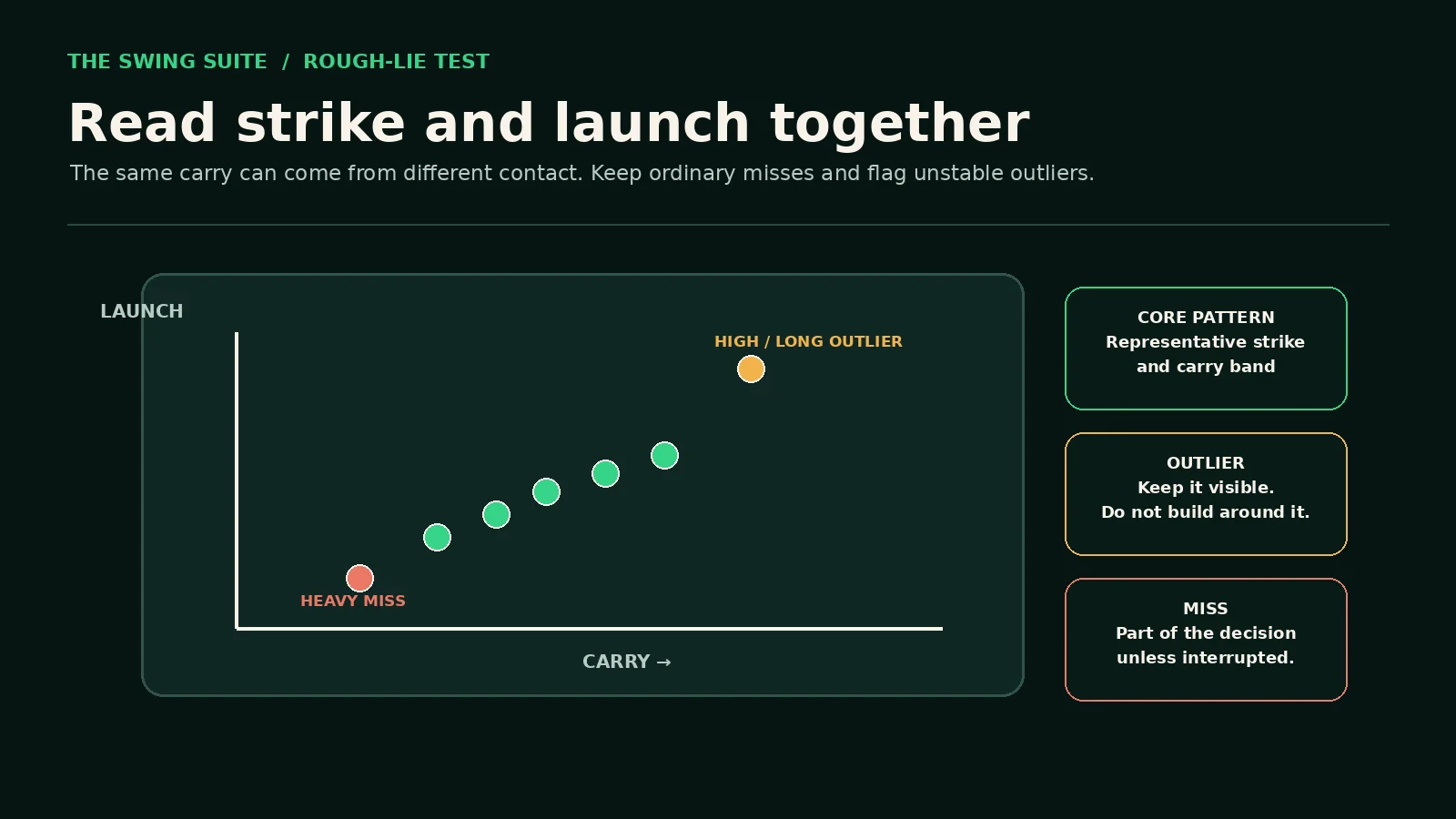
Compare complete groups rather than the best strike. Identify the central carry band, the short miss and any high or long outlier. Then ask whether the whole relevant pattern fits the intended landing area. If a ball sitting up occasionally launches higher and carries farther, that outcome belongs in the decision even when it looks attractive. If a sitting-down lie produces heavy contact, that short result belongs too.
On the course, match the live lie to the closest tested label, then use the cautious edge of the window. Protect the expensive boundary first. If short brings a bunker or penalty area into play, choose an option whose representative low carry clears it or aim elsewhere. If a long outlier reaches trouble, add depth margin rather than selecting from the average alone.
Why a single “rough number” fails
A single adjustment assumes that rough behaves consistently. It does not. A ball can perch on top of grass with relatively little material between face and ball, settle halfway down, or sit at the base of dense stems. Those conditions change the club’s access, strike and launch in different ways. Two balls only a metre apart can therefore belong to different tests.
The same lie can also create more than one outcome. One strike may come out normally, another may lose speed and carry, and another may launch unusually high with reduced spin. Averaging those balls can produce a number that describes none of them. A course decision needs the shape and width of the pattern, not merely its centre.
Use the language of windows instead. A carry window has a representative lower edge, a central region and an upper edge. It also has a confidence label tied to the lie. A narrow, repeatedly observed first-cut window can support a more precise target. A wide or two-part deep-rough pattern should move the target towards safety or change the objective to a controlled advance.
Build lie labels you can recognise again
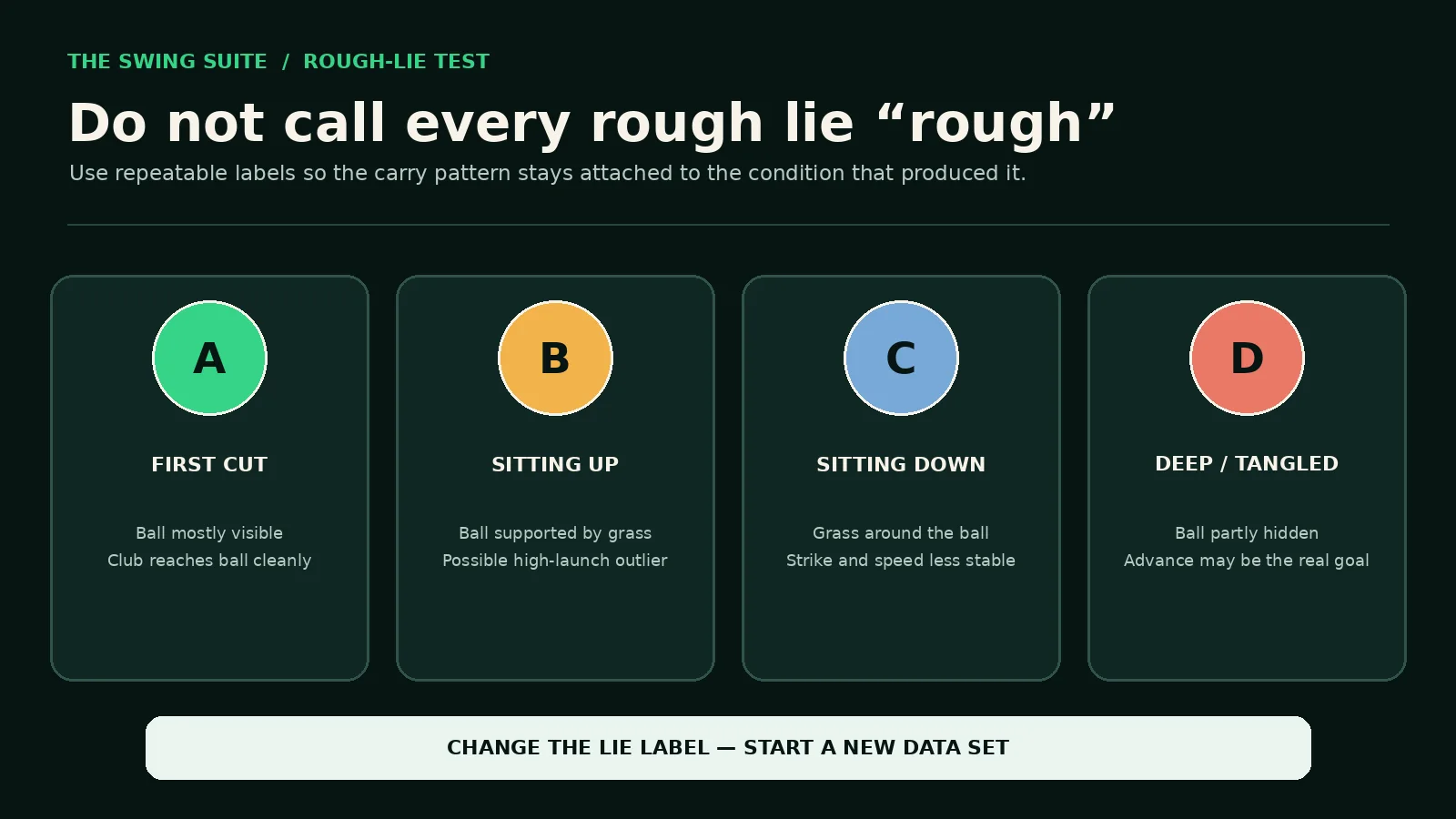
Start with visible, practical features rather than millimetres you cannot reproduce. “First cut” might mean the ball is almost fully visible and the club can approach without dense grass at the back. “Sitting up” means the ball is supported above the soil. “Sitting down” means grass surrounds the equator. “Deep or tangled” means the ball is partly hidden and access is uncertain.
Add moisture and grain when they are obvious. Wet grass can change resistance and reduce confidence in contact. Strong grain can alter how the club enters and exits. Do not create so many labels that every ball becomes unique, but do not merge visibly different lies merely to make the spreadsheet neat. Four useful categories beat one vague category or fifteen unreproducible ones.
Photograph the practice lie from above and from the target line when the facility permits it. The photograph is not proof that every future lie will behave identically, but it helps you remember what the label meant. Keep the image with the date, club, ball and surface notes so a later retest can identify genuine drift rather than a changed condition.
Separate lie quality from shot intention
Do not compare a full 7-iron from first cut with a guided 8-iron from deep rough and call the difference a lie effect. The club and intention changed as well. Build the first comparison with one club, one target, one ball type and one clearly described motion. Only after that baseline is visible should you test a different club or a deliberate recovery intention.
Plain intention labels are enough: normal committed swing, controlled three-quarter motion, or advance-to-safety swing. Avoid pretending that a swing was exactly 70 per cent. The label should help you repeat the task, not add false precision. If the smaller motion changes strike quality, record that as part of the option rather than assuming less speed automatically creates more control.
When you change club, begin a new group. A more lofted club may improve access and stopping potential, while a stronger club may produce a lower flight or more run, but those are questions for the player’s evidence. Do not force equipment theory onto a pattern that says the opposite. The winning option is the one whose representative outcomes fit the available space.
Record strike before interpreting the flight
Strike is the first explanation field because rough can make the flight look informative when the contact was not representative. Record centred, heavy, thin, heel, toe or uncertain. Add “grass first” when the club clearly meets substantial material before the ball. A low carry from a heavy strike should not be blended silently with solid contact and treated as one smooth distance curve.
Keep ordinary misses. Removing them because they were “bad swings” makes the carry window falsely narrow. Exclude only a genuine interruption, measurement failure, wrong ball or clearly different task, and write the reason. The course pattern must include the contact you can actually produce from that lie under ordinary pressure.
Look for clusters. If five representative strikes form one carry band and two heavy contacts finish much shorter, the decision may have a central window plus a meaningful short tail. If the heavy outcome is common, it is not a tail; it is the pattern. The language should become more cautious as the short result becomes more likely or more costly.
Use launch as a description, not a verdict
TrackMan defines launch angle as the vertical angle of the ball immediately after it leaves the clubface relative to the ground plane. It is useful because rough can alter how the ball begins its flight, but the number does not tell you whether the shot is good. Launch must be read beside strike, speed, carry, height, landing and the intended target.
Review TrackMan’s launch-angle definition ↗
Without a launch monitor, use stable categories: low, expected, high and unusually high. Tie those categories to a visual reference or to the clean-lie baseline. Do not invent degree estimates. The aim is to identify whether one lie creates a repeatable launch band or whether it produces two different families that need separate risk treatment.
A high launch is not automatically a flyer, and a low launch is not automatically safe. A high ball may carry less because speed fell; a lower ball may run beyond the target. Record what actually happened. The useful sequence is strike, launch, carry and finish—not a dramatic label applied from the first second of flight.
Measure carry consistently
TrackMan defines carry as the straight-line distance from the ball’s starting position to the landing point. That makes carry a useful depth measure for clearing a bunker, bank, rough strip or front edge. Total distance answers a different question because it includes what happens after landing. Keep carry and finish separate when the target has important short and long boundaries.
Review TrackMan’s carry definition ↗
Use one unit throughout the session and state whether the monitor is normalised or measured in current conditions. Outdoors, wind, temperature and elevation affect the observed ball. Indoors, simulated turf and calculated landing behaviour are not identical to a real rough lie. The test is strongest when the lie is real, the carry measurement is consistent and the course decision keeps those limitations visible.
Do not round a wide pattern into a confident club number. If representative balls carry across a broad band, write the band. If one subgroup is tied to a visible lie difference, split the label and retest. Precision in the notebook should reflect precision in the shots; extra decimal places cannot rescue a mixed or unstable task.
Treat spin information with care
TrackMan describes spin rate as the amount the ball rotates around its axis each minute. It is useful context, but rough can make measured or estimated spin less stable. Read the value beside strike, launch, ball speed, height, carry and landing. Do not infer a guaranteed flyer merely because one spin number is lower than the clean-lie baseline.
Review TrackMan’s spin-rate definition ↗
TrackMan’s Spin Rate Difference parameter compares expected spin from launch conditions with measured spin, and TrackMan notes that negative values can signal a possible flyer from rough. That is a diagnostic clue, not a universal prediction. A negative result should prompt you to inspect the lie and full flight, then look for repetition across matched shots.
Review TrackMan’s Spin Rate Difference explanation ↗
If spin is not measured reliably for a shot, keep the other fields and mark spin unavailable. Do not fill the gap with a guess. Launch, carry, height, landing and finish still support a useful decision. A smaller set of trustworthy observations is better than a complete-looking table built from unstable or inferred numbers.
Know which measurements are reliable
TrackMan’s current TM4 data guidance distinguishes measured and calculated parameters and notes that reliable spin measurement depends on conditions. The practical lesson is to know what your session actually captured. Before using a number in the carry map, confirm that the system reported it, that the shot was tracked correctly and that the result belongs to the intended group.
Review TrackMan 4 data guidance ↗
When a shot is missed by the monitor, record the visible result only if you can do so honestly, and do not invent the absent values. Mark it “unmeasured, observed short” or repeat the shot while preserving the original note. Deleting every untracked poor strike can bias the window just as surely as deleting a tracked heavy one.
Use video carefully. A face-on or down-the-line clip can help classify the lie and motion, but it may not reveal exact contact or carry. Keep video as context rather than converting visual impressions into measured claims. The scorecard should distinguish what the monitor measured, what you observed and what remains uncertain.
Establish a clean-lie reference
Begin with a small clean-lie group using the same ball, club and target. The purpose is not to prove your stock yardage. It creates a session reference for strike, launch and carry under the day’s conditions. Warm up first, then record only the labelled baseline set so early stiffness does not become part of the comparison by accident.
Keep the clean-lie target broad enough to encourage normal swings. If the target is narrow or intimidating, you may alter the motion before the rough test begins. Record the central carry band and ordinary misses. The baseline should be honest enough that the later rough pattern can be compared with it without flattering either group.
Return to the clean lie near the end. If the baseline shifts materially, fatigue, adaptation or conditions may have changed. That does not invalidate the session, but it weakens direct comparison. Note the shift and repeat the rough category another day rather than forcing one tidy conclusion from moving inputs.
Test first cut before deeper grass
First cut is the best starting category because the ball is usually visible and the task remains close to ordinary contact. Place or find several comparable lies without improving the ball beyond the practice rules. Use the same club and intention as the clean baseline. Record every attempt before discussing technique or changing target.
Compare strike distribution first. If centred contact remains common, inspect launch and carry. If heavy contact increases, the first-cut window may widen mainly on the short side. If a high-launch group appears, keep those balls visible and ask whether the lie photographs show the ball sitting higher. The pattern should drive the next label.
Do not assume first cut always removes distance. Some players may produce a similar central carry with more variation, while others may see a clear loss or an occasional longer result. The article’s method deliberately avoids a fixed adjustment because the useful answer belongs to the player, club, lie and day.
Split sitting-up and sitting-down lies
A ball sitting up can tempt a player to expect a clean strike, yet the elevated position may change contact on the face or pass more grass between face and ball. Treat it as its own category. Record whether the strike feels high or uncertain, but let launch, carry and finish show whether that impression mattered.
A sitting-down ball asks a different access question. The club may meet more grass before impact, and the player may respond by adding effort or steepness. Keep the normal intention for the first set. If the group becomes unstable, the result is useful: it may show that the green-target option has no dependable window from that label.
Do not combine the two categories because both are “medium rough”. Their risk can point in opposite directions. A sitting-up lie may create a high or long outlier; a sitting-down lie may create a short or low-speed outcome. The target and club decision must protect against the relevant side, so the labels need to remain separate.
Use deep rough to test the objective, not bravery
Deep or tangled grass may make precise carry control unrealistic. Begin by asking whether the club can reach the ball and whether the player can keep balance. Use a safer lofted option and a broad advance area where appropriate. The first objective may be to return the ball to playable ground, not to reproduce a normal approach distance.
Record the shortest representative outcome, not only the balls that escape cleanly. If several shots barely advance, that is central evidence. If one ball jumps out and travels much farther, keep it as an outlier rather than allowing it to redefine the plan. The correct course response may be a target that contains both or a different club that narrows the spread.
Stop when the practice area, footing or grass creates risk to the player, equipment or other users. Do not create artificial deep lies beside stones, roots, paths or hidden objects. A useful test is controlled and repeatable. It does not require recreating every dangerous course situation.
Build the scorecard
Give every ball a row with date, lie label, club, intention, strike, launch category, carry, finish and note. Add measured spin or height only when reliable. Keep the fields short enough to complete after each shot. Delayed batch entry invites memory to promote the best strike and forget the ordinary miss.
After the group, add three summaries: representative lower carry, central carry region and representative upper carry. Then list any separate outlier family. Do not calculate a lower or upper boundary from one obvious mishit unless that mishit is part of the repeatable risk. The boundary should describe the outcomes you need to plan for, with the raw rows preserved underneath.
Use cautious language: “observed in this test”, “likely first-cut window”, “short tail from heavy contact” and “possible high-launch outlier”. Avoid “always”, “guaranteed” and “this lie goes ten yards farther”. The scorecard is a dated decision aid, not a law of rough physics.
A 55-minute rough-lie carry session
Minutes 0–8: warm up and inspect the area
Hit ordinary shots towards a broad target, then walk the approved practice area and identify safe, comparable lie categories. Remove any station with stones, roots, poor footing or a line that could endanger others. Decide the club, ball and target before recording begins.
Minutes 8–16: clean-lie baseline
Hit a small labelled set from a clean lie. Record strike, launch category, carry and finish. Preserve misses. Write the central band and short or long edge without changing technique. This is the session reference, not a competition for the best ball.
Minutes 16–27: first-cut test
Use the same club, intention and target from comparable first-cut lies. Photograph the category if permitted. Record each ball immediately. Compare strike first, then launch and carry. Do not move the target or choose a different club after one surprising result.
Minutes 27–38: sitting-up or sitting-down test
Choose one category, not a mixture. Complete the same process. If the lie changes materially, stop the set and relabel it. Keep high or short outliers visible. The purpose is to learn whether one recognisable condition creates a different carry family.
Minutes 38–46: test one course option
Choose one evidence-led change: more loft, less ambitious target or controlled motion. Start a new group and state the objective. Compare whether the complete window becomes more useful. One attractive strike does not beat a narrower representative pattern.
Minutes 46–52: matched retest
Return to the leading rough category and repeat the original club and intention. A similar window increases confidence; a changed window exposes uncertainty. Record the change rather than averaging both sets into a false stable answer.
Minutes 52–55: write the course rule
Write one sentence naming the lie, club, carry window, costly boundary and simple alternative. For example: “From a visible first-cut lie, this club produced a broad carry band with a high outlier; aim to the deep safe side, and choose the lofted advance if long brings trouble into play.”
Turn the window into target selection
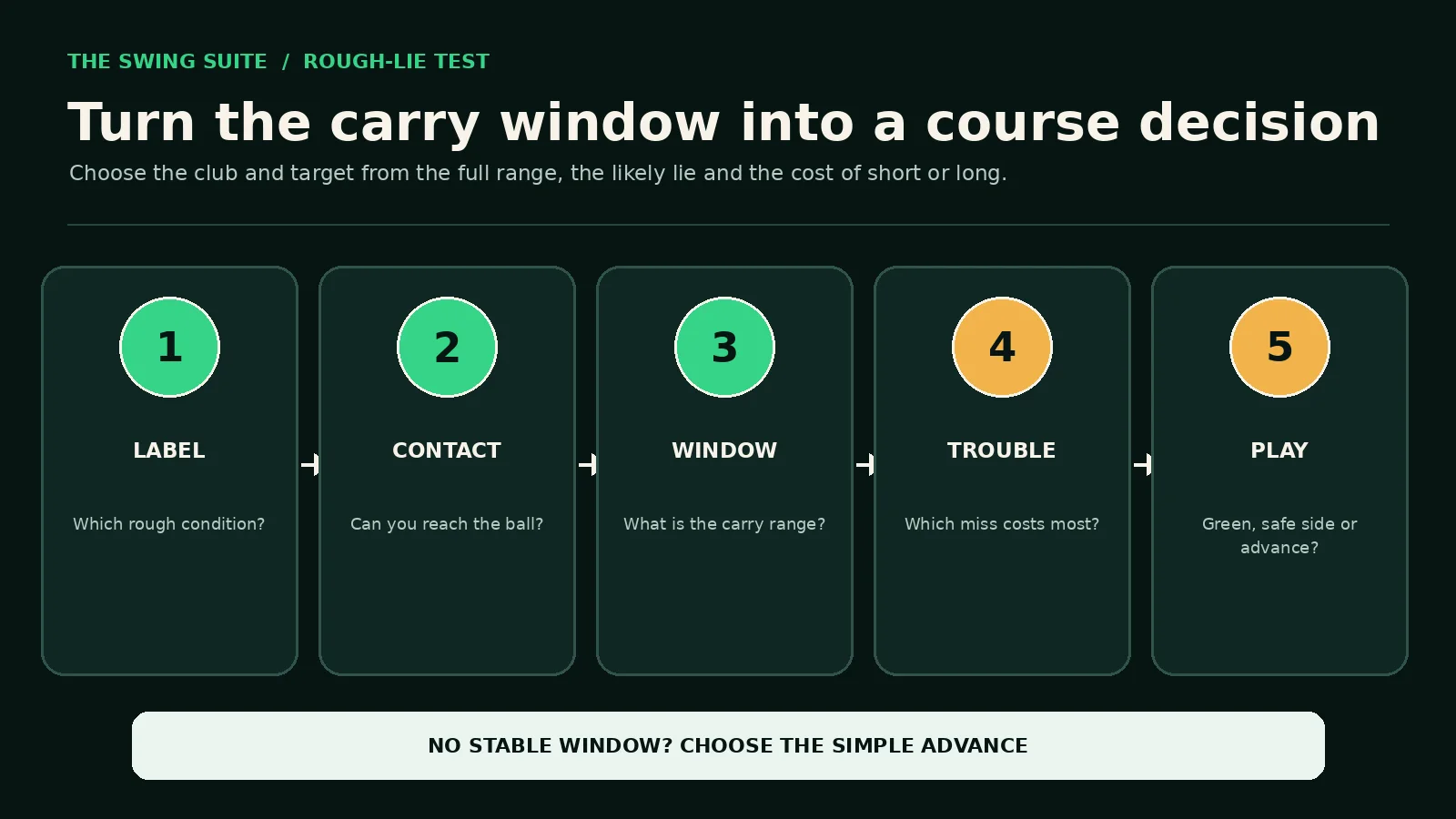
Begin with the landing area, not the flag. Mark the short boundary, long boundary and side that offers the safest next shot. Place the carry window over that space. If the representative lower edge fails to clear the short hazard, the club does not fit. If the upper edge reaches long trouble, move target, change club or reduce the objective.
Use the centre only after both edges have room. Averages are helpful summaries, but course safety lives at the boundaries. The target should contain the likely pattern with extra allowance for uncertainty, wind, slope and a less-than-perfect lie match. If that space does not exist, the green may not be the correct destination.
Choose a safe side that still works after the rough pattern widens. Aiming at a pin tucked beside trouble can turn a normal outlier into a large cost. A broad part of the green, fairway apron or lay-up area may produce the better next shot even when it is farther from the hole.
Protect against the short result
Short risk matters when a bunker lip, water, bank or another strip of heavy rough sits ahead. Use the representative lower carry, including the short tail when it occurs often enough to matter. Do not choose the club because its average clears. If the lower edge overlaps the hazard, find more loft, more club only when access permits, or a different route.
More club is not automatically safer from rough. A longer shaft or lower loft may reduce access and widen strike. Test the alternative rather than assuming it shifts the whole window forward. The correct change is the one that improves the lower boundary without creating an unacceptable long result or contact problem.
When the lie is deep, the safest short-side solution may be a lateral or diagonal advance. That decision protects the score by removing the hazard from the immediate carry requirement. A recovery target can be successful even when it leaves a longer next shot.
Protect against the long or high-launch result
Long risk matters when the green falls away, a path or penalty area sits beyond, or the safe landing zone narrows with depth. Keep any repeatable high-launch or reduced-spin outlier visible. Do not delete it because it happened only on the cleanest contact; the course lie may produce that contact again.
Add margin by choosing a shorter target, more open side or club whose tested upper edge stays inside the area. If the outlier is rare but severe, describe the uncertainty explicitly. The decision should reflect both probability and consequence without pretending that a small session measures either perfectly.
Remember that finish can differ even when carry is similar. A ball arriving with different height, speed or spin may stop or release differently. Record the actual finish during outdoor tests and avoid turning simulator roll into a precise course forecast. The long boundary should protect against both carry and likely release.
Choose club from access and window together
Ask whether the club can reach the back of the ball before asking how far it normally goes. A strong-lofted club that cannot access the ball cleanly may create a larger short tail than a shorter, more lofted option. The carry map should therefore begin with lie access and strike distribution, not a stock-distance chart.
Compare only sensible candidates. Test a club that can clear the immediate boundary and one safer lofted option. Preserve the same lie label and target. If the lies cannot be made comparable, mark the limitation and repeat another day. Do not claim a precise club comparison from one perched ball and one buried ball.
Keep the option that produces the best playable pattern. That may be the club with less average carry but a narrower window, or the club whose lower edge clears the front while the upper edge remains short of trouble. Distance gained is useful only after access and containment are solved.
Common patterns and the next test
The carry window is mostly short with one normal-looking ball
Treat the normal-looking ball as an outlier until it repeats. Inspect whether it came from a better lie or strike. Test a more lofted club or simpler advance objective. Do not build the course plan around the one ball that escaped the central pattern.
Launch is high and carry varies both ways
Separate strike and ball speed if available. The high flight may include both weak contact and a longer outlier. Split the rows by visible lie and strike, then retest. A two-part pattern needs more target margin than one average suggests.
Strike feels solid but the ball runs too far
Keep carry and finish separate. Test a more lofted option or a safer landing area, and verify outdoors. Do not assume a solid strike makes the result suitable; the complete depth pattern must fit the target.
The first test is narrow and the retest is wide
Confidence should follow the wider evidence. Conditions, fatigue or lie matching may have changed. Preserve both sets, reduce course ambition and repeat on another day before writing a strong rule.
Spin is missing or inconsistent
Use the trustworthy fields: strike, launch, carry, height and finish. Mark spin unavailable. Do not manufacture a flyer diagnosis from appearance alone. Retest when measurement conditions improve if spin is important to the question.
Common mistakes in rough-lie testing
- Calling every lie “rough” and merging incompatible conditions.
- Comparing different clubs, targets and swing intentions in one group.
- Deleting heavy shots because they spoil the average.
- Building the plan around one high or long outlier.
- Using one average without the lower and upper carry edges.
- Treating launch or spin as a verdict without strike and carry.
- Assuming a fixed rough adjustment applies to every player and course.
- Using simulated run as an exact outdoor forecast.
- Changing technique before recording a baseline.
- Testing from unsafe lies near roots, stones or unstable footing.
- Choosing the flag before checking whether the whole window fits.
- Failing to retest the original condition after the comparison.
The correction is a governed sequence: label the lie, preserve one club and intention, record strike, describe launch, measure carry, keep outliers, retest and then choose the target from the boundaries. That process makes uncertainty visible instead of hiding it inside a tidy distance number.
Questions golfers often ask
How much distance does rough take off?
There is no responsible universal number. The effect depends on the lie, club, player, strike and conditions, and some lies can produce a longer outlier rather than a simple loss. Build a personal carry window for recognisable categories and use its boundaries.
What is a flyer lie?
Use the term cautiously for a lie and flight that may produce reduced spin and an unexpectedly long or different trajectory. TrackMan’s Spin Rate Difference can offer context, but one value does not prove the result. Inspect the lie, strike, launch, carry and repetition.
Should I always take more club from rough?
No. More club may shift carry, but it can also reduce access or widen strike. Test sensible candidates. Choose the club whose complete window fits the landing area, not the club whose stock yardage looks closest on paper.
Should I hit down harder?
Do not begin with an exaggerated technical response. Record the normal committed baseline first. If contact is unstable, test one coached change or a different club and compare the full pattern. Added effort is not evidence of better access.
How many shots do I need?
No small set proves a permanent rule. Use enough attentive shots to show more than one outcome, preserve misses and repeat the task on another day. Consistency of lie and scoring matters more than a large mixed bucket.
Can I practise this indoors?
You can compare measured launch and carry from appropriate simulated or prepared lies only when the facility permits it, but ordinary mats do not reproduce real rough. Use indoor work for measurement habits and verify the lie-dependent pattern outdoors in an approved area.
What if the rough is beside a path or abnormal condition?
Before playing, check whether relief is available under the Rules. Rule 16 covers certain abnormal course conditions, dangerous animal conditions and embedded balls, with exact procedures and exceptions. Use the official Rule for the live situation rather than assuming every difficult lie is simply played as it lies.
Review Rule 16: Relief from Abnormal Course Conditions ↗
A simple rough-lie decision checklist
- Confirm the lie and footing are safe.
- Check whether a Rule may provide relief before testing a risky stroke.
- Match the ball to a recognisable lie label.
- Ask whether the selected club can reach the ball.
- Use the representative lower and upper carry edges, not only the average.
- Keep heavy misses and high or long outliers visible.
- Protect the most expensive short or long boundary first.
- Choose a broad target that contains the full relevant window.
- Change club or objective when the window does not fit.
- Use a simple advance from deep or unstable rough.
- Retest the lie category before turning it into a strong course rule.
This checklist keeps the decision attached to evidence. The aim is not to predict every blade of grass. It is to recognise when the current lie resembles a tested condition, when the carry pattern has enough room and when uncertainty should move the target away from trouble.
A concise course note might read: “First cut, ball mostly visible, controlled 8-iron; representative carry 118–126 metres with one higher long ball; use only when the front clears below 115 and the deep safe side extends beyond 130. Otherwise play to the apron.” Every number in that example is hypothetical; your note must use your own data.
Use the Rules before forcing the shot
A difficult rough lie is not automatically an abnormal course condition, but nearby ground, an obstruction, a dangerous animal condition or an embedded ball may bring Rule 16 into the decision. Exact definitions, reference points and relief areas matter. Check the official Rule before lifting or moving the ball.
Relief and recovery are parts of course management, not signs that the practice failed. The carry map helps only after the correct lie is established. If relief changes the ball’s position or condition, reassess the label and target. Do not carry the original rough adjustment into a materially different lie without checking it.
This guide is a practice framework, not a complete ruling for every situation. When penalty areas, unplayable balls, movable obstructions or local rules may apply, identify the relevant Rule and procedure. The responsible choice can be relief, a simple advance or a different target rather than a technically ambitious strike.
Turn the test into one coaching priority
A structured lesson can reduce a wide rough pattern to one useful priority: lie recognition, access, strike, launch control, club choice or target selection. Bring the scorecard and photographs. The coach can recreate the task, identify which measurement matters and keep the technical change tied to a practical outcome.
Measured data should narrow the next experiment. If strike explains most of the short tail, the next session may focus on access and club choice. If strike is stable but launch and carry split into two families, the next test may separate sitting-up and sitting-down lies. The data is useful when it improves the question.
Avoid leaving with a speech about numbers and no course rule. Finish with one lie label, one leading club or objective, one carry window, one costly boundary and one refusal condition. That is enough to guide the next round while preserving uncertainty for the retest.
See the related guide to controlling low point ↗
Review the map as conditions change
Retest when the season changes, the rough becomes wetter or denser, equipment changes, speed changes or the old window stops matching the course. Keep the dated versions rather than editing the past into one permanent number. A useful map shows where the evidence came from and when it may no longer transfer.
After a round, record the live lie, intended carry and actual result without judging the whole method from one shot. A good outcome can come from a weak decision, and a poor outcome can come from a sensible target. Compare whether the ball belonged to the expected window and whether the chosen area contained the relevant miss.
Current Swing Suite lesson options, venues and availability remain on the live booking page rather than being hard-coded here. The goal is a practical rough-lie map: recognise the condition, measure a representative carry window and choose the safest target or recovery objective that contains it.