

A reliable fairway-wood carry number from turf is not the longest shot you can produce and it is not a blended average of turf, tee and perfect-mat strikes. It is a labelled window built from representative shots taken from the ground: a short-side carry, a typical carry and a long-side carry, supported by strike and direction notes. That window should be wide enough to describe what you actually do and specific enough to guide a carry over trouble or into a landing area.
The central task is separation. Keep turf shots separate from tee shots. Keep ordinary valid misses in the set. Record where the ball carries as well as whether contact, launch and direction were useful. Then choose safe front and back limits for the course problem instead of asking one average to make the whole decision.
This guide uses hypothetical yardages only. Fairway-wood loft, shaft, ball, speed, technique, turf, weather and launch-monitor environment all change the result. Build your own window under known conditions, date it and retest it when the pattern changes. The aim is a practical decision tool, not a universal benchmark for what a 3-wood, 5-wood or 7-wood should do.
The direct answer: build a short, typical and long carry from turf
Warm up, choose one fairway wood and hit a baseline set from the ground to a defined target. Use the same ball type and a representative turf or hitting surface. Record every valid shot. For each one, note carry, left-right finish or carry side, and a simple strike label such as centred, low on the face, heavy or thin. Do not erase a common miss just because it makes the range untidy.
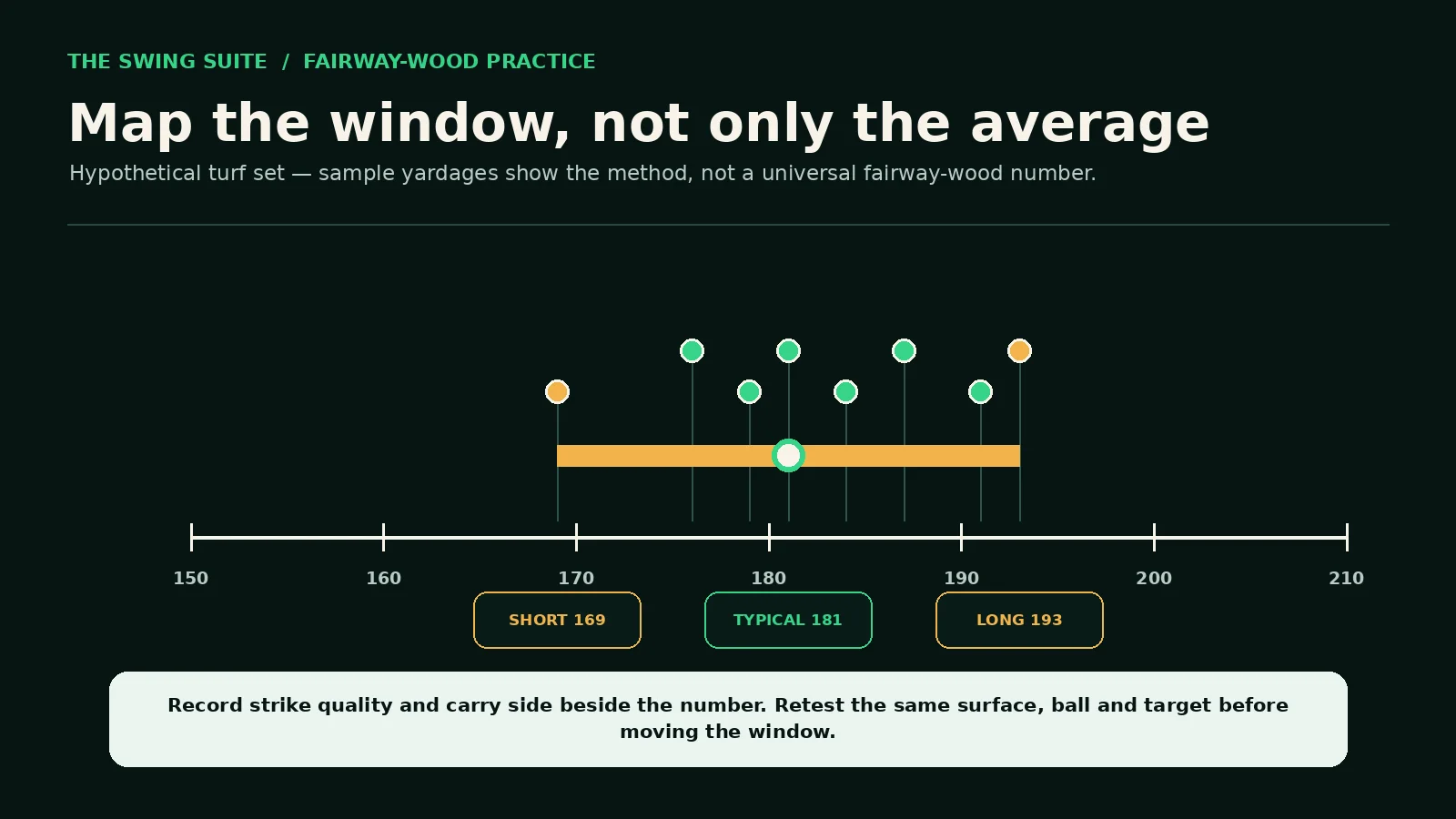
Summarise the set with three working references. The short-side carry describes the lower end you may need to clear a front problem. The typical carry describes the centre of the current pattern. The long-side carry shows what can reach the back problem. These can be practical summaries rather than formal percentiles, but the method must remain consistent from one test to the next.
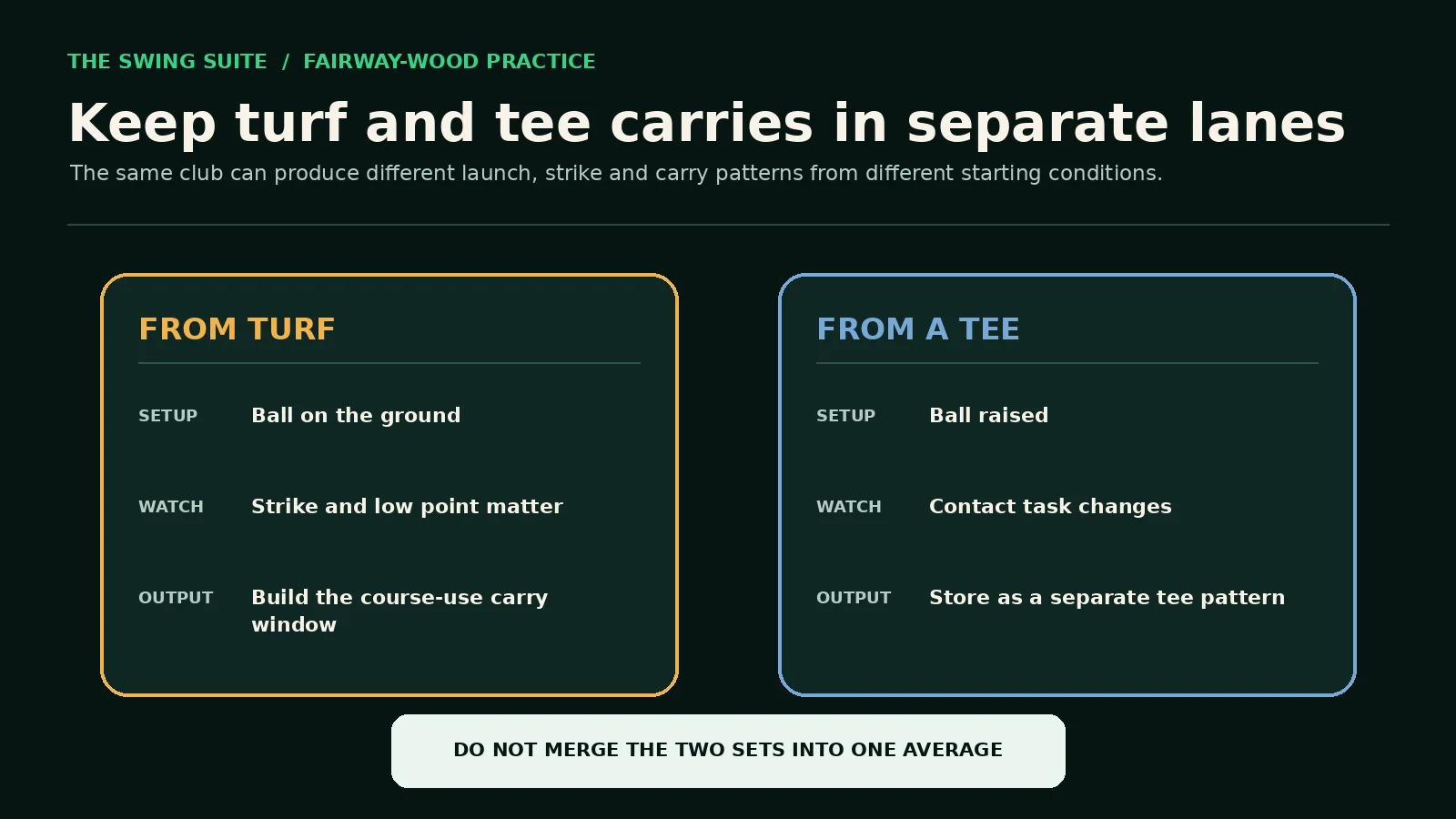
Store a separate tee pattern if you also use the club from a tee. Compare the two later, but do not merge them. A raised ball changes the contact task and may change launch, strike location, attack angle and carry. The turf window is the one to use when the ball is sitting on the ground and the shot must be produced from that condition.
Why fairway-wood carry from turf deserves its own test
A fairway wood asks the player to launch a relatively long club from a ball resting on the ground. There is little room to hide a low point that arrives too early, a strike that is too low on the face or a delivery that changes dramatically from one swing to the next. The result can look powerful on the best ball and uncertain across the complete group.
That uncertainty matters because fairway woods are often used for decisions with real boundaries: clearing a cross bunker, carrying rough to a lay-up zone, reaching the front of a par-five green, or staying short of trouble beyond a landing area. The important question is not whether one shot can fly far enough. It is whether the useful part of the current pattern fits between the front and back limits.
Testing from turf also prevents a comforting tee result from becoming the default memory. A player may strike the same club well when the ball is raised, then assume that carry transfers to a tight fairway lie. Sometimes it does. Sometimes the turf set is shorter, wider or shaped differently. Only a separated test can show which description is more honest for the shot being planned.
Start by defining the exact shot you are mapping
Name the club, starting surface, ball, target and intended flight before the first recorded swing. “5-wood from turf towards the centre target” is more useful than “hit some woods”. If you are indoors, record the mat and ball. If you are outdoors, record whether the lie is fairway-like, light rough, damp, firm or uneven. The label is part of the data because it limits what the result can honestly represent.
Use a stock shot unless the purpose is to map a deliberate alternative. A reduced flight, cut, draw or choked-down fairway wood can be valuable, but it should have its own identity. Combining several intentions into one set creates a wide number without explaining why it is wide. The practice task should answer one course question at a time.
Choose a visible target rather than swinging into open space. Direction influences strike, commitment and the usefulness of the result. A shot that carries the intended distance but starts thirty yards away from the corridor is not evidence that the course problem is solved. The carry number belongs beside direction, not above it.
Warm up before the recorded set
Do not make the first fairway-wood swing of the day the first data point. Begin with movement and shorter clubs, then introduce the fairway wood gradually. The goal is not to manufacture your fastest possible speed. It is to reach a state in which balance, intention and attention resemble the shots you want to map.
Use a few non-recorded rehearsals to confirm the target and starting condition. If the surface is unfamiliar, learn how the club interacts with it before the baseline begins. Once the set starts, avoid repeated technical experiments between balls. A changing swing thought can turn the test into several small tests that cannot be compared.
If fatigue or frustration changes the task, stop and label the set incomplete. Ten distracted swings are not automatically stronger evidence than six attentive swings. The useful sample is large enough to reveal more than one outcome and controlled enough that the player is still attempting the same shot.
Measure carry before total distance
TrackMan defines carry as the distance from the starting position to where the ball first lands. That makes carry the primary measurement when the shot must clear a bunker, penalty area, rough bank or other front boundary. Total distance remains useful for the full finish, but rollout cannot rescue a ball that never clears the required carry.
Review TrackMan’s carry parameter guidance ↗
For a fairway-wood landing area, record both when they are available. Carry protects the front. Total distance and the observed release help protect the back. Keep those jobs separate. A low-running shot may finish near the desired total while offering an unreliable forced carry. A higher shot may carry the front safely and stop sooner. The same total can hide two very different decisions.
Avoid adding decimal precision that the task cannot support. A displayed value may be measured precisely, but the course conclusion still depends on the width of the pattern, the lie and the conditions. Round the decision rule to a level you can use. The raw session can retain the exact measurements while the on-course card uses a practical window.
Record strike beside every carry
Carry without strike context can be misleading. A short shot might be a normal lower-end result, a heavy contact, a thin strike or a ball that started so far offline that it no longer represents the intended corridor. A long shot might be a centred strike, a flyer-like lie or a different delivery. Add a short strike label immediately after each ball while the feel and sound are fresh.
Keep the labels simple enough to use. “Centred”, “low face”, “heel”, “toe”, “heavy”, “thin” and “uncertain” can be sufficient. The purpose is not to diagnose the whole swing from feel. It is to stop unlike outcomes being averaged without explanation. If face-impact spray or another permitted feedback method is used in practice, it can support the label, but the conclusion should still come from the whole shot.
Look for relationships after the set, not during every backswing. If the short carries are mostly heavy, the immediate priority may be low-point control rather than a new club. If centred strikes still produce a broad range, speed, launch, face delivery or environment may deserve attention. One pattern can suggest the next test; it does not prove a complete cause.
Use attack angle and low point as context, not targets by themselves
TrackMan describes attack angle as the vertical direction of the clubhead at impact. It describes low point distance as the horizontal position of the bottom of the swing arc relative to the ball. Those measurements can help explain why a turf strike behaves differently, but neither should become a universal number that every golfer must copy.
See TrackMan’s attack-angle explanation ↗
Review TrackMan’s low-point parameter definition ↗
See the related Swing Suite guide to controlling low point ↗
Use them to compare like with like. If the fairway-wood set contains several heavy strikes, inspect whether low point and attack-angle patterns change with those shots. If the clean strikes form a stable carry window, keep that evidence while retaining the frequency of the heavy miss. Do not delete the miss and claim the narrow clean-strike window is the whole club identity.
A measured delivery can also change during practice as the player tries to chase a preferred number. That is why the outcome remains primary. The useful question is whether the current movement produces a repeatable strike, launch and direction from turf. A parameter is valuable when it clarifies that relationship, not when it becomes a score divorced from the ball flight.
Read launch and dynamic loft carefully
TrackMan defines launch angle as the angle at which the ball takes off relative to the horizon and dynamic loft as the vertical angle of the clubface at the centre of the face at impact. These can help distinguish a low bullet from a higher flight, but the same displayed carry does not mean the two shots will behave the same on the course.
Review TrackMan’s launch-angle parameter definition ↗
Review TrackMan’s dynamic-loft parameter definition ↗
Compare launch only within a clearly labelled club and task. Do not turn one player’s result into a launch prescription for everyone. Club design, speed, impact location and delivery all contribute. The article’s purpose is to build a usable carry window, not to publish a supposedly ideal launch chart without the player, club and ball context needed to support it.
If two groups carry similarly but one launches unpredictably, preserve that uncertainty in the course decision. A fairway wood used over a front hazard may need more margin when the flight is variable. A shot into an open lay-up area may tolerate a broader launch pattern. The acceptable window belongs to the course problem as well as the launch monitor.
Keep direction attached to the distance pattern
Carry side describes the lateral position of the ball at the carry point relative to the target line. Even when that exact parameter is unavailable, record whether each shot carried left, near the corridor or right. A long carry that finishes well outside the useful width should not be celebrated as proof that the club reaches the target safely.
Review TrackMan’s carry-side parameter definition ↗
Draw a simple rectangle for the intended landing area. Mark each shot by depth and side. This makes the difference between a distance range and a playable window visible. A group can look tight in carry while spreading widely left and right. Another can be broad in carry but remain inside a generous lay-up corridor. The course use is different.
When the miss is mainly one-sided, place the target so the pattern occupies useful ground. When the group is two-sided, increase the margin or choose a larger landing area. Do not use a tiny set to declare a permanent shot shape, but do use today’s pattern to avoid aiming directly at the side it is already reaching.
Build the first carry window
After the baseline, order the valid turf carries from shortest to longest. Keep the complete list visible. Mark obvious measurement failures separately with a reason. Ordinary poor strikes remain part of the evidence because they are part of the current on-course risk. The purpose is not to create a flattering club profile. It is to create a decision profile.
Choose a short-side reference that represents the lower end you could reasonably see again. Choose a typical reference near the centre of the useful group. Choose a long-side reference that represents the upper end rather than the single longest shot of your life. State the rule used so the next test can repeat it. Consistency matters more than pretending the labels are formal statistics.
For example, a hypothetical set might carry 169, 176, 179, 181, 184, 187, 191 and 193 yards. The average alone does not show that the lower result could fail a 174-yard front carry or that the upper result could reach trouble beginning at 190. The practical output is a window with strike and direction notes, not one tidy centre number.
Decide which shots belong in the set
Define invalid conditions before reviewing the numbers. A launch monitor that clearly missed the ball, an interruption during the swing or a different ball accidentally used can justify exclusion. “I did not like that strike” is not enough. If the shot occurred under the stated task and was measured normally, it belongs in the performance picture even when it is inconvenient.
You can create a secondary clean-strike subset for diagnosis, but keep it beside the full set. The clean subset answers what happens when contact meets the agreed standard. The full set answers what the club may currently do on the course. Confusing those questions is a common way to build an overconfident carry number.
If the set includes one extreme result, note its cause and frequency. A single heavy shot may widen the range substantially. That does not mean the short-side reference must equal the extreme forever, but the miss should remain visible as a risk. Repeat the task on another day before deciding whether it is rare noise or a recurring boundary.
Separate turf and tee data without ranking them
The tee set is not automatically better and the turf set is not automatically more authentic. They answer different questions. A tee can help when the club is used for a controlled tee shot. Turf data helps when the ball is on the ground. The error is not having both. The error is combining them into one number and forgetting which condition produced it.
Use matching labels: club, tee height or turf surface, ball, target, date and environment. Then compare the pattern width, typical carry, short side, long side, strike and direction. A player may discover that tee carry is longer but more left, or that turf carry is slightly shorter but centred. The course strategy should respond to the actual pattern rather than a hierarchy of which version looks more impressive.
If the two sets are nearly identical, retain them separately anyway. Future technique, equipment or conditions may move one more than the other. Separate records preserve the ability to see that change. Merged history cannot be cleanly separated later without the original shot labels.
Build safe front and back limits for a course shot
Once the turf window exists, give the course problem two boundaries. The front limit is the minimum useful carry: the number required to clear the main obstacle and reach ground that can produce an acceptable result. The back limit is the maximum acceptable carry or finish before the next costly problem begins.
Compare the short side with the front limit. If ordinary short carries do not clear it, the club is not a safe forced-carry choice merely because the typical shot reaches. Compare the long side with the back limit. If the upper end reaches the danger, aim to a wider part, choose a different club or accept a different strategic result.
The limits can change with direction. A front bunker may cover only the left half. A back hazard may sit beyond the right side. Overlay the two-dimensional pattern rather than treating the landing area as a straight yardage strip. A club can fail the centre line and still fit a safer side, or fit the depth while failing the width.
Use the window for lay-ups as well as heroic shots
Fairway woods are not only for reaching greens. A reliable turf window can be especially useful for lay-ups because the player can choose a landing corridor with room on both sides of the typical carry. The decision becomes: clear the front rough or bunker, remain short of the narrowing fairway, and leave a preferred next distance.
Measure the landing area rather than aiming at a distant visual feature. A tree, bunker or marker can define the line, but the useful area has depth and width. If the long side reaches a downslope or narrowing section, move the target back even when the typical carry looks comfortable. If the short side leaves a blocked next shot, choose more club or a different route.
A lay-up that finishes ten yards shorter than the maximum can still be the strongest decision. The purpose is to make the next shot simple, not to prove the fairway wood can travel its longest possible distance. Use the carry window to remove pressure from the swing rather than to create a new distance challenge.
Account for turf without inventing exact corrections
Turf condition changes the strike task. A tight, firm lie can feel different from a soft fairway, light rough or a ball sitting down. Moisture, grass direction and slope can alter confidence and contact. Do not apply one universal deduction to every imperfect lie. Label the lie and widen the expected window when the task becomes less predictable.
If the ball is sitting down, first decide whether the fairway wood remains the right tool. A shorter club that returns the ball to a wide area may be safer than trying to reproduce a fairway carry from a lie that does not support it. The carry chart describes the tested condition; it does not override the evidence under the ball.
Build additional lie profiles only when they are useful and repeatable. “Light rough, sitting up” can be a valid separate task. “Every possible rough lie” is not one coherent category. The more varied the starting condition, the less precise the carry promise should become.
Account for wind and temperature with matched evidence
Wind can change carry, curve, height and the player’s strike. Temperature can change the environment and how the player moves. Avoid fixed rules that claim the same adjustment for every club and flight. Begin with a calm or known baseline, then compare matched sessions or shots under labelled conditions.
Into the wind, check whether the short side still clears the front limit. Downwind, check whether the long side and rollout remain short of the back. In crosswinds, shift attention to carry side and the width of the corridor. If the wind is gusting, choose the club and target with the largest acceptable landing area rather than relying on one adjusted number.
Indoor numbers can remain valuable when their environment is stable. Label the ball, temperature and surface, then compare with outdoor evidence rather than silently converting one into the other. A repeated difference can support a practical note. One surprising outdoor shot cannot support a universal correction across the whole bag.
Do not chase a benchmark yardage
A fairway-wood test can become distorted when the player arrives with a number they believe the club should reach. They may swing harder, delete shorter shots or accept a direction pattern they would reject on the course. The resulting number measures a distance attempt rather than the stock shot needed for decisions.
Build the baseline at a repeatable effort. If you later test a higher-speed version, give it a separate label and judge whether the direction, strike and carry window remain useful. More speed can be valuable, but only the complete result determines whether it belongs in the course plan.
Equipment comparisons need the same discipline. Test clubs with matched balls, targets and rest. A single best shot is a weak fitting argument. Compare the window, strike pattern, direction and flight under the intended use. A club that produces a slightly shorter but much more reliable turf pattern may create better decisions.
Run a matched retest
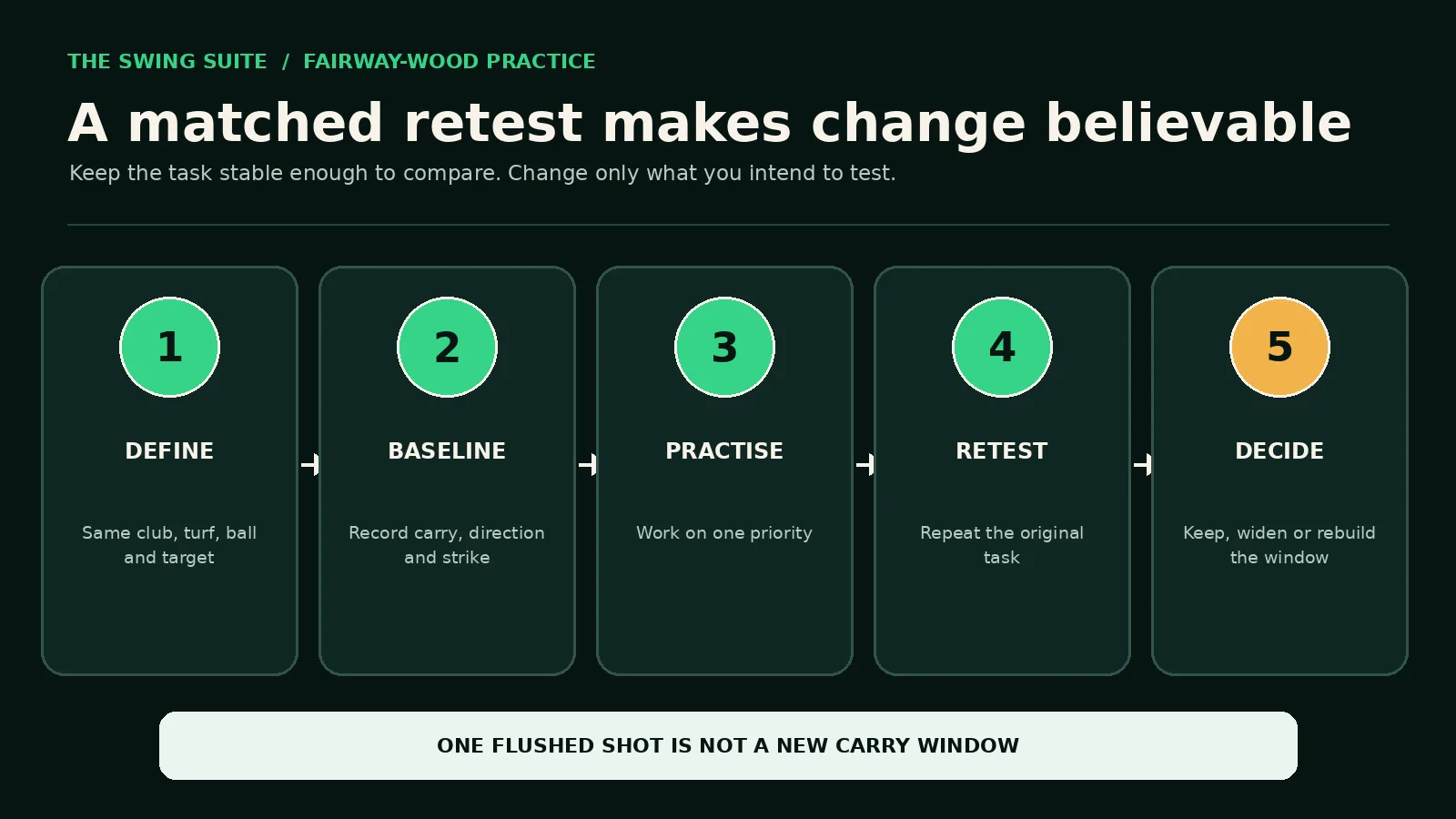
A matched retest repeats the original task after practice or a coaching change. Use the same club, turf or mat, ball type, target and recording method. Warm up in the same way. The goal is not laboratory perfection; it is enough consistency that a changed result is less likely to be explained by a completely different task.
Retest the complete set, not only three celebratory swings after the best feeling appears. Record carry, direction and strike using the original labels. Compare the short, typical and long references, the frequency of costly misses and the width of the useful corridor. A stronger window can come from a higher typical carry, a safer short side, a controlled long side or fewer shots outside the width.
If the retest is worse, preserve it. The change may be unstable, fatigue may be present or the original set may have been unusually good. Return to the stated priority and repeat on another day. Do not rewrite the baseline or invent a new scoring rule simply to make the intervention look successful.
A 50-minute fairway-wood turf session
Minutes 0–10: warm-up and task definition
Move through shorter clubs, establish balance and finish with a few unrecorded fairway-wood swings. Write the club, turf or mat, ball, target and intended stock flight. Confirm that the target corridor and carry boundaries are visible before recording begins.
Minutes 10–20: baseline set
Hit a controlled set from turf. Record carry, total where useful, carry side or direction, and a simple strike label after every ball. Keep ordinary misses. Stop if the task changes materially or attention drops.
Minutes 20–30: identify one priority
Review the group. Choose one priority that could improve the usable window: strike location, low-point pattern, target commitment, start direction or another evidence-backed issue. Do not rebuild the whole swing. Use feedback that directly relates to the selected priority.
Minutes 30–40: constrained practice
Practise the priority with a clear success condition. Alternate feedback balls with normal target shots so the player does not become dependent on the aid. Keep the stock intention. If the practice creates a new flight, label it instead of allowing it to blend invisibly with the baseline.
Minutes 40–48: matched retest
Repeat the original set with the same target, surface and recording rules. Avoid a speed challenge or a new technical cue. The retest should answer whether the original course-use shot changed, not whether the player can perform a different task after practice.
Minutes 48–50: write the course rule
Finish with one decision rule: the current short, typical and long turf carry; the common direction; and the front or back boundary that deserves most caution. Add the date and condition. If the evidence remains uncertain, write “provisional” and schedule another matched set rather than forcing confidence.
Common patterns and what they may mean
One long shot sits far beyond the group
Treat it as the upper observation, not the new normal. Check strike, launch and direction. If the ball was centred and useful, retain it as long-side risk until more shots show whether it repeats. Do not rebuild the entire carry window around one flushed result.
The shortest shots are mostly heavy
The immediate risk is the front carry, and the practice priority may involve strike and low point. Keep the shots in the full set, compare the cleaner subset for diagnosis and choose larger course margin. A hazard does not ignore a heavy strike because the golfer knows why it happened.
Carry is stable but direction is wide
The distance window alone is not course-ready. Move the target towards the widest safe section, work on the directional pattern or choose a larger landing area. Do not call the club reliable because the depth numbers look tidy.
Tee shots are longer than turf shots
That is a comparison, not a defect by itself. Keep both profiles. Use the tee window for tee decisions and the turf window for ground lies. Investigate strike and delivery only if the difference creates a practical problem or suggests a useful coaching priority.
The indoor turf window is longer than the outdoor result
Check ball, temperature, wind, elevation, surface, strike and whether the indoor group contained more centred contacts. Gather matched outdoor evidence. Do not subtract one unexplained number from every club after one round.
The window is too wide for the intended landing area
Change the decision before changing the story. Choose a safer club, a wider route or a lay-up. In practice, identify whether strike, direction or speed variation creates most of the width. A narrow landing area does not become safe because the centre of the pattern fits inside it.
Common fairway-wood carry-window mistakes
- Merging turf and tee shots into one average.
- Using the longest strike as the stock carry.
- Deleting ordinary heavy or thin shots without a pre-agreed rule.
- Recording carry but ignoring where the ball finished left or right.
- Letting total distance hide a failed forced carry.
- Comparing sessions with different balls, surfaces and targets without labels.
- Chasing a benchmark yardage by swinging harder than the intended stock shot.
- Changing several technical priorities before the retest.
- Calling one better session a permanent improvement.
- Using a clean fairway profile from a lie that does not resemble the test.
The correction is to preserve identities and boundaries. Name the turf task, keep the complete set, summarise the window, attach strike and direction, and compare it with a real front and back limit. Every later adjustment should remain traceable to that original question.
Questions golfers often ask
How many fairway-wood shots should I record?
Enough to reveal more than one outcome without allowing fatigue to become the main finding. A short attentive set can be a useful baseline, then repeated matched sets can build confidence over time. Treat any small sample as provisional and keep the date and condition.
Should I average only the good strikes?
Not for the complete course-use profile. A clean-strike subset can help diagnosis, but the full set should retain ordinary valid misses and their frequency. The course decision needs to know both what happens when contact is good and how often the costly miss appears.
Can I use the same carry from a mat and fairway turf?
Use the mat result as a labelled profile and verify it outdoors. Some players transfer closely; others change strike or delivery. Do not assume equivalence and do not discard stable indoor practice evidence. Compare matched tasks and keep the limitation visible.
Do I need club data for this test?
No. Carry, direction and an honest strike label can build a useful first window. Club and ball data may help explain the pattern when available, but more parameters do not replace a clear question. Start with the measurements that change the decision.
What if I use the fairway wood only from a tee?
Build the tee profile and use it for that purpose. The turf process matters only if you intend to play the club from the ground. Keeping the identities separate prevents an unused turf number from cluttering the plan.
How often should I retest?
Retest after a meaningful technique or equipment change, when the on-course result repeatedly disagrees with the stored window, or when conditions have changed enough that the old profile no longer feels representative. Date the record rather than treating it as permanent.
Should I choose the club that carries farthest?
Choose the club whose complete pattern fits the shot. Distance can matter, but so do front clearance, back protection, direction, strike and the next shot. The longest option is useful only when its window occupies useful ground.
A simple fairway-wood checklist
- Name the club, surface, ball, target and intended stock flight.
- Warm up before recording.
- Keep turf and tee sets separate.
- Record carry, direction and strike for every valid shot.
- Keep ordinary misses visible.
- Mark short, typical and long carry with one consistent rule.
- Compare the short side with the front limit.
- Compare the long side and rollout with the back limit.
- Use direction to choose the safest corridor.
- Retest the same task before declaring the window changed.
The checklist is designed to produce a decision rather than a collection of attractive numbers. A fairway wood becomes more useful when the player knows the ground condition the profile represents, the normal width of the result and the limits that make the club safe or unsafe on a particular hole.
Reliability does not mean every shot carries the same distance. It means the player understands the present pattern well enough to choose an honest target. The short side, typical carry and long side create that picture. Strike and direction make it playable. A matched retest keeps the picture current.
Turn the pattern into one coaching priority
If turf contact changes from swing to swing, the short side repeatedly fails the intended front carry or the direction makes the landing window unusable, a structured lesson can reduce the problem to one practical priority. The useful outcome may be a clearer strike pattern, a more stable target process or a better club choice—not simply a larger number on the screen.
Current Swing Suite lesson options, venues and availability remain on the live booking page rather than being hard-coded here. Bring a recent fairway-wood set if you have one: the club, surface, ball, carry list, direction and strike notes. The goal is to leave with a window you can use, a matched test you can repeat and a course rule that protects the expensive miss.