
A reliable fairway-bunker carry window starts with one decision: can your representative flight clear the lip with useful margin? Only then should distance towards the green enter the plan. Measure the lip and lie as a practical constraint, test a matched set of shots, keep the heavy and thin outcomes, and compare the full carry pattern with the safe landing area. If clearance or strike is unstable, the correct window may be a short advance rather than a green attempt.
The practical outcome is a three-part map. First, identify the launch and strike pattern that clears a recognisable lip. Second, record the lower, central and upper edges of carry from that bunker condition. Third, write a course rule that distinguishes a genuine green-attempt window from a recovery whose only job is to return the ball to grass. The map should make a refusal easier, not make every bunker look attackable.
All yardages, launch patterns, lip dimensions and scorecards in this guide are hypothetical unless they come from your own measured practice. Sand depth, firmness, moisture, slope, ball position, stance, lip shape, club, speed and strike can change the result. There is no universal fairway-bunker adjustment that responsibly replaces testing and observation.
The direct answer: lip first, strike second, carry third
Stand behind the ball and read the lip in the intended start direction. Note its height, the distance from ball to lip and whether the ground rises before the face. Then inspect the lie and stance. A clean ball on firm sand with level feet is a different task from a ball sitting down on a downslope. Decide whether a full committed motion is safe before choosing a target.
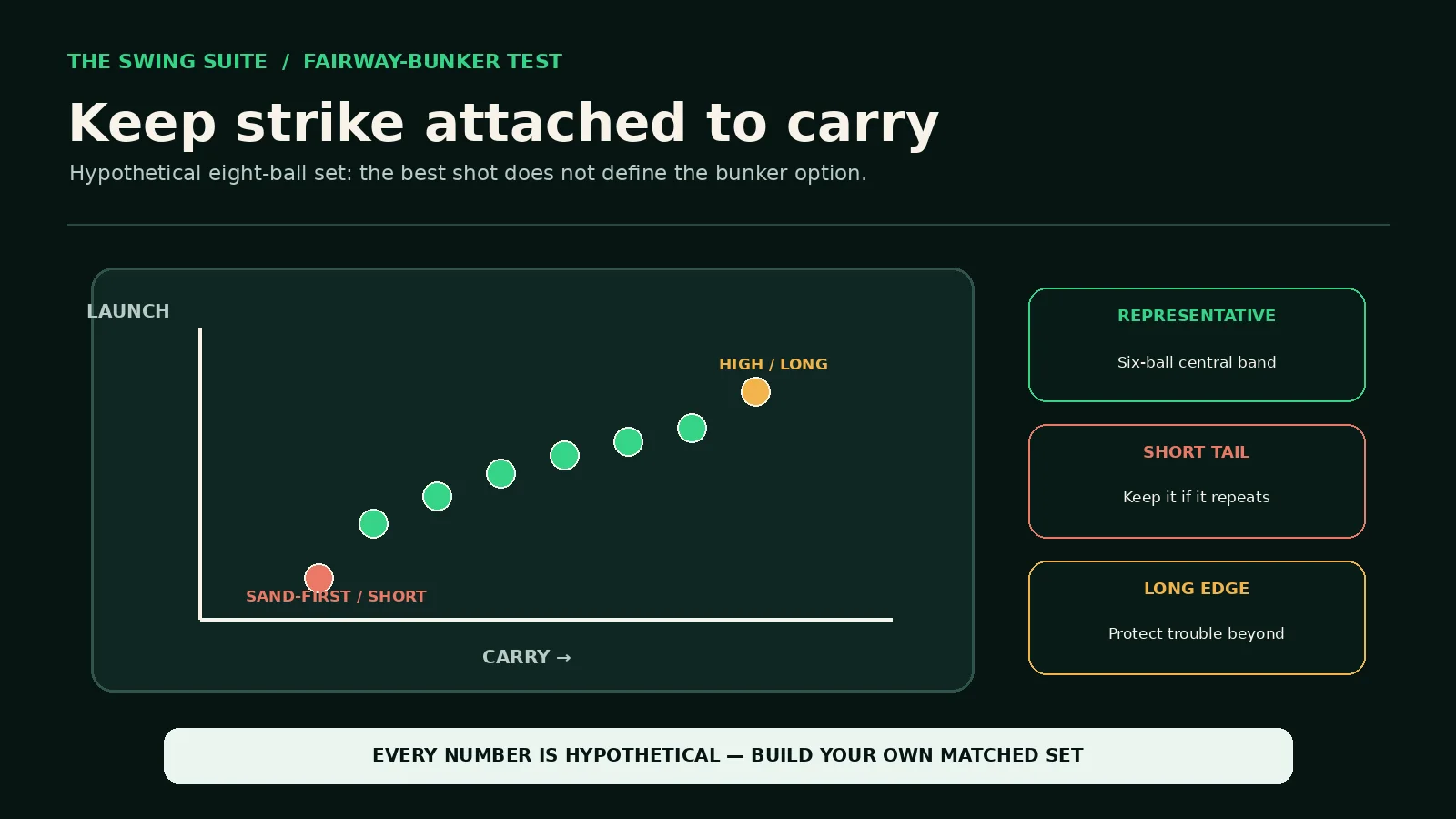
In practice, begin with a lofted club and a broad target. Record whether every representative flight clears the chosen lip line, then attach strike, launch category, carry and finish to each ball. Do not promote the longest clean strike into the stock answer. The lower launch or sand-first ball determines whether the lip is genuinely cleared; the long edge determines whether trouble beyond the target remains protected.
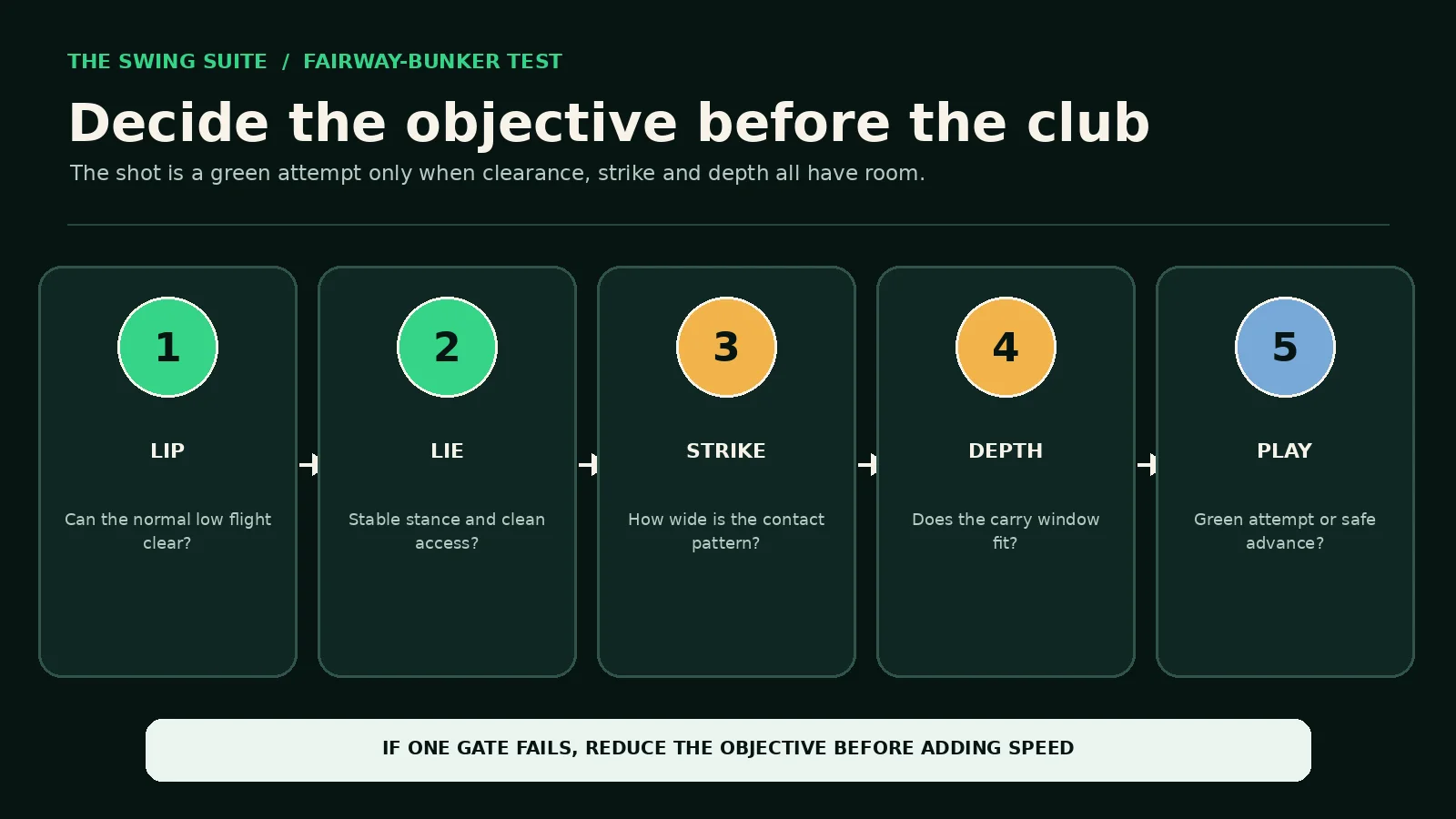
On the course, attempt the green only when three conditions align: the representative low flight clears the lip with margin, the ordinary strike pattern is stable enough, and the complete carry window fits a wide landing area. When any one condition fails, reduce the objective. A diagonal or sideways advance that leaves grass and a clear next shot is a successful bunker decision.
Why fairway bunkers need their own decision map
A fairway bunker combines a forced launch constraint with an uncertain contact surface. From turf, a player can often choose a club mainly from carry, direction and the landing area. In sand, the lip can reject the shot before its final carry matters. The first few metres of flight therefore have a different importance from the eventual distance.
The result also depends on where the ball lies within the bunker. A low front lip may offer a broad exit. A high face close to the ball can remove several clubs immediately. A diagonal line may reduce the apparent lip but change the landing corridor. The bunker is not one distance problem; it is a set of possible start directions with different clearance and finish costs.
Treat a fairway bunker separately from a greenside bunker. The greenside task often uses sand deliberately to control a short, high shot. A longer bunker shot may seek cleaner ball contact and a more normal carry pattern, but the exact technique belongs to the player, lie and coaching context. This guide governs the decision and test rather than prescribing one universal swing.
Read the lip as geometry, not emotion
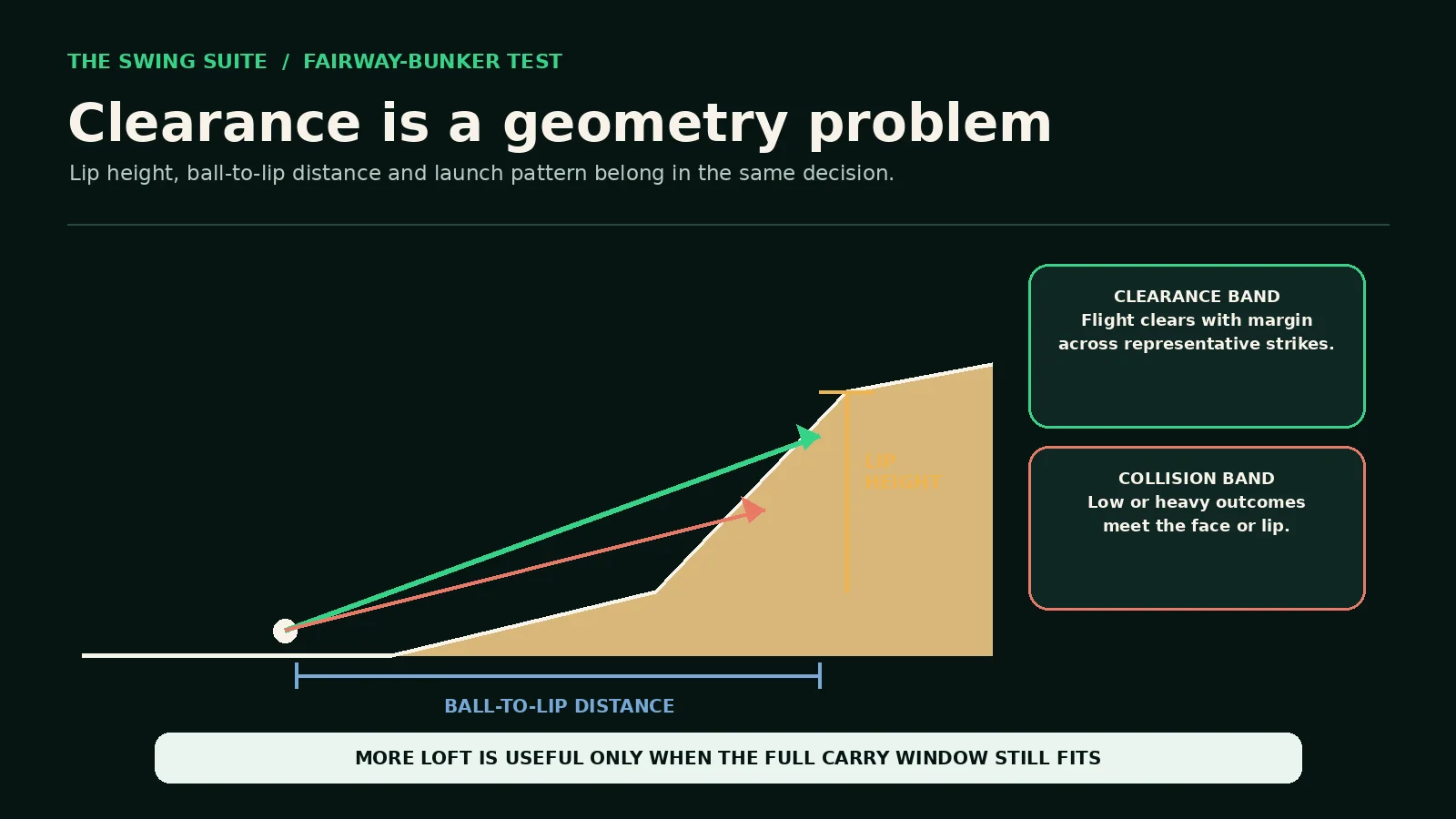
A lip can look intimidating without occupying the chosen flight line, or appear modest while sitting very close to the ball. Break the picture into three observations: vertical height, ball-to-lip distance and the slope of the ground between them. These do not produce a perfect calculation, but they stop the club choice being based on fear or optimism alone.
Choose the start direction before judging clearance. The direct line to the flag may cross the highest section, while a line towards the wide side of the fairway may cross a lower face. Changing the line changes both the lip and the destination. Mark the full trade: easier escape can be worth a longer next shot when the alternative asks for a narrow launch window.
Do not use a static club-loft number as proof that the ball will clear. Delivered loft, strike, ball position and speed affect the initial flight. The lip is crossed at a particular distance from impact, not at peak height. Build clearance from observed representative shots in a safe practice setting, then retain margin for the course lie.
Use launch angle carefully
TrackMan defines launch angle as the vertical angle of the ball immediately after it leaves the clubface relative to the ground plane. It is useful for comparing matched fairway-bunker shots, but launch angle alone does not prove lip clearance. The lip has its own height and distance, while the ball follows a curved flight rather than a straight ruler line.
Review TrackMan’s launch-angle definition ↗
Use launch as one label beside actual clearance. Record low, expected, high or unusually high when no monitor is available. If the monitor reports a number, keep the shot video or observed lip result attached to it. A launch value from a mat does not automatically represent a sand strike, and a ball that launches high can still carry too short for the intended landing area.
Build a lower launch edge from ordinary outcomes, not from the single flight you hope to reproduce. If the lowest representative shots brush or strike the lip, the green-attempt option is not ready. More speed is not the first solution; a more lofted club, lower section of lip or simpler direction may create the more reliable escape.
Inspect lie, stance and access before distance
Describe the lie in plain language: clean and sitting on top, slightly settled, partly buried, upslope, downslope or side slope. Add sand condition only as an observation such as firm, soft, shallow or deep. Avoid pretending those labels guarantee a specific result. Their job is to preserve the context of the shots you test.
Check the stance separately. Feet below the ball, feet above it, an unstable edge or a steep slope can change balance and strike even when the ball looks clean. If a full motion cannot be made safely and predictably, shorten the objective before selecting a longer club. A theoretical carry number is irrelevant when the stance cannot support the motion that produced it.
Ask whether the club can reach the ball cleanly without the sole meeting a large amount of sand first. A stronger, longer club may offer more distance on paper while making access and lip clearance less reliable. The useful option is the club whose representative strike, launch and carry all fit the problem—not the club with the largest stock yardage from turf.
Record strike before interpreting the number
Strike is the explanation field that keeps a fairway-bunker chart honest. Use simple labels such as centred, slightly thin, heavy, sand first, heel, toe or uncertain. The label does not need laboratory precision. It needs to separate the flight you can reproduce from outcomes caused by visibly different contact.
Keep ordinary misses in the set. A thin ball that still escapes may create a long, low finish. A sand-first ball may clear a low lip but finish far short. If those outcomes occur under the normal task, they belong in the window. Exclude only an interruption, wrong ball, clear measurement failure or intentionally different shot, and write the reason.
Do not diagnose technique from one number. A lower launch could come with different strike, delivered loft or speed. A shorter carry could be a heavy strike, a more lofted option or a cautious motion. Read the sequence—lie, stance, strike, launch, clearance, carry and finish—before deciding what the next test should change.
Use low point as context, not a universal target
TrackMan’s low-point distance parameter describes where the lowest point of the clubhead’s swing arc is relative to the ball. That can help compare matched shots and understand whether the club is tending to meet the sand too early, but it does not create one fairway-bunker target that suits every club, player and lie.
Review TrackMan’s low-point distance definition ↗
If the short group repeatedly includes sand-first contact, inspect low point beside strike and launch. Preserve the raw outcomes while testing one coached change. The comparison should answer whether contact, clearance and carry become more stable—not whether a single parameter moved towards a fashionable number.
When low point is unavailable, the test still works. Record observed contact, the mark in the sand when appropriate, launch category, clearance and carry. Do not estimate a measured value from appearance. A smaller set of trustworthy observations is stronger than a complete-looking table filled with guesses.
Measure carry and finish as different jobs
TrackMan defines carry as the straight-line distance from the starting position to the landing point. In a fairway bunker, carry can protect both the lip and a later boundary such as rough, another bunker or the front of a green. Total finish answers the separate question of what happens after the ball lands.
Review TrackMan’s carry definition ↗
Write the lower, central and upper carry edges for the representative set. Then note the finish area: fairway, apron, green, back rough or trouble. A low shot may carry safely but run through the target. A higher flight may clear and stop sooner. Similar carry does not guarantee a similar next shot.
Keep units and conditions consistent. State the club, ball, sand condition, target line and whether values are measured or normalised. Outdoor wind and temperature affect observed flight. Indoor mats cannot reproduce the lie. A simulator can train the recording method, but a sand-dependent course rule needs representative bunker evidence.
Use landing angle only where it helps the decision
TrackMan defines landing angle as the angle at which the ball approaches the ground. It can help explain why two shots with similar carry finish differently, but it is not a promise of stopping distance. Surface firmness, slope, spin and landing location also matter.
Review TrackMan’s landing-angle definition ↗
For a green attempt, compare landing angle with the actual depth and firmness available. A low-running option may be useful when the front is open and the back is safe. The same flight may be unsuitable when a front bunker must be carried and the green falls away. Let the target define whether landing behaviour matters.
For an advance to fairway, a shallower flight may be completely acceptable if the corridor remains wide and the finish stays short of the next hazard. Do not demand a green-style landing from a recovery. Match the measurement to the practical job of the shot.
Build a clean reference before the bunker set
Warm up from turf and record a small reference group with the club you expect to test. The purpose is not to transfer the turf carry into the bunker. It confirms the day’s general strike, launch and direction before the surface changes. If the reference is already unstable, the bunker decision should begin with more caution.
Keep the target broad and the motion normal. Record enough ordinary shots to see the central pattern and normal miss. Then move to the bunker and start a new data set. Never blend turf and sand numbers into one average. The surfaces answer different questions and should remain labelled separately.
Return to the turf reference near the end if practical. A major shift can reveal fatigue or a changed intention. Preserve both groups rather than smoothing them together. The fairway-bunker window should be dated and conditional, not treated as a permanent club distance.
Start the bunker test with the easiest responsible line
Choose a safe practice bunker and an authorised direction with a modest lip and a broad landing area. Confirm that no person, property or maintenance activity can enter the flight. Begin with enough loft that clearance is not a heroic requirement. The first task is to establish a repeatable escape, not to discover the longest club that might work once.
Hit a small labelled set without changing the target after each result. Record lie, stance, strike, launch category, lip clearance, carry and finish. If the ball or stance condition changes materially, stop and begin a new label. A mixed collection of clean, buried and sloping lies cannot produce a useful window.
Write a clearance verdict after the set: comfortable, marginal or failed. Comfortable means the representative low flights clear with visible margin. Marginal means ordinary outcomes approach the lip. Failed means the pattern includes collisions or does not support the chosen direction. Use those labels as course language rather than inventing exact centimetres you cannot reproduce.
Add club only after clearance is stable
Once the lofted baseline clears reliably, test one stronger option while keeping the line, lie label and scoring method as similar as possible. Start a new group. Compare clearance first, strike second and carry third. If the stronger club adds distance but turns the lower launch edge into a lip risk, it has not improved the option.
The stronger club can also widen the strike pattern. A longer shaft or different sole may change how the player reaches the ball. Do not assume that one extra club shifts every shot forward by the same amount. The full set may gain a long edge while retaining the same short outcome, which can make the target harder to contain.
Stop the progression when clearance becomes marginal. There is no prize for finding the last club that can occasionally escape. The leading option is the strongest club whose representative low flight, ordinary strike and complete depth window all remain useful. In many bunkers, that may be a shorter club and a longer next shot.
A 55-minute fairway-bunker session
Minutes 0–8: warm up and define the task
Use turf to establish movement and a small reference group. Choose one authorised bunker, safe direction and broad landing area. Record the intended objective, ball, club options and visible lip line. Remove any test with unstable footing, stones, poor visibility or people who could enter the corridor.
Minutes 8–16: map the lip and lie
Mark the intended start line, lowest responsible section of lip and alternative safe direction. Label the ball and stance condition. Do not improve a live course lie during play; in a dedicated practice area, create only the conditions the facility permits. The goal is a repeatable test, not a dramatic photograph.
Minutes 16–27: lofted clearance baseline
Hit a small set with the lofted option. Record every representative ball immediately. Score clearance before carry. Keep heavy, thin and uncertain strikes. At the end, mark the lower launch edge, central carry region and finish pattern without changing technique to rescue the numbers.
Minutes 27–38: test one stronger option
Change only the club where possible. Keep the same target and scoring. Compare whether the stronger option still clears across ordinary strikes and whether its complete carry window fits the destination. Stop if the lip or stance makes the task unsafe or unrealistic.
Minutes 38–46: play the green-attempt gate
Create a front boundary, wide landing zone and long boundary. Score each ball in order: clears lip, clears front, finishes in zone, stays short of long trouble. A shot fails the green-attempt gate when any critical boundary is missed, even if the strike felt good.
Minutes 46–52: practise the simple advance
Choose a lower section of lip and a broad fairway target. Use one club and objective that prioritise grass for the next shot. Compare how often the advance creates a clear next decision. The exercise makes recovery a rehearsed option rather than an emotional retreat.
Minutes 52–55: write two course rules
Write one green-attempt rule and one advance rule. Example: “Level stance, clean lie, middle lip line, lofted iron only when the representative low flight clears and the whole carry window fits the centre.” Then: “Any settled lie, marginal lip or unstable stance: play diagonally to the wide fairway.” The wording is illustrative; your rules need your evidence.
Build a scorecard that exposes the decision
Give each ball a row with lie, stance, club, target line, strike, launch category, lip clearance, carry and finish. Add measured low point or landing angle only when available and reliable. Keep the form short enough to complete after every shot. Delayed entry tends to remember the clean escape and forget the heavy ball that struck the face.
After each group, summarise four fields: representative low clearance, lower carry edge, central carry region and upper carry or finish edge. Add a confidence note such as repeatable, mixed or unstable. Do not reduce a two-part pattern to one average. The decision must retain both the ordinary success and the costly miss.
Use cautious language: “observed from this clean firm lie”, “marginal over this lip”, “short tail from sand-first contact” and “advance only when stance is uneven”. Avoid “always”, “automatic” and “this club clears every bunker”. The scorecard is a dated map of one recognisable condition.
Separate the green attempt from the advance
A green attempt needs all three gates: reliable lip clearance, representative contact and a carry window that fits a responsible target. The target should normally be a broad section of green or apron rather than a tucked flag. The decision is not whether the best ball can reach; it is whether the relevant pattern has room.
An advance has a different job. It may aim diagonally across the bunker, clear the lowest face and finish in the widest fairway. Its success is the quality of the next shot, not distance gained. A shorter escape can protect the score when a failed green attempt leaves the ball in sand, thick rough or another hazard.
Write the objective before addressing the ball. “Centre of green” and “wide fairway left” create different clubs, lines and acceptable outcomes. If you cannot state the objective clearly, default to the simpler area. Indecision tends to combine the speed of an ambitious shot with the direction of a recovery.
Protect the short side first
The immediate short boundary is the lip. Beyond it, the next short boundary may be rough, another bunker, water or the front edge of a green. Use the representative lower launch and carry outcomes, not the average. If the ordinary low ball can strike the lip or fail the second boundary, the club does not fit that route.
More club is not automatically the answer. A stronger club may lower the clearance band or make clean access less likely. Test the alternative. The safer solution may be more loft towards a closer landing area, or a different start line that removes the highest face from the shot.
Do not let one successful low bullet redefine the test. A ball can escape under the lip and run well once, yet remain a poor policy when a small change in strike hits the face. Course strategy should be built from repeatable room, not from the memory of one narrow success.
Protect the long and side boundaries
Once clearance is secure, inspect what happens at the upper edge. A clean or thin strike may travel farther and lower than the central group. If long brings back rough, a path, trees or a penalty area into play, preserve that outcome in the decision. The green attempt may need a shorter target or more loft.
Direction matters because a bunker stance can influence balance and face delivery. Record start side and finish corridor even when the primary test is carry. A depth window that fits the green is not useful if the side pattern overlaps the highest lip or a narrow section of trouble.
Choose the widest responsible target. A central or apron target often provides both short and long margin. The flag is relevant only after the complete window fits the available space. A longer putt from the green can be a stronger result than another bunker shot from a failed aggressive line.
Use the Rules before touching the sand
Rule 12 covers bunkers and explains when a ball is in a bunker, what loose impediments and movable obstructions may be removed, and restrictions on touching sand before making a stroke. The exact facts and exceptions matter. Check the official Rule rather than relying on a remembered summary before grounding, testing the sand or taking a practice action near the ball.
Practice sessions and a ball in play are different contexts. Use a designated practice bunker for repeated tests and follow the facility’s instructions. During a round, do not turn the live lie into a laboratory. Observe what the Rules permit, make the decision and play the shot without actions that test or improve the condition illegally.
When the ball is unplayable or another Rule may apply, identify the correct procedure and penalty before moving it. The carry map does not override the Rules. A responsible recovery can include taking relief, accepting a penalty or choosing a route that avoids injury and repeated failure.
Common fairway-bunker patterns and the next test
The ball clears comfortably but carry is very short
Inspect strike and speed before changing club. If sand-first contact dominates, a stronger club may not solve the lower edge. Test one coached contact priority with the same lofted club, then compare clearance and carry. Keep the simple advance available until the retest is stable.
The best shots reach the green but the low flight hits the lip
The green attempt fails the clearance gate. Change the start line, add loft or reduce the objective. Do not average the collision with the clean ball. A result that remains in the bunker carries a different cost from a shot that finishes slightly short on grass.
Every ball clears, but the finish runs through the target
Separate carry and total. Test more loft, a shorter landing area or a wider side. Use landing angle only as context and verify the real surface. The option is not controlled merely because it escaped cleanly.
The clean lie works and the settled lie does not
Keep two categories. The course decision should begin by identifying which condition is present. Do not transfer the clean-lie club to a partly buried ball because both are in the same bunker. The objective may change from green attempt to advance immediately.
The first set works and the retest becomes mixed
Confidence follows the mixed evidence. Fatigue, changed sand or an inconsistent setup may have widened the pattern. Preserve both groups, reduce course ambition and repeat on another day before writing a strong rule.
Common mistakes in fairway-bunker testing
- Choosing the club from stock turf yardage before reading the lip.
- Judging clearance from club loft alone.
- Using one launch value as proof that every flight clears.
- Deleting thin or heavy shots because they spoil the carry average.
- Blending clean, settled and sloping lies into one group.
- Changing club, line and target at the same time.
- Treating the longest clean strike as the stock bunker shot.
- Ignoring run and the long boundary after the lip is cleared.
- Aiming at the flag before proving the full window fits.
- Adding speed when the real problem is geometry or access.
- Testing from an unsafe stance or an unauthorised area.
- Forgetting Rule 12 restrictions during a live round.
- Practising only the green attempt and never rehearsing the advance.
- Turning a small session into a permanent universal rule.
The correction is a fixed sequence: choose the start line, assess the lip, label the lie and stance, test clearance, attach strike to launch and carry, protect the long edge, then decide whether the objective is green or grass. The sequence makes the refusal condition visible before pressure encourages a heroic choice.
Questions golfers often ask
How much extra loft do I need to clear a bunker lip?
There is no responsible universal amount. Lip height and distance, delivered loft, strike, speed and lie all matter. Use observed representative flights in a safe practice bunker. Choose the most lofted practical option first, then strengthen only while clearance and the full carry window remain stable.
Should I take one more club from a fairway bunker?
Not automatically. A stronger club may add potential carry while lowering the flight or making access less reliable. Compare matched groups. The correct club is the one whose ordinary clearance, strike and depth pattern fit the target—not the one that matches a turf yardage chart.
Can launch angle tell me whether the lip will be cleared?
It helps describe the initial flight, but it is not enough by itself. The lip has a particular height and ball-to-lip distance, and the ball’s path is curved. Pair launch with actual observed clearance from a representative setup and preserve the lower launch edge.
Should I try to pick the ball cleanly?
Technique should be matched to the player, club and lie rather than reduced to one slogan. Record contact honestly and work on one coached priority. The decision framework requires representative strike and clearance; it does not prescribe a universal impact feel.
What if the ball is below my feet or on a slope?
Treat the stance as a separate condition. Reduce the objective when balance or strike becomes uncertain. Test slopes only in a safe practice environment. A green-attempt window from level sand should not be transferred to a materially different stance without evidence.
Can I practise this indoors?
You can practise the recording method and compare launch, carry and direction from a suitable surface, but ordinary mats do not reproduce sand, lip geometry or bunker stance. Use indoor work as preparation and verify the actual clearance pattern in an authorised practice bunker.
How many shots make the window reliable?
No small set proves a permanent rule. Use enough attentive shots to show more than one outcome, preserve misses and repeat the task on another day. Consistency of lie, line and scoring matters more than hitting a large mixed bucket.
A simple fairway-bunker checklist
- Confirm the stance, footing and target corridor are safe.
- Check the relevant Rule before touching or testing sand during play.
- Choose the intended start line and inspect that section of lip.
- Label the lie, stance and sand condition.
- Begin with a lofted option and a broad landing area.
- Score representative low-flight clearance before carry.
- Keep ordinary thin, heavy and sand-first outcomes.
- Use lower, central and upper carry edges rather than one average.
- Protect the long and side boundaries after the lip.
- Attempt the green only when clearance, strike and depth all fit.
- Rehearse a diagonal or sideways advance.
- Write separate rules for clean and compromised lies.
- Retest before strengthening the course policy.
The checklist is designed to create a decision rather than an impressive number. A fairway-bunker shot becomes more manageable when the player knows which lip line is available, what the ordinary strike produces and which outcome makes the green attempt unacceptable.
A hypothetical course note might read: “Level stance, clean firm lie, middle lip line, 8-iron; representative flight clears with margin and carries 118–126 metres, with one thin 131-metre finish. Use only to the wide centre when the front is below 112 and long trouble begins beyond 136. Otherwise advance left.” Every number in that example is illustrative; build yours from measured shots.
Turn the test into one coaching priority
A structured lesson can reduce a mixed bunker pattern to one useful priority: lip assessment, setup for balance, strike location, low-point control, launch consistency, club choice or target selection. Bring the scorecard. The coach can recreate the task and keep the technical change tied to a course decision.
Measured data should narrow the next experiment. If the low flight is the problem, the next test may compare one more lofted club. If clearance is stable but carry is broad, strike may become the priority. If carry is stable but run crosses the back, target and landing behaviour may matter more than adding distance.
Finish with a refusal condition. “If the lower launch edge is marginal, I play to grass” is more valuable than a collection of best shots. The goal is not to prove that every fairway bunker can be attacked. It is to know when the evidence supports the attempt and when the simple advance protects the next decision.
Compare this with the fairway-wood carry-window guide from turf ↗
Review the map as conditions change
Retest when sand becomes softer or firmer, the season changes, equipment changes, speed changes or the old clearance pattern stops matching the course. Keep dated versions rather than editing the past into one permanent rule. A useful map shows the exact lie and lip context that produced it.
After a round, record the live lie, lip decision, chosen objective and result without judging the whole method from one ball. A good outcome can follow a weak decision, and a poor outcome can follow a responsible target. Ask whether the relevant window had room and whether the refusal condition should have applied.
Current Swing Suite lesson options, venues and availability remain on the live booking page rather than being hard-coded here. The goal is a practical fairway-bunker map: clear the lip with representative flight, understand the carry window and choose confidently between a responsible green attempt and a simple advance.