
A reliable downhill-lie carry window begins by treating the slope as a separate condition, not as a small correction to a level-lie yardage. Label the severity, footing and ball access, test a matched group with a stock option and a safer alternative, and keep every representative strike attached to launch, carry and finish. The useful answer is a range with refusal conditions—not one adjustment number.
The practical outcome is a dated map for a recognisable downhill lie. It should show the lower, central and upper carry edges, the normal launch pattern, the strike descriptions that produced them and the amount of target room required. It should also say when the slope, stance or lie is too different for the map to apply. That boundary is as important as the longest successful shot.
All yardages, launch patterns, slope labels and scorecards in this guide are hypothetical unless they come from your own measured practice. Ground angle, grass, moisture, wind, ball position, stance, club, speed and strike can change the result. There is no universal downhill-lie adjustment that responsibly replaces observation and testing.
The direct answer: label, strike, launch, carry
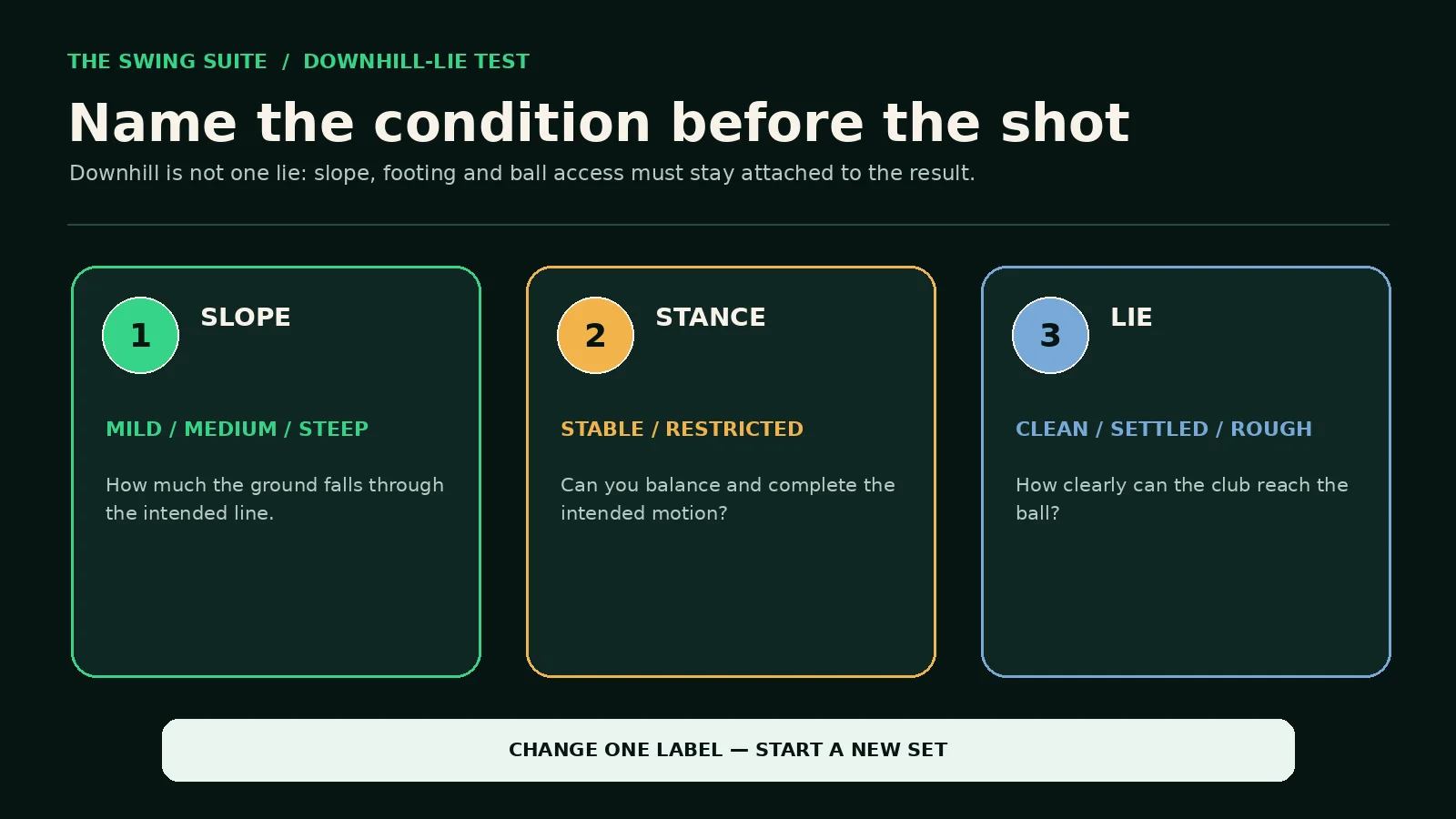
First, describe the condition in plain language: mild, medium or steep downhill; stable or restricted footing; clean, settled or rough lie. Choose the intended start line because the ground may fall differently across another direction. If balance or access is uncertain, reduce the objective before selecting a club.
Second, test a small matched set. Record strike before reading the number, then add launch category, carry, finish and start side. Keep the short and long outcomes. Compare the stock option with one safer alternative—often a different club, target or motion intention—without assuming which should win.
Third, choose the course target from the full observed window. Protect the short edge, long edge and side corridor. Use the downhill map only when the live condition genuinely resembles the tested label. If the slope is steeper, the stance less stable or the lie less clean, step down to a simpler objective.
Why a downhill lie deserves its own map
A stock carry number normally describes a relatively controlled reference condition. A downhill lie changes the geometry between the golfer, ball and ground. It can affect balance, where the club meets the turf and the launch pattern that results. The direction and size of those changes are not identical for every player, so the task is to measure the complete outcome rather than repeat a slogan.
The slope also changes the visual picture. A target below the player can look closer or more exposed. The ground under the feet may encourage a cautious motion or a rushed attempt to stay with the slope. Those reactions can widen the strike pattern even when the ball itself is sitting cleanly.
Treat downhill lies separately from sidehill and uphill lies. They can share the need for stable footing and honest strike labels, but they ask different questions. A sidehill test often emphasises start direction and curve. A downhill test should keep strike, initial launch, carry and the landing area connected.
Define the direction of downhill
Do not label the lie until the intended shot direction is chosen. Ground that falls towards the flag may fall less sharply towards the wide side. A diagonal route can create a different stance, start line and landing corridor. Record the direction with the slope label so the map cannot be transferred silently to another angle.
Use an ordinary visual scale rather than invented precision when no slope tool is available. Mild means the fall is noticeable but the stance and motion remain comfortable. Medium means balance or club-ground interaction needs deliberate attention. Steep means the full stock motion or target may no longer be responsible. These labels are personal and must be calibrated by your own practice.
If a measured gradient is available, retain it as context but do not assume the same number creates the same shot for every golfer. Grass length, firmness and how the feet sit can change the task. The purpose of the label is repeatability, not false exactness.
Separate stance from the ball lie
The ball can be clean while the stance is poor, or the feet can feel stable while the ball sits down. Record those as different fields. A single “downhill” label hides the reason a set became unreliable and makes later decisions harder to trust.
Test whether you can settle into the ground without slipping, reaching or forcing the knees into an uncomfortable position. The aim is not to prescribe one setup. It is to decide whether the intended motion can be made safely and repeatedly. If it cannot, shorten the shot, choose a broader target or use an available relief procedure when the Rules allow.
Ball access matters as much as balance. Thick grass behind the ball, a bare patch, moisture or an uneven tuft can change the strike. Start a new group when access changes materially. Mixing clean fairway lies with settled rough lies produces a neat average that describes neither condition.
Use strike as the explanation field
Write the strike label before interpreting launch or carry. Useful categories include centred, slightly thin, heavy, heel, toe, uncertain and interrupted. They do not need to be technically perfect. They need to preserve what was visibly different so the short or long edge is not mistaken for a mysterious yardage change.
Keep ordinary misses. A thin strike may launch differently and finish beyond the central group. A heavy strike may shorten the carry enough to bring a front boundary back into play. If those outcomes occur during the intended task, they belong in the window. Delete only a clear measurement error, wrong ball, interruption or deliberately different shot, and record the reason.
Avoid diagnosing the swing from one data point. Similar carry can come from different combinations of strike, speed and launch. Different carry can occur even when the strike label looks similar. Use the sequence—condition, stance, strike, launch, carry, finish—to decide what the next controlled comparison should be.
Use launch angle as a description, not a promise
TrackMan defines launch angle as the vertical angle of the ball immediately after it leaves the clubface relative to the ground plane. That makes it useful for comparing matched downhill-lie groups. It does not create a universal downhill rule and it does not, by itself, tell you whether the target has enough depth.
Review TrackMan’s launch-angle definition ↗
When no monitor is available, use observed categories such as lower than reference, similar to reference or higher than reference. Do not invent a number from appearance. Keep the category attached to strike and start direction. A low flight from a centred strike means something different from a low flight caused by obvious heavy contact.
Build the launch edge from representative shots rather than the best one. If the low edge repeatedly creates a front-boundary problem, the stock option needs more room or a different objective. If one unusually high shot stops quickly, do not let it define the expected finish.
Use attack angle, dynamic loft and low point carefully
TrackMan defines attack angle as the vertical direction of the clubhead movement at the moment of maximum compression. Dynamic loft describes the vertical angle of the clubface at that same moment. Low-point distance describes where the bottom of the swing arc occurs relative to the ball. These parameters can add context to a coached comparison, but none supplies a universal downhill target.
Review TrackMan’s attack-angle definition ↗
Review TrackMan’s dynamic-loft definition ↗
Review TrackMan’s low-point distance definition ↗
Use those numbers only when the measurement is available and the sets are genuinely comparable. If the short group includes visibly heavy strikes, examine low point beside the strike labels. If launch changes while strike remains stable, dynamic loft and attack angle may help a coach frame the next test. The goal is a more reliable window, not movement towards an isolated fashionable number.
When the parameters are unavailable, the test remains valid. Record observed strike, launch category, carry and finish. A smaller set of honest observations is more useful than a complete-looking table filled with estimated data.
Carry and finish answer different questions
TrackMan defines carry as the straight-line distance from the starting position to the landing point. Use it to protect front and back carry boundaries. Then record finish separately, because slope, firmness, landing location and spin can alter what happens after the first bounce.
Review TrackMan’s carry definition ↗
Write the lower, central and upper carry edges for the representative set. Do not hide a short heavy strike inside the average or ignore a long thin result. The target needs room for the observed pattern, not only for the middle number. When the long edge brings trouble into play, a shorter option can be better even if its best shot finishes farther from the flag.
Note the finish area in practical terms: front apron, centre, back fringe, rough, bunker or penalty area. Similar carry values can create different next shots. The landing surface is part of the course decision, not a decorative note after the measurement.
Build a level-lie reference without blending it into the slope set
Begin with a small level-lie reference using the club you expect to test. The purpose is to understand the day’s ordinary strike, launch and carry before changing the ground. It is not permission to subtract a fixed amount from the stock number.
Use a broad target and a normal intention. Record enough shots to show the central pattern and ordinary miss. Then start a completely separate downhill group. Keep the club, ball and target as consistent as practical, but do not combine the two groups into one average.
Return to the reference near the end if fatigue or changing movement may have affected the session. Preserve both reference sets. A downhill comparison is stronger when the surrounding level-lie pattern is stable, and weaker when the whole session is drifting.
Choose a safe and repeatable practice slope
Use an authorised practice area with a broad landing corridor and no chance of a person, path, property or maintenance activity entering the flight. Avoid unstable, wet or severe footing. The exercise is not worth an injury or an uncontrolled shot.
Choose one recognisable section where the slope is consistent enough for a small group. Place or play balls only as the facility permits. During a round, play the course as it is found and follow the Rules; do not alter a live lie to recreate practice conditions.
Start with the milder condition. Confirm that the stance and strike are repeatable before moving to a more demanding slope. If the label changes, start a new set. The purpose is to build decision boundaries, not to prove that the steepest possible lie can be attacked.
Test the stock option first
Use the option you would normally choose from the level reference, but frame it as a test rather than the answer. Hit a small attentive set to one broad target. Record every representative ball immediately so feel and result are not rewritten after the best shot.
For each ball, write slope label, stance, lie, club, strike, launch category, carry, finish and start side. Add measured parameters only when captured reliably. At the end, identify the lower carry edge, central region, upper edge and the strike descriptions attached to each.
Give the set a plain verdict: repeatable, mixed or unstable. Repeatable does not mean perfect. It means the ordinary pattern is clear enough to support a target. Mixed means the short or long edge needs more room. Unstable means the set should not become a course rule yet.
Test one safer alternative
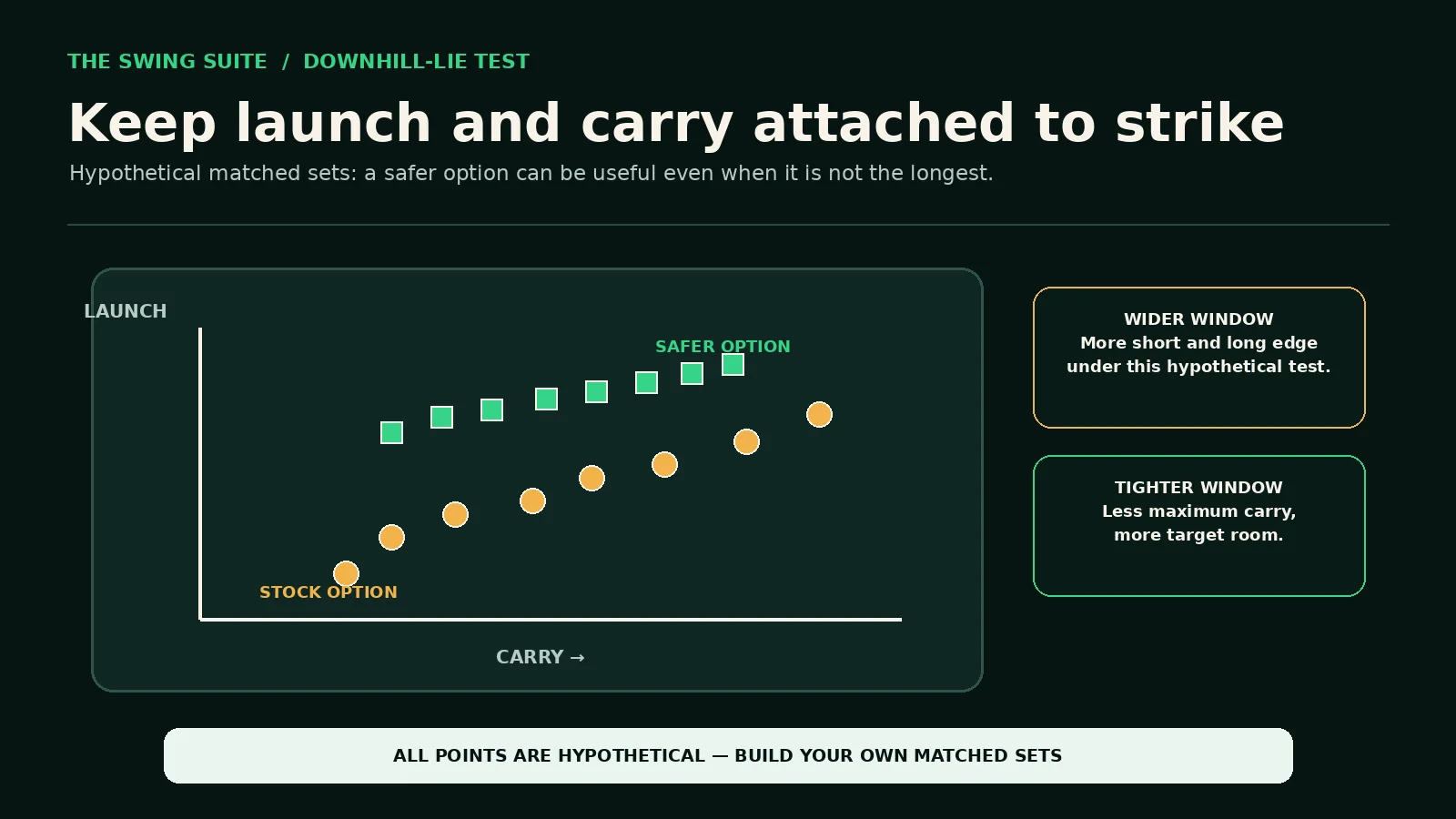
The safer alternative might be more loft, less club, a shorter motion, a wider target or a different start line. Change one main variable where possible. The comparison should reveal whether the complete pattern becomes easier to contain, not merely whether the centre moves.
Keep the same recording fields. A safer option can succeed by narrowing the strike and carry window even when its maximum carry is shorter. It can fail if the new choice creates another problem, such as a front boundary that the lower edge no longer clears. Let the target and the full pattern decide.
Do not assume that “club up” or “club down” is universally correct from a downhill lie. Those phrases hide the effects of stance, delivered loft, speed and contact. The useful rule is personal: under this labelled condition, which option gives the target enough room?
A 55-minute downhill-lie session
Minutes 0–8: warm up and define the target
Use level ground to establish movement and a small reference. Choose one safe landing corridor with clear short, long and side boundaries. Record the ball, clubs and intended comparison before moving to the slope.
Minutes 8–15: label slope, stance and lie
Walk the intended line and describe the fall. Settle into the stance without a ball if the facility permits. Mark mild, medium or steep; stable or restricted; clean, settled or rough. Stop if footing is unsafe or the motion cannot be made comfortably.
Minutes 15–26: stock-option set
Hit a small group without chasing the previous result. Record strike first, then launch, carry, finish and start side. Keep the ordinary heavy or thin outcomes. Summarise the lower, central and upper edges before changing anything.
Minutes 26–37: safer-option set
Change one principal variable and repeat the scoring. Compare the width and location of the full pattern. Ask whether the safer choice creates more usable room at the actual target, not whether it feels more cautious.
Minutes 37–46: randomise the decision
Alternate between a level reference and the labelled slope, or between two target depths, while keeping the safety corridor intact. State the condition and option before each ball. This tests whether the decision survives a change of context rather than existing only in a blocked group.
Minutes 46–52: rehearse the refusal condition
Create one situation where the stock window does not fit. Choose the wider target, shorter option or recovery route deliberately. Score the quality of the next position. A refusal condition becomes useful when it is practised, not merely written.
Minutes 52–55: write the course note
Record the exact slope label, stance, lie, stock verdict, safer verdict and target-room rule. Keep it concise enough to use on the course. Date the note and mark every number as measured, normalised or hypothetical.
Build a scorecard that preserves the pattern
Use one row per ball. A compact form can contain condition, club, strike, launch category, carry, finish, start side and decision note. If the form is too complicated to complete after every shot, remove optional fields. Delayed entry usually remembers the centred strike and forgets the awkward short edge.
After the group, summarise the lower carry edge, central region, upper carry or finish edge, launch range and confidence label. Keep any split pattern visible. If six balls cluster and two ordinary misses sit far away, write both groups rather than reducing them to one average.
Use cautious language: “observed from a mild clean downhill lie”, “short tail attached to heavy contact”, “stock option mixed”, and “safer target needed when footing is restricted”. Avoid “always”, “automatic” and “subtract one club”. The scorecard is evidence from one condition, not a law of golf.
Protect the front boundary
The short edge deserves attention first. It may be a bunker, water, rough face, false front or simply a landing area that leaves a difficult next shot. Use the representative lower carry outcomes. If the ordinary short ball does not clear the boundary, the option needs a different target or should be rejected.
Do not solve a short edge by looking only at the central number. The heavy strike and lower launch outcome can carry a different cost from finishing a few metres short on open grass. Match the severity of the miss to the amount of safety margin you require.
When the front is open and the long side is dangerous, a shorter landing target may be sensible. When the front is severe and the back is generous, the chosen option may need a stronger lower edge. The map supports the decision; it does not choose the same answer for every hole.
Protect the long and side boundaries
The upper edge can matter because a thin or unusually clean strike may travel beyond the central group. Record the long finish, not only the carry. If the back contains a path, bunker, trees or penalty area, keep that result in the target decision even when most balls stop safely.
Direction belongs in the test because balance and alignment can change on a slope. Mark start side and finish corridor. A carry window that fits front to back is not useful when the ordinary side pattern overlaps the narrow edge of the green or a hazard.
Choose the widest responsible target. Centre green, apron or a broad fairway section will often provide more room than a flag. The correct question is not whether the best ball can reach the pin. It is whether the whole relevant pattern can finish somewhere acceptable.
Turn the window into a course rule
A useful rule names the condition, option and refusal point. For example: “Mild downhill, stable stance, clean lie: use the tested safer option only when the lower carry clears the front and the long edge stays short of the back.” Then add: “Medium slope, restricted stance or settled lie: choose the wider recovery target.” The wording is illustrative; the evidence must be yours.
Use the rule only when the live lie resembles the tested category. If you cannot identify the condition confidently, default to more room. A map built on a mild fairway slope should not be stretched to a steep rough bank because the destination looks inviting.
Say the objective before addressing the ball. “Wide centre” and “front apron” create clearer decisions than “somewhere near the flag”. If the target cannot be stated in one sentence, the plan probably has competing intentions.
Separate the slope effect from wind and elevation
A downhill lie and a downhill target are not the same thing. The ground under the ball may fall towards the target, while the target itself may sit level with, above or below the starting point. Record the lie condition first, then treat target elevation as a separate course-planning field. Combining them into one guessed adjustment makes it impossible to learn which part of the decision was wrong.
Wind is another separate influence. Note its direction and strength in plain language or with a trusted measurement, but do not use a windy set as the permanent downhill reference. A following wind can change the flight and finish without improving the strike pattern. A headwind can expose a launch difference that is less visible in still air. Preserve the condition rather than normalising it from memory.
When possible, build the first downhill window in calm or modest conditions and repeat it later. If the live course shot has materially different wind or elevation, widen the safety margin or choose the simpler target. The map is a starting point for the decision, not permission to ignore other variables.
Transfer the test from blocked practice to play
A blocked set helps reveal the pattern because several shots share one condition. The course provides one ball, one lie and one decision. Add a transfer phase in which the target, club or condition changes between shots, and require yourself to state the label and objective before each attempt. This tests the decision process rather than only the repeated motion.
Score the choice separately from the outcome. Give the decision a pass when the selected target had room for the known window, even if the strike was poor. Give it a fail when the target was too narrow for the evidence, even if one excellent shot finished close. This prevents a lucky result from strengthening a weak policy.
After a round, compare the live condition with the practice label before changing the map. If the slope, stance or lie was different, record a new category rather than declaring the old window wrong. If the condition matched but the ordinary outcome fell outside the expected edges, that is a reason to retest and possibly weaken the rule.
Repeat the useful condition, not just the favourite result
One session can establish a working hypothesis, but it cannot prove a permanent downhill formula. Repeat the same labelled condition on another day and look for the same broad lower, central and upper edges. The exact balls do not need to land on identical numbers. The question is whether the option still occupies a similar usable space and whether the same refusal condition remains sensible.
Preserve the date, surface condition and weather for every version. If the second set is materially wider, the course rule should become more cautious rather than averaging the two sessions into false confidence. If the sets agree, the map has stronger practical value while remaining conditional on the tested lie and stance.
Review the notes before practising again. Choose the one uncertainty that most affects the decision—perhaps the short edge, a thin long finish or balance on the medium slope—and design the next set around it. Repetition should answer a question, not merely produce more shots.
Use Rule 8 before changing the conditions
Rule 8 covers the principle that the course is played as it is found and restricts actions that improve conditions affecting the stroke, while also describing permitted actions and restoration. The exact facts and exceptions matter. Check the official Rule rather than relying on a remembered summary before moving, bending, breaking or altering anything around the lie or stance.
Review Rule 8: Course Played as It Is Found ↗
A dedicated practice session and a ball in play are different contexts. Use a facility-approved practice area for repeated tests. During a round, observe the lie, make the decision and play under the Rules. Do not turn the course condition into a laboratory by improving the slope, grass or stance area.
If another Rule may provide relief, identify the correct procedure before moving the ball. The carry-window method does not replace the Rules. A responsible decision can include taking relief, accepting a penalty or choosing a recovery that protects safety and the next shot.
Common downhill-lie patterns and the next test
The launch looks lower and the short edge grows
Keep the strike labels attached. If centred strikes also show the pattern, compare the safer option or a wider target. If heavy strikes dominate, work on one coached contact priority before rewriting the carry rule. Do not assume one club change solves both launch and contact.
Carry is similar but the finish runs farther
Separate carry from total. Inspect the landing area, firmness and trajectory. Move the target away from the long boundary or compare an option with a more containable finish. Do not describe the shot as predictable merely because the carry number is familiar.
The best shots are good but the set is split
Preserve both groups. A split pattern is not one reliable average. Identify whether stance, strike or changing slope label separates the outcomes. Until the cause is controlled, choose a target with room for both or use the simpler option.
The mild slope works and the medium slope does not
That is a useful boundary. Keep two categories rather than forcing a continuous adjustment formula. On the course, move to the safer rule as soon as the condition resembles the medium label.
The first set is stable and the retest is mixed
Confidence follows the mixed evidence. Fatigue, footing, wind or changed intention may have widened the window. Preserve both sets and reduce the strength of the course rule until the task is repeated on another day.
Common mistakes in downhill-lie testing
- Applying a fixed club adjustment before describing the slope.
- Calling every falling lie “downhill” without recording the shot direction.
- Blending stable and restricted stances in one group.
- Mixing clean fairway lies with settled or rough lies.
- Reading carry before writing the strike label.
- Deleting heavy or thin outcomes because they spoil the average.
- Changing club, target and motion intention at the same time.
- Using one launch number as proof of a universal slope effect.
- Treating level-lie carry as the answer rather than a reference.
- Ignoring the long finish after protecting the front carry.
- Aiming at the flag before the full window fits.
- Testing on unsafe footing or in an unauthorised area.
- Improving a live lie or stance area without checking the Rules.
- Turning one small practice set into a permanent adjustment formula.
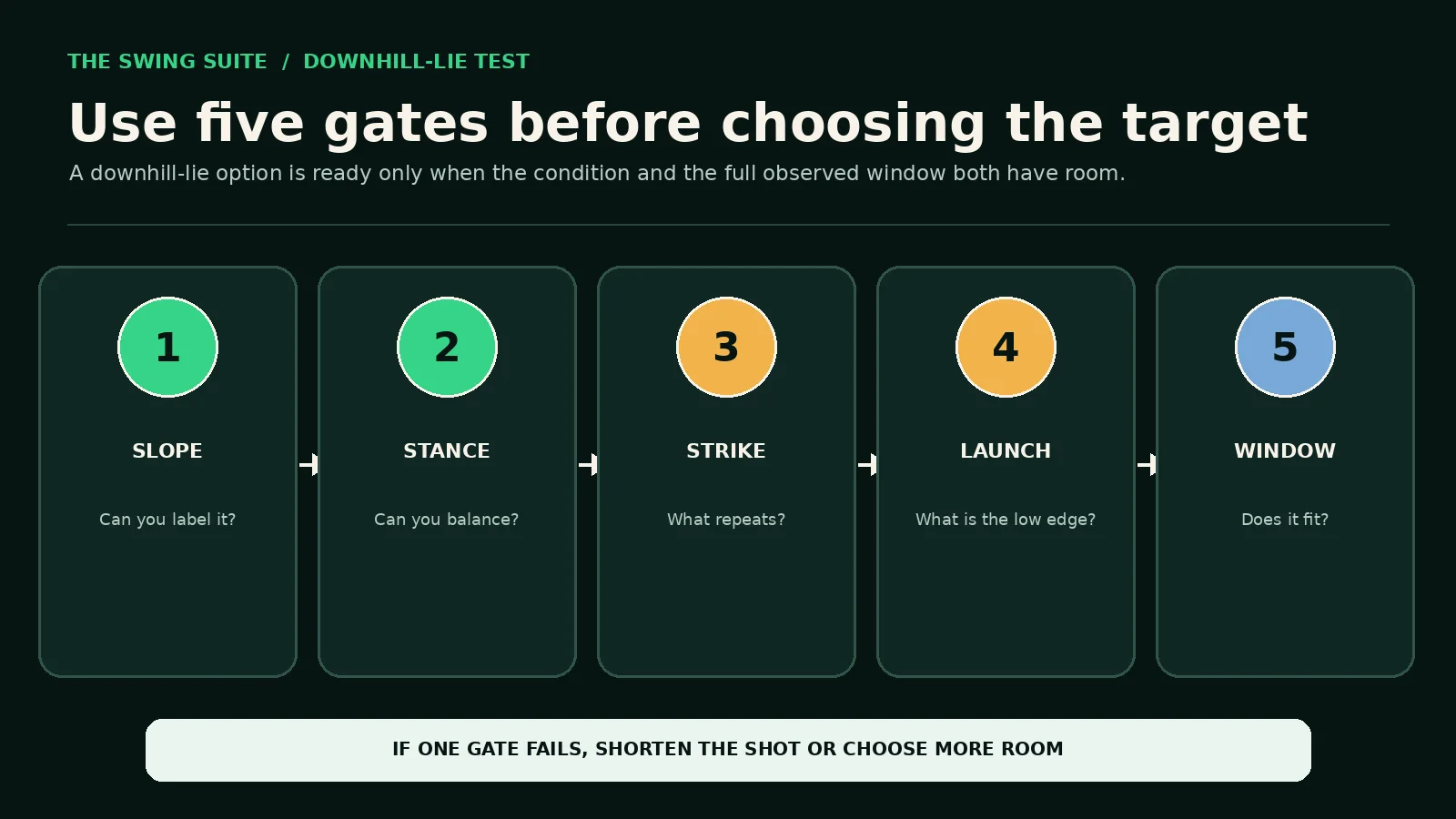
The correction is a fixed sequence: choose the line, label slope, check stance and access, record strike, describe launch, measure carry and finish, compare one alternative, then choose the target from the complete window. The sequence keeps the condition attached to the decision.
Questions golfers often ask
How many clubs should I change for a downhill lie?
There is no responsible universal number. The slope, stance, lie, strike, launch, speed and landing area all matter. Compare a stock option with one safer alternative under a labelled condition, then choose from the observed window.
Will every downhill lie launch lower?
Do not treat that as guaranteed. Record what your representative shots do. Track launch beside strike and the exact slope label. A universal statement can hide a contact problem or an option that behaves differently for your delivery.
Should I move the ball in my stance?
That is a technical choice to test with a coach rather than a universal instruction. Change one priority at a time and judge whether balance, strike, launch and the full carry window improve together. Do not promote a feel into a course rule after one shot.
Can I use a launch monitor indoors for this?
You can practise the recording method and compare launch and carry from controlled surfaces, but ordinary mats do not reproduce the slope, footing or grass interaction. Use indoor work to prepare the process, then verify the actual condition in a safe authorised outdoor setting.
How steep is too steep?
The refusal point is personal and safety comes first. If the stance is unstable, the intended motion cannot be completed comfortably or the target needs a result outside the tested window, reduce the objective. Do not chase an exact gradient merely to justify an ambitious shot.
How many shots make the map reliable?
No small group proves a permanent rule. Use enough attentive shots to reveal more than one outcome, retain ordinary misses and repeat the task on another day. Consistent conditions and honest recording matter more than a large mixed bucket.
A simple downhill-lie checklist
- Choose the intended start line before naming the slope.
- Label slope severity, stance and ball access separately.
- Stop if footing or the intended motion is unsafe.
- Build a small level-lie reference without blending it into the slope set.
- Record strike before launch, carry or finish.
- Keep ordinary heavy and thin outcomes.
- Use lower, central and upper carry edges rather than one average.
- Compare one stock option with one safer alternative.
- Protect front, back and side boundaries.
- Use the map only when the live condition matches the tested label.
- Choose the widest responsible target before considering the flag.
- Write a clear refusal condition.
- Check the Rules before changing anything around a live lie.
- Retest as conditions, equipment or movement change.
The checklist is designed to create a decision, not a slogan. A downhill lie becomes more manageable when the golfer knows which condition is present, what the ordinary strike produces and how much room the complete pattern requires.
A hypothetical note might read: “Mild downhill, stable stance, clean fairway lie; safer option carries 126–134 metres with a central group at 130–132 and one thin finish long. Use only when the front is below 122, the back begins beyond 142 and the centre target is wide. Otherwise play to the front apron.” Every number is illustrative; build yours from measured shots.
Turn the result into one coaching priority
A structured lesson can reduce a mixed downhill pattern to one priority: balance, setup, strike, low-point control, launch consistency, club choice or target selection. Bring the scorecard. The coach can recreate the condition and keep the technical change tied to a course decision.
Measured data should narrow the next experiment. If the short edge is attached to heavy contact, strike may be the priority. If strike is stable but the launch and carry window remain wide, compare an option or target. If the carry is contained but the finish runs through the back, landing area and strategy may matter more than changing the swing.
Finish with a refusal condition. “If the stance is restricted or the slope is beyond my mild label, I choose the wider target” is more useful than a collection of best shots. The goal is not to make every downhill lie attackable. It is to know when the evidence supports the intended shot.
Compare this with the sidehill-lie start-line and contact test ↗
Review the map as conditions change
Retest when the ground becomes softer or firmer, grass length changes, equipment changes, speed changes or the old window stops matching the course. Keep dated versions rather than editing the past into one permanent formula. A useful map shows the condition that produced it.
After a round, record the live slope label, stance, lie, chosen target and result without judging the whole method from one ball. A good outcome can follow a weak decision, and a poor outcome can follow a responsible target. Ask whether the relevant window had room and whether the refusal condition should have applied.
Current Swing Suite lesson options, venues and availability remain on the live booking page rather than being hard-coded here. The goal is a practical downhill-lie map: label the condition, understand the representative strike and launch, build the complete carry window and choose a target with honest room.